The way patriarchy mars the lives of rural women in India is not accidental or in some cases not even intentional. While the oppressor revels in it, one must notice that it is an unwavering and apathetic system that upholds the patriarchal hierarchies. Gender identities shape not only the familial norms but also the economic and political life. For rural women, this system was shaped by the policies that aimed at economic and social upliftment of the rural masses but ignored the gender question altogether.
The rural social fabric has been intricately woven by the post-independence reforms. Evidence elucidates that the reforms aimed at the economic, political and social mobility of the rural masses have been largely discriminatory to women. A study by the ISI points to the differential impact of technological changes on division of labour. India’s agrarian reforms have brought gendered distraughts; negligence and oversight have cost women more than economic stability.
Mechanised erasure: Green Revolution and defeminization
In 1965, when the Green Revolution was to usher in greater farm output and prosperity in farmer households, women were grappling with a different challenge. Surinder S. Jodhka, in his book, ‘The Indian Village’, explores this gender question. He holds in centre that “the state policy of land reforms, modes of mechanising agriculture, the structures and processes of marketing agricultural output, labour migrations, and wage rates for labouring hands all have a gender dimension. They tend to all exclude women or include them on terms that are unfair to them.”
Gender identities shape not only the familial norms but also the economic and political life. For rural women, this system was shaped by the policies that aimed at economic and social upliftment of the rural masses but ignored the gender question altogether.
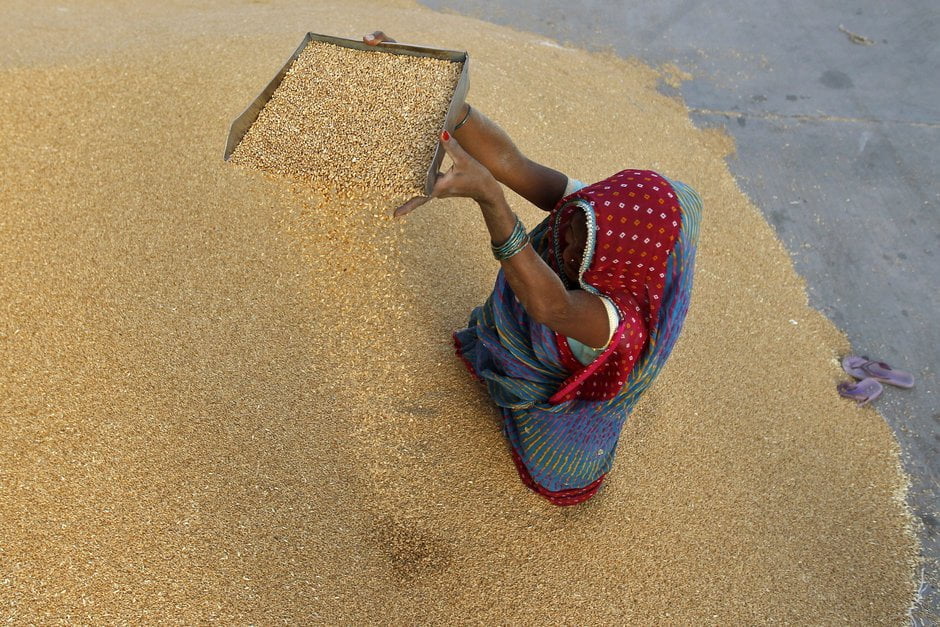
When through the Green Revolution, the agrarian methods were mechanised women were among the first and the most to leave the farms. The nature of women’s work was more substitutive than that of men. Women were largely engaged in weeding, which was quickly taken over by the machinery. No compensatory employment came to be realised. Meanwhile, the men secured their labour largely by learning to operate this machinery. This led to the process of ‘defeminisation of farm labour.’

Interestingly, an important trend of feminization of farm labour did emerge. It happened in the places where men left for urban centres in search of jobs, while their wives took hold of cultivating in small plots. Jodhka points out that this instance did have some favourable changes, as it made women more pioneering in interacting with the social world. However, it also left on the shoulders of women the burden of families with no commensurating economic resource.
At present, we see that female employment in agriculture, we see that agriculture employed a large number of the women labourers, and witnessed a decline in its employment rates. Women were displaced post-liberalisation, bringing down their participation from 32.8% in 1993-94 to 26.1% in 2009-10.
A caste-based analysis of data of rural women and their migratory patterns reveals that Scheduled Tribe and Scheduled Caste women suffered a deeper blow of intersectionality, with 59% and 41% being engaged in short-term casual labour in agriculture, construction and brick-making. While 75% of upper caste women were engaged in long-term migration.
Land ownership as a tool of caste purity in rural India
Another central characteristic of rural life is the landownership. It defines one’s economic and social stature. Land has also been the central tenet of rural politics. Scholastic accounts show that land reforms aimed at dismantling the oppressive Zamindari system and providing security to landless labourers entirely overlooked the gender facet.
Bina Aggarwal argues that the overarching emphasis on class over gender and caste created a lacuna that led to the concentration of arable and agricultural land in the hands of male patriarchs. Even the feminist movements were apprehensive of advocating for private ownership for the females, as it conflicted with the socialist principles. However, a similar apprehension did not surface as the private ownership went into the hands of men.
Land rights are crucial for women’s rights; any dismissal of it paves the way for economic and even sexual exploitation of women. Studies have also shown how land rights have also been a tool in gaining sexual control over women.
In 1979, the World Conference on Agrarian Reforms and Reform Development suggested that the gender discriminatory laws related to ‘rights in inheritance, ownership and control of property should be repealed. Likewise, a policy statement in the Sixth Five Year Plan considered giving joint titles to spouses, but the implementation remained unsatisfactory. The National Perspective Plan 1988 helped to bring consensus on women and land rights. But the process remained highly unsatisfactory.
Land rights remain a contested issue till today. Patriarchal notions aggravated the policy lacunae to put the women at the margins. Data shows that daughters are endowed with smaller and lesser quality pieces of land. Acquiring land from the state and market becomes arduous in an already unjust patriarchal setup. As a result, we see landless women that grip to the patriarchal heads for social security.
A patrilineal descent has come into place, pushing the individual identity of women at bay. A patrilineal nature of descent causes more than just erasure of lineage from women’s lives. To recognise this is to recognise the very patriarchal superstructures that snatch away the rightful from the women.
Land rights are crucial for women’s rights; any dismissal of it paves the way for economic and even sexual exploitation of women. Studies have also shown how land rights have also been a tool in gaining sexual control over women. For instance, in communities where land was given to women, there was a preference for premarital virginity and chastity. It has also served to uphold the Brahmanical notion of caste purity, barring land rights to women who married into a lower caste.
While land remains a contention, female mobility in rural politics has been an issue as well. The dominating nature of the male patriarchs paved the way for the culture of “Pradhan Pati.” As seen in the popular web series ‘Panchayat’ proxy leadership has been a significant roadblock in genuine women’s leadership in rural India.
Recently, the Ministry of Panchayati Raj (MoPR) initiated a campaign to eliminate proxy representation. It aims to bring transparency through the means of education and penalization. The impact is yet to be monitored.
Dr Ambedkar, in his address to the Bombay Legislative Council on the Village Panchayats Bill reflected on the ills of establishing a rural republic. Dr Ambedkar, who was contesting for a special status for the ‘depressed classes’, rightly predicted the exploitative and unjust nature of establishing the rural government bodies without considering the caste and the gender question.
Today, we see the manifestations of these oppressive patriarchal systems in the form of extremely controversial diktats coming from the Khap Panchayats. One instance that recently caught public attention was the banning of smartphones for females in rural Rajasthan. One can only revel in the consolation of the rollback of the orders after the backlash. It shows the value of public dissent. However, as far as the uprooting of patriarchy is concerned, the rural road to patriarchy traverses through socio-economic, political and policy lacunae. An egalitarian society requires analysing the gender question.