Whenever a favorite book is turned into a film, the readers are anxious not to be disappointed too much in the characters and the plot they loved. Just when the weather had turned cold and we were all daydreaming of an escape, the release of Netflix’s early January romcom People We Meet on Vacation the adaptation of Emily Henry’s much loved romance novel published in 2021, directed by Brett Haley was very smartly timed. Both the novel and the film centres the stories of two best friends Poppy Wright (Emily Bader) and Alex Nilsen (Tom Blyth) who are polar opposites.
A friendship built on movement and avoidance
Poppy is free-spirited, restless and a gregarious travel writer whose fashion is as loud as her personality. Alex, on the other hand, is the typical homebody, someone who just wants to move back to their small Ohio town and raise a family. They were opposites in every way but a single car ride from their college in Boston to their hometown cements their friendship. On this road trip, they make a pact that every summer, no matter where they are or what they are doing, they will go on a vacation together.
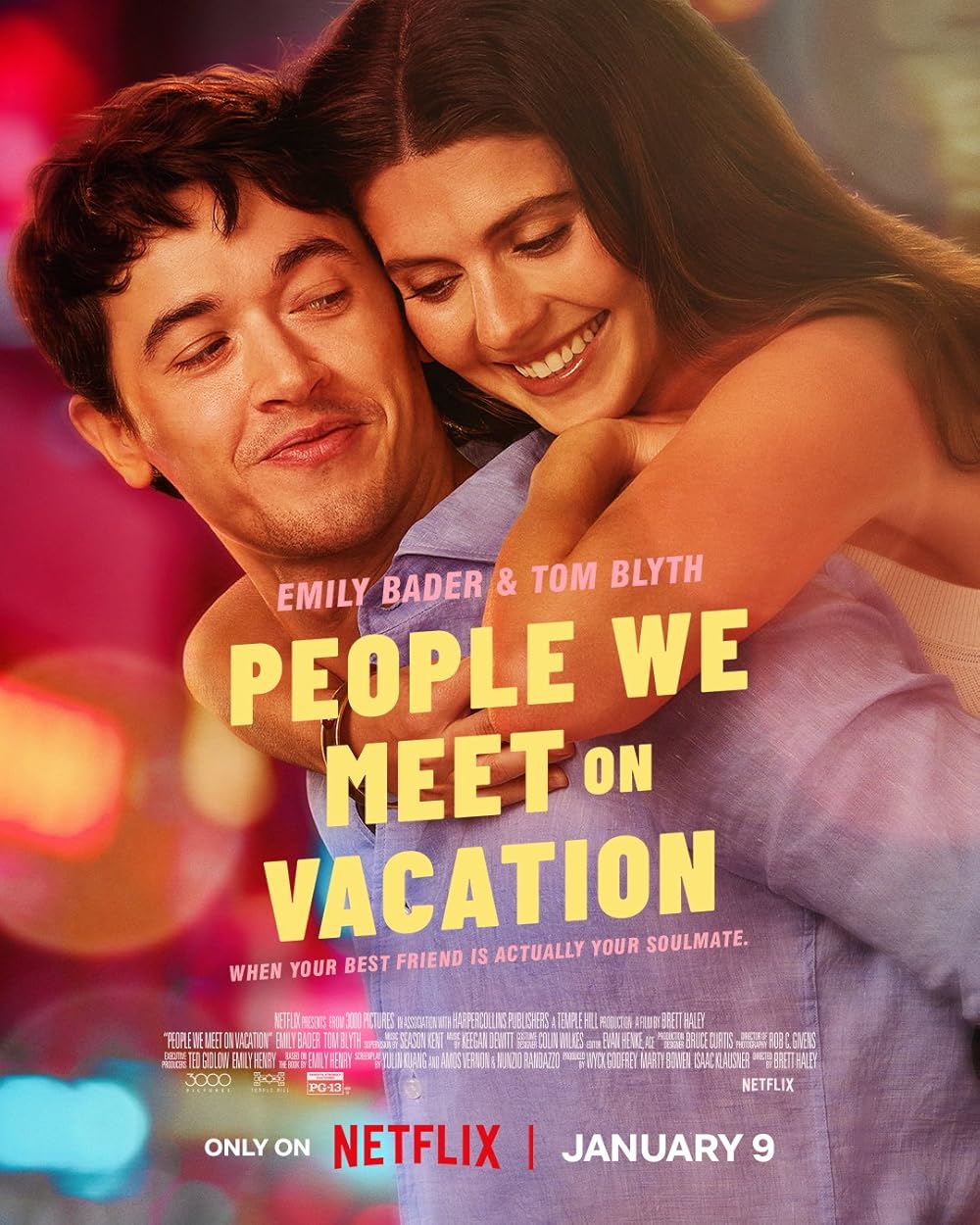
Two years before the narrative begins, during their Tuscany trip, a pregnancy scare and an almost-kiss brought their long-standing friendship to a screeching halt. But when Alex’s brother David invites Poppy to his destination wedding in Barcelona, she takes it as an opportunity to mend their broken friendship. And now the friends who no longer talk to each other are stuck in an up-scale Airbnb in Barcelona, dealing with a broken AC unit and unresolved feelings. While the film seems like a simple rom-com based on the centuries old friends-to-lovers trope, its politics of freedom, love and mobility demand a closer feminist reading especially from a Global South perspective.
Leisure feminism and the politics of mobility in People We Meet On Vacation
The intersectional feminism of People We Meet on Vacation is first and foremost built on class and economic privilege. Poppy’s freedom to travel annually and later to quit her job on a whim, hints that she likely comes from an upper-middle-class background which is in contrast with the majority of South-Asian women for whom economic dependency is a primary barrier to freedom.
This privilege is compounded by geographic and cultural capital. Poppy’s American passport is her invisible golden ticket to the very places that shaped her identity. For a South-Asian woman, particularly one from a non-elite background the act of travel itself is layered with bureaucratic hurdles, safety calculations and often familial negotiations. Her journey is not just a vacation but can be a quiet rebellion. Poppy’s social mobility and professional network (working with a glossy New York magazine – R&R) makes her journey smooth, bypassing these strata of struggle.
In essence, the film offers a “leisure feminism” that mistakes privilege for universal empowerment.
In essence, the film offers a “leisure feminism” that mistakes privilege for universal empowerment. It shows that while the desire to experience feminist joy is universal, the pathway to it is deeply intersectional, paved or blocked by class, geography and even race sometimes.
Poppy Wright and the myth of the empowered wanderer
Poppy and Alex, the two college besties dynamic, offer a refreshing blueprint for a relationship built on genuine friendship and emotional parity. However, a closer look uncovers deeper layers.

Despite Poppy’s rather lavish lifestyle and the fact that she can go anywhere she wants on her magazine’s dime, she feels dischanted with her life. As depicted in the beginning of the film where Swapna (Jameela Jamil) says to her in a disappointed tone ‘If I don’t at least consider leaving my husband and children after reading your article, then you are not doing it right.‘ Swapna reminds Poppy how “lonely” she has started to feel, flying solo in Prague or Paris or Kyoto.
She gradually comes to realise that her profession is not as satisfactory as she thought it was and she is not particularly happy with her life or frankly with some of her life choices. This burnout is crucial. Poppy’s vibrancy is not pure empowerment; instead her free-spirit and jetting around the world is more of a coping mechanism, an escape from confronting a static self. The film cleverly critiques the neoliberal “girlboss” fantasy of freedom, suggesting that a career of curated wanderlust can be just another gilded cage.
Alex Nilsen and his conformist progressivism
In turn, Alex represents a model of non-toxic masculinity. He is not the stoic, brooding hero but someone who feels and thinks deeply, but often has trouble expressing them. He is the man who has unwavering respect for Poppy’s autonomy and doesn’t “pursue” her to give up her wild lifestyle and settle down with him. Instead he mates her gaze, engaging in a dance of mutual revelation.
In turn, Alex represents a model of non-toxic masculinity. He is not the stoic, brooding hero but someone who feels and thinks deeply, but often has trouble expressing them.
His identity as a high school teacher provides him economic stability and a sense of respectability allowing him to be progressive towards his brother’s queerness. It costs him nothing, he faces no social penalty, no need to unlearn deep-seated homophobia. This contrasts sharply with the realities of many other men for whom expressing such support, particularly in non-urban or less liberal families could mean risking social capital, family ties or even physical safety.

A thoughtful character note is Alex’s ex – Sarah, with whom he has been on and off for years and to whom he eventually proposes. The film avoids the easy trope of villainising the ex-fiancee. Instead, Sarah realises the relationship’s fundamental incompatibility, calls off the engagement and pursues her own career as an air hostess, highlighting that women’s worth exist independently of their connection to the male lead.
The story overturns the nice-guy-gets-the-girl trope by giving their friendship depth, history and equal weight.
The story overturns the nice-guy-gets-the-girl trope by giving their friendship depth, history and equal weight. The resolution of the film is not him winning her over, but mutual realisation and vulnerability. This reframes romantic love not as a conquest, but as the courageous choice to be deeply known by your best friend.
Sexuality and desire: progressive, yet peripheral
Poppy is portrayed as a woman who doesn’t shy away from expressing her sexual desire. She dates, owns her desire and even initiates physical intimacy with Alex. This is progressive in contrast to the still-cautious portrayal of female desire in much of mainstream South-Asian cinema.
While the film does shed a bit light on queer sexuality as David marries a man which is presented as a normalised, joyful event, yet it remains on the periphery. This sanitised, “homonormative” ideal stands in sharp contrast to films like Shubh Mangal Zyaada Saavdhan (SMZS), which, while flawed, is noted for its great cultural significance in bringing LGBTQIA+ struggles into the mainstream Indian discourse. Where the privileged bubble of People We Meet on Vacation offers a conflict-free gay wedding as a decorative backdrop, allowing queer identity to exist without struggle; SMZS‘ significance lies in its portrayal of abuse and violence that queer people face even within their own homes which is a non-negotiable reality for millions.

People We Meet on Vacation is ultimately a charming fantasy of privilege. Its value for the South-Asian feminist viewer lies not in aspiration but in critical dissection. Between Poppy’s gilded cage, Alex’s costless sensitivity and the peripheral diversity that adorns their world, the film highlights the vast chasm between tokenistic inclusion and transformative intersectionality. Our task is to demand stories where the Sarahs, the Davids and the countless women without Poppy’s passport are not mere supporting actors but the authors of their own, more complex scripts.
About the author(s)

Gunn Bhargava (she/her) is a Political Science undergraduate at the University of Delhi and a feminist writer focusing on gender justice, power, and human rights. Her work engages with feminist media, pop culture and political analysis, drawing from her experience with platforms such as Feminism in India, Writing Women and The Women Story. She is keen on contributing to transnational feminist conversations through progressive journalism.