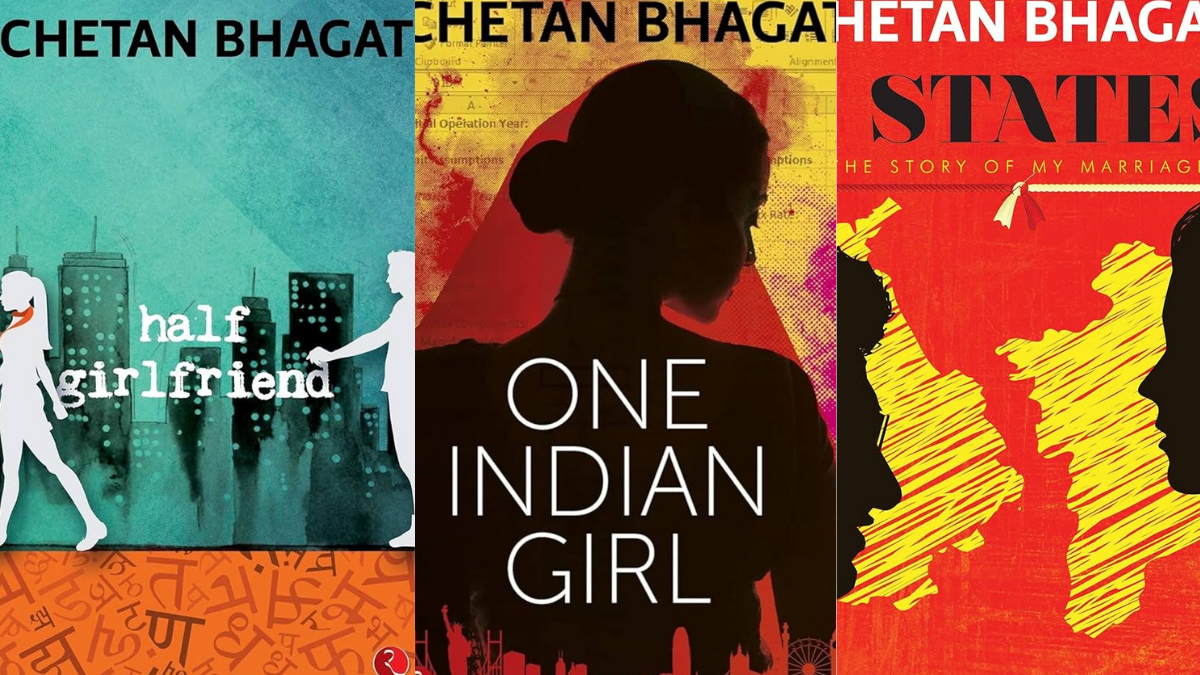
Chetan Bhagat’s name is synonymous with that of contemporary Indian Literature. The investment banker-turned-writer wrote books such as Five Point Someone, One Night at the Call Centre, 2 States, Half Girlfriend, and One Indian Girl, which are known for using English in a simple, accessible way, reflecting the everyday aspirations of the Indian middle class.
Despite his popularity, Chetan Bhagat has been criticised for the way he portrays women in his books. Male protagonists are depicted as emotionally vulnerable, uncertain and searching, written in a way that invites public sympathy. Their desires, confusions, and insecurities form the emotional core of the narrative. Women, in contrast, are interpreted, explained and judged through their male counterparts’ inner monologue, leaving little room for a life that exists independently of patriarchal perceptions.
By framing male vulnerability as sincerity and female autonomy as inconvenience, his novels reproduce the familiar patriarchal logic where a man’s emotions and decisions are given more prominence.
When Female Autonomy Is Rewritten as Emotional Excess
Radhika Mehta in One Indian Girl is an example of how female autonomy exists only when filtered through the male gaze, which does not destabilise the patriarchal narrative. She is a senior employee at Goldman Sachs, making her financially independent and professionally accomplished, and is also outspoken about sexism in both the workplace and personal relationships.
However, none of these accomplishments matters because they stand no chance against her so-called emotional failures. Radhika always finds herself measuring her worth through male validation. She remains emotionally tethered to men who feel threatened by her success, expressing willingness to compromise her career for romantic acceptance.
The novel’s most poignant moment happens when Radhika has a conversation with her suitor about feminism, defining it as a movement for women’s equal rights. The suitor’s response completely flips the script as he calls feminism ‘humanism’, a move that erases structural gender inequality.
What’s striking here is that instead of presenting a counterargument, Radhika agrees with him. Feminist assertion works only until it risks conflict, and beyond that, it should be neutralised. Her autonomy is never allowed to stand on its own, as it must be justified through male vulnerability. The result is the type of feminism that appears progressive while quietly reaffirming patriarchal authority.
Riya Somani and the Illusion of the Modern Woman
In Half Girlfriend, Riya Somani aims to represent the “modern Indian woman”. She is an English-speaking, economically privileged woman. The male protagonist, Madhav Jha, is not fluent in the language. The class and identity differences surface in their interpersonal dynamics, where Madhav is constantly wary of his inability to speak fluent English compared to Riya’s. These differences form an important part of the story.
Riya Somani’s modernity and independence only scratch the surface of her character arc. She is a victim of an abusive marriage and comes from a troubled family. The trauma she endures makes her emotionally complex and, most of all, human. However, these aspects are buried under the sheer weight of Madhav Jha’s story, leaving them largely undermined. Her character is underdeveloped despite being the female protagonist. She is brought into the narrative only at Madhav Jha’s pivotal moments, making her little more than a plot device. Madhav even works to improve his English “for her”, suggesting that Riya is the inspiration behind his move. Her own choices and story, however, take a back seat. She is shown as emotionally unavailable and someone who silently endures her trauma.
When she disappears from her family and Madhav in the story, the focus shifts entirely to the male protagonist, not on the reasons behind her move. Her disappearance becomes the catalyst for the male protagonist’s personal growth. The only time Riya Somani finds her voice is through her diary. It is discovered only when Madhav reads it and learns why she left him. “I wanted to disappear. I didn’t know how else to be free,” she writes. The delayed disclosure is not deliberate, but it further proves how her character arc was diluted for narrative effect.
Female Characters Deserve More Than Symbolic Modernity
Writing strong female characters does not rely solely on showing them as ambitious, independent, and modern. It also involves giving them a strong voice. Chetan Bhagat’s novels are often dismissed as harmless popular fiction. It is not that his stories do not portray the modern Indian woman. It is the lack of depth that takes away her autonomy in the story.
Popular fiction is meant to be extrapolated and critiqued. They are not immune to it. Chetan Bhagat’s books are no exception here, as they aim to tell stories of the Indian middle class. But when these stories continue to place women on the sidelines, it is necessary to ask the right questions about whose voice finds precedence over whom.
Therefore, women in such stories deserve more than just symbolic modernity. They deserve narrative power. They deserve equal space with the male protagonist, not just to be a plot device.
About the author(s)

Akanksha Saxena is a digital journalist based in Aligarh. She graduated from Columbia Journalism School in 2023 with a M.A in Arts and Culture reporting. She has 3+ years experience and written for publications like The Hindu, The Indian Express, The Logical Indian, Film Companion, Travel + Leisure India.