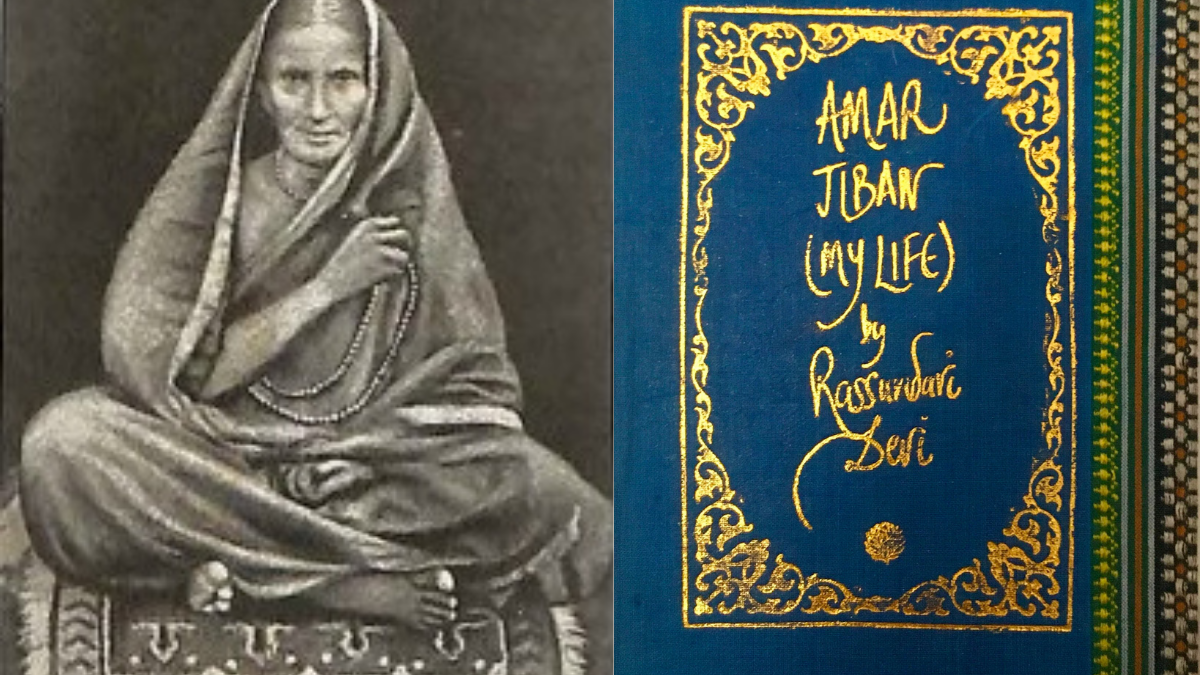
In 1876, Rashsundari Devi, a self-taught Bengali woman from a conservative upper-caste Hindu household, penned what is widely considered the first autobiography by a woman in Bengali—Amar Jibon (My Life). Devi documented her experiences from the hidden corners of her kitchen as an unacknowledged housewife. At 26, she taught herself to read, well past the socially accepted age for women’s education, and published her life story at 60 and 88. Her narrative confronts gender expectations and ageist beliefs about the appropriate social expectations for an older woman and the timing of pursuing education.
Tanika Sarkar notes that when Amar Jibon was published, Devi was not a timid wife. She was an elderly matron whose learning and experience were valued by everybody around her. In this light, Amar Jibon disrupts dominant ideologies that link learning to youth and equate education with institutional advantage, thereby introducing a subversive, embodied, and fundamentally feminist pedagogy.
Although Amar Jibon has been extensively analysed through the lenses of gender, caste, religion, and the politics of self-representation, there remains a gap in scholarship in understanding it as a powerful life-course story of transgression and transformation. Her autobiography underscores the problems and urgency surrounding older women’s access to education in India. Elder states that a life course narrative emphasises how individual lives unfold over time through interconnected trajectories shaped by age, historical context, and social structures. It highlights how events such as marriage, education, or widowhood affect identity and agency across the lifespan.
Historicising Female Education in India: Too Old to Learn?
Women’s education, particularly among upper-caste Hindus, has historically faced mixed feelings and resistance, deeply influenced by Brahmanical patriarchy and concerns about “modernity.” The sex segregation of education during colonial India was due to ideas that women are not breadwinners and hold a less productive societal role, reinforced by traditional taboos and beliefs. The Laws of Manu (Manusmriti) restricted women’s independence, mandating dependence on male authority—first fathers, then husbands, and finally sons. Women were denied autonomy, mobility, education, property, and sexuality, with obedience and chastity framing their virtues.
Partha Chatterjee (1990) argues that nationalism promoted a hollow sense of female empowerment that failed to negotiate with tradition. The Zenana system offered informal, domestic education mainly to upper-class women, reinforcing traditional gender roles, while Western education was banned for women, fearing to “unsex” them. According to the World Bank (2023), women’s literacy rate lags 15 percent behind men’s. Even today, women discontinue their education and drop out of school due to reasons such as poverty, lack of support for high tuition fees, child marriage, parents’ lack of awareness about female education, child labour, or ill health. In a country where, at one point, younger women were either barred from education or only given selective access based on the Nationalists’ ideology of zenana education, the literacy rates among older women would likely be even lower.
Is Women’s Education an Ageist Concept?
Undoubtedly it is. Age is often overlooked in conversations about women’s education in India. Efforts to promote education among older women encounter socio-cultural and ideological obstacles. These challenges stereotype older women, socially confining them and restricting their access to opportunities. Numerous older Indian women are excluded from educational and empowerment programs primarily aimed at younger girls. This ageist perspective views older women as passive rather than active citizens entitled to rights. Older women are often overlooked in literacy programs due to perceptions of low productivity and social staticity, reflecting a policy blind spot.
In Indian society, where gender inequality persists, the lack of education among older women worsens their vulnerability. Urvashi Jain links cognitive disadvantages in older women to gender inequality in education. They note that education helps close this gap. Women need at least a middle school education to outperform men and reduce disparities. A 2015 study by Agewell Research and Advocacy Centre reports that even though older women outnumber men, they face poverty, dependency, and a lack of income, leading to neglect or abandonment. Low functional literacy limits their independence and life chances. Skirbekk and James find that nearly 43% of older women experience abuse. Education affects their vulnerability and willingness to report such abuse. The link between aging, gender vulnerability, and education has a long history. Rassundari Devi’s autobiography exemplifies how late-life literacy can challenge patriarchal silences.
The Old Woman Speaks: An Untold Story of Late-Life Learning in Amar Jibon
bell hooks, in Teaching to Transgress (1994), states that “education as the practice of freedom” is about creating the conditions for critical thinking, self-actualization, and liberation from oppressive systems. Rassundari Devi’s life and writing epitomise this principle. Devi did not just learn through unconventional ways; she vehemently contested the oppressive system that entangles women, of all ages, into one calamitous ending. Devi firmly believed that women are to blame for their own illiteracy because they failed to support each other and often criticised women who sought education. She notes, “older women used to show a great deal of displeasure if they saw a piece of paper in the hands of a woman.”
Due to the internalisation of gender roles as custodians within Indian society, older women frequently discouraged the younger women from pursuing education. For example, in Second Composition, Devi highlights the struggles of older women who felt lonely, abandoned, and neglected, using the character of Khuri Maa—an elderly aunt she met at age 12—who was compelled to do household chores despite suffering from gout. As Devi gradually learned household chores from Khuri Maa and began doing them skillfully, Khuri Maa praised her for her excellent work at such a young age, which revived her and eased her physical suffering.
Although this experience was painful for Devi, Khuri Maa’s narrative revealed that older women, especially those without social standing (i.e., married with adult children), were considered surplus within the traditional family structure. They were denied rest, and their importance solely relied on their invisible domestic labour and caregiving, with no space for intellectual or emotional growth, indicating the generational transfer of educational deprivation, sexist oppression, and gender appropriation. Devi objectively records her marriage at age 12 and her move to Ramdia, where she gave birth to 12 children between ages 18 and 33, each year burdened with household labour.
Devi trusts her God, Dayamadhav, believed to grant her reading, thinking, and writing abilities. Her compositions begin with an invocation praising Him for inspiring her to question, think critically, overcome inhibitions, and challenge limiting systems that hinder women’s learning. Rashsundari Devi’s connection to God came through her mother—an intergenerational transfer—rather than through rituals or myths, breaking hegemonic norms. Her devotion was both personal and rebellious. At 25, she read Chaitanya Bhagabat by stealing a page from her husband’s copy, understanding how sacred scriptures salvaged marginalised groups, including women.
This act of clandestine literacy within the kitchen becomes a model of non-institutional, embodied adult education, rooted in desire, necessity, and resistance. As hooks notes, authentic feminist pedagogy must recognise the learner as a subject—embodied, emotional, and intellectual—and open the possibility of transformation through education regardless of age or social role. hooks’s insistence on the importance of voice and experience in the classroom also resonates with Devi’s narrative. Although she had no formal teacher or classroom, the kitchen became a textual classroom and her autobiography a site of learning for future generations.
Transgressive pedagogy also involves unlearning, relearning, and fostering collaborative strength, which was evident more in her experiences as an older woman. For Devi, middle age brought considerable privilege and power, as she was already the senior-most woman in the family, having borne 12 children and become a mother-in-law at 40. Margaret Gullette states that ageing is not always physical but also cultural and relational. Women not only age with time, but also as their social seniority rises, moving from being the youngest wife to the mother-in-law in the family. Devi, at 40, was devoid of inhibitions. She had considerable authority and new perspectives on life and religion. During this period, she openly read books, and her family members, including her son and sisters-in-law, were aware of her reading habits. She was also respected for her reading abilities.
Conclusion: Past That Reads the Present
Devi’s work exemplifies feminist adult education by foregrounding the need for literacy among older women in India. While literacy has risen nationally over the years, only 30.3% of women aged 65+ were literate in 2018. Tamil Nadu’s India Literacy Program (2021–2025) has made progress, certifying nearly 18,000 older women who demonstrated their desire for education by simply signing their names. Furthermore, 96-year-old Karthyayani Amma from Kerala gained national recognition for scoring 98 on a literacy exam in 2018 and later became a Commonwealth of Learning Goodwill Ambassador in 2019. Similarly, Maharashtra’s Aajibaichi Shala, a grandmother’s school established in 2016, is India’s only school dedicated to underprivileged older women aged 60 and above. Literacy in later life, therefore, is a rebellion against gendered ageism.
References
- Agewell Foundation. (2015). Gender discrimination among older women in India (Thematic Paper 2) https://eapon.ca/wp-content/uploads/2021/09/Gender-Discrimination-Among-Older-Women-in-India.pdf
- Chakravarti, U. (1993). Conceptualising Brahmanical Patriarchy in Early India: Gender, Caste, Class and State. Economic and Political Weekly, 28(14), 579–585. http://www.jstor.org/stable/4399556
- Forbes, G. (1999). Women in Modern India (The New Cambridge History of India) (1st ed.). Cambridge University Press
- hooks, bell (1994). Teaching to transgress: Education as the practice of freedom. Routledge.
- Jain, U., Angrisani, M., Langa, K. M., Sekher, T. V., & Lee, J. (2022). How much of the female disadvantage in late-life cognition in India can be explained by education and gender inequality. Scientific reports, 12(1), 5684. https://doi.org/10.1038/s41598-022-09641-8
- Karthiyayini Amma – Kerala’s Alphabet Granny who became an icon of literacy. (2018, October 1). YouTube. https://www.youtube.com/watch?v=hWA48VpitIY
- Sarkar, T. (2013). Words to win: The making of Amar Jiban: A modern autobiography (p. 132) [Kindle edition]. Zubaan. (Original work published 1999)
- Skirbekk, V., & James, K. (2014). Abuse against elderly in India – The role of education. BMC Public Health, 14, 336. https://doi.org/10.1186/1471-2458-14-336
- World Bank. (2025). Adult literacy rate, by gender: India. Gender Data Portal. https://genderdata.worldbank.org/en/economies/india
About the author(s)

Madhurima Guha is currently a Doctoral Candidate in Gender Studies at Arizona State University, USA. She earned her BA, MA & MPhil from Jadavpur University. Her Doctoral thesis focuses on non-normative representations of ageing Indian women, their sexualities, desires, and subversive actions in cinema.