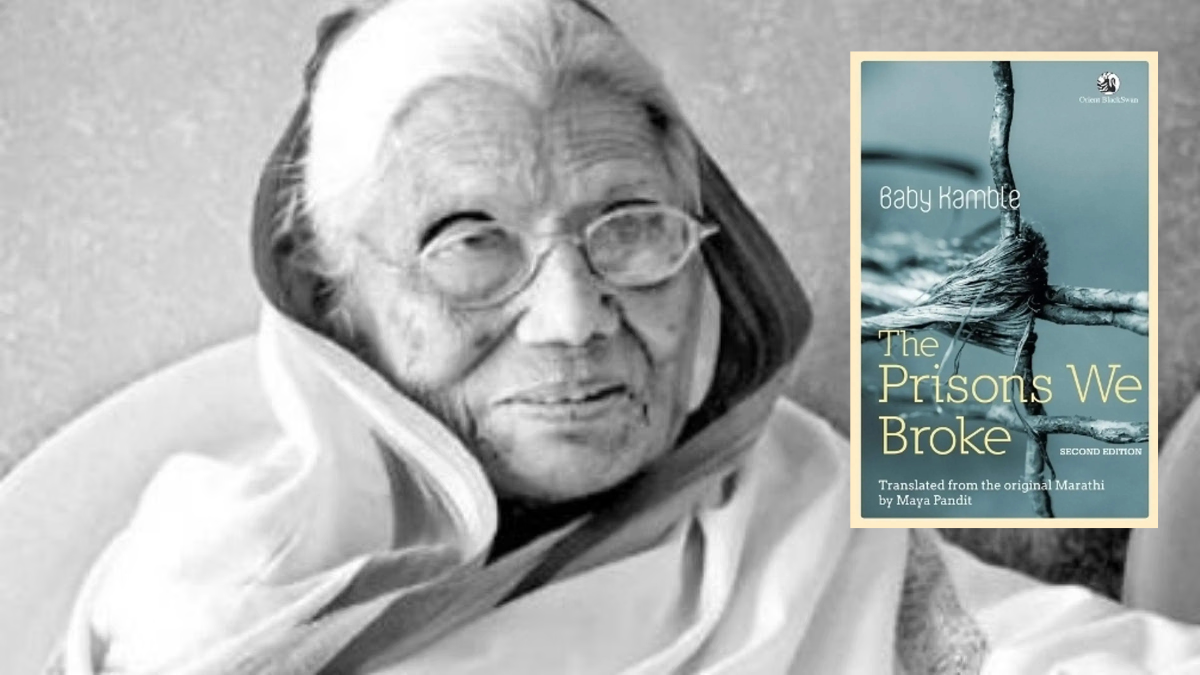
When Babytai Kamble penned The Prisons We Broke, the first published autobiography by a Dalit woman in Marathi, she did more than just narrate a life; she exposed the architecture of caste-determined care. “We clean the filth others create, then are called filthy ourselves,” wrote Kamble, naming an untouchable reality that Indian literature has long rendered invisible. While mainstream narratives celebrate the housewife’s domestic sacrifice, they systematically erase the Dalit and Bahujan women whose blistered hands scrub floors before dawn, wash vessels others have dirtied, and absorb the household’s emotional dumping, only to disappear from the stories when the time comes. Their labour is what sustains the upper-caste domesticity, yet remains the silent infrastructure of comfort: foundational, uncredited, unnamed.
Literary Testimonies of Embodied Labour
Kamble’s testimony resonates powerfully across Dalit feminist literature. Bama’s seminal Tamil autobiography Karukku (1992) documents how Paraiyar Christian women scrubbed floors on their knees while being denied dignity by upper-caste nuns who “would not even drink water touched by our hands.” Similarly, Shantabai Kamble’s Majya Jalmachi Chittarkatha (The Kaleidoscope Story of My Life) traces how Mahar women’s bodies became sites of caste-allocated sanitation work, writing, “Our hands were meant only for sweeping, scrubbing, and serving.”
Dalit feminist scholar Urmila Pawar writes in The Weave of My Life, “My mother used to weave aaydans,” the Marathi generic term for all things made from bamboo. “I find that her act of weaving and my act of writing are organically linked. The weave is similar. It is the weave of pain, suffering, and agony that links us.” This metaphor transcends poetry: her mother’s bamboo weaving, like the Dalit domestic worker’s scrubbing, was never “just labour”. It was an unacknowledged infrastructure of survival, transformed into literary resistance.
Interestingly, however, Pawar has analysed the differences between Brahman and Dalit women, arguing that the Dalit woman, in contrast to the Brahman woman, was not bound by customs such as sati, child marriage, among others. Pawar further exploded some myths regarding the gender question in relation to the Dalit movement, such as the wide gap between Dalit and Brahman women on economic, social and educational levels.
Pawar continues, “A myth is harboured that unlike the brahman woman the dalit woman is free from bondage and stifling restrictions. The pain of the devadasi, the deserted woman and the murali is ignored in this stand. In fact the woman in the household is yet to get recognition as a full and equal human being (ibid: 94).”
On similar lines, Joanna Liddle and Rama Joshi, in their work entitled Daughters of Independence, write about the non-sexual and the sexual divisions of labour. Although economically deprived, Dalit women lead more sexually liberated lives than upper-caste women. Lower caste women, by contrast, experience far fewer controls over their physical freedom.
“The economic benefits and the social constraints of seclusion are unknown to them. Sati was never demanded of them, widowhood was no curse, divorce was allowed in many lower caste communities and widows and divorced people could re-marry without disgrace (Liddle and Joshi 1986: 95-69 and 91).”
In Aayda: Mahila Adivasi Jivan Katha (edited by Pawar and Meenakshi Moon), oral histories of Adivasi and Dalit women reframe domestic work not as a naturalised duty but as caste-determined exploitation. Oxfam’s data confirms this structural truth: urban Indian women spend 312 minutes daily on unpaid care work, compared with men’s 29 minutes; rural women spend 291 minutes, compared with men’s 32 minutes.
What The Data Says?
The rate of this invisibility is concerning. Oxfam’s 2020 report, Time to Care, along with an India-focused supplement, demonstrates how our sexist economies are acting as a catalyst for the inequality crisis. “Women and girls are among those who benefit least from today’s economic system. They spend billions of hours cooking, cleaning and caring for children and the elderly. Unpaid care work is the ‘hidden engine’ that keeps the wheels of our economies, businesses and societies moving. It is driven by women who often have little time to get an education, earn a decent living or have a say in how our societies are run, and who are therefore trapped at the bottom of the economy,” stated former Oxfam India CEO Amitabh Behar. Furthermore, the report suggests that women make up two-thirds of the paid ‘care workforce’. Jobs such as nursery workers, domestic workers, and care assistants are often poorly paid, provide scant benefits, impose irregular hours, and can take a physical and emotional toll.
Thus, pressure on carers, whether unpaid or paid, is set to grow over the coming decade as the global population ages. Climate change could worsen the looming global care crisis —by 2025, up to 2.4 billion people will live in areas without enough water, and women and girls will have to walk even longer distances to fetch it. 80% of indigenous people live in Asia and the Pacific, a region vulnerable to climate change. “Governments must prioritise care as being as important as all other sectors in order to build more human economies that work for everyone, not just a fortunate few,” said Behar.
In the Periodic Labour Force Survey (2017–18) report, it is seen that in rural areas, the share of helper in household enterprises was nearly 17 per cent among male self-employed workers whereas 67 per cent among female self-employed workers while in urban areas, the share of helper in household enterprises was nearly 11 per cent among male self-employed workers and 32 per cent among female self-employed workers.
This is what Sharmila Rege indirectly implies in her essay ‘Dalit Women Talk Differently’ where she writes about the societal tendency of masculinisation of dalithood and feminisation of savarnas, whereas, in reality, the share of work is deeply gendered, with the lower caste women bearing the brunt of it. In Rege’s essay, “Guru (1995) had argued that to understand the dalit women’s need to talk differently, it was necessary to delineate both internal and external factors that have a bearing on this phenomenon. He locates their need to talk differently within a discourse of descent against the middle-class women’s movement by Dalit men and within the moral economy of the peasant movements. It is a note of dissent, he argues, against their exclusion from both the political and cultural arena.” It is further underlined that social location shapes perceptions of reality, making this even more crucial.
The Journey Towards Identity and Recognition
Thus, to change the reality, Dalit women need to be more than mere add-ons in the mainstream feminist literary discourse. Their limitless potential shall remain limited to theory if their care labour remains unidentified and unrecognised. As Rege insists, Dalit women’s standpoint offers not marginal testimony but essential critique of Indian feminism itself. Scholarly work needs to centre Dalit women as narrators of their own labour—like Kamble, Pawar and Bama—whose literary testimonies document care work as political resistance. Meena Kandasamy’s poetry captures this urgency. It recognises that when a Dalit domestic worker feeds our children, she isn’t just doing the duty of a house help—she is sustaining an entire economy that refuses to see her. There is a hidden rage in Kamble’s autobiography, just as there is a hidden generational conditioning in Pawar’s The Weave of My Life. It is important for this ‘hidden engine’ to get the recognition it truly deserves.
About the author(s)

Ahana Saha is currently pursuing her Master's in Political Science at Pondicherry University, where she explores how postcolonial socio-economic realities shape gendered experiences of labour, care, and identity. When she's not buried in theory, you'll find her rehearsing classical dance or drafting stories that sit at the intersection of literature, caste, and feminist politics.

A brilliant synthesis of lived testimony and empirical data. It masterfully exposes the caste-based architecture of care.
A vital critique of the double-erasure of Dalit women’s labor.This is the intellectual infrastructure modern feminism needs.