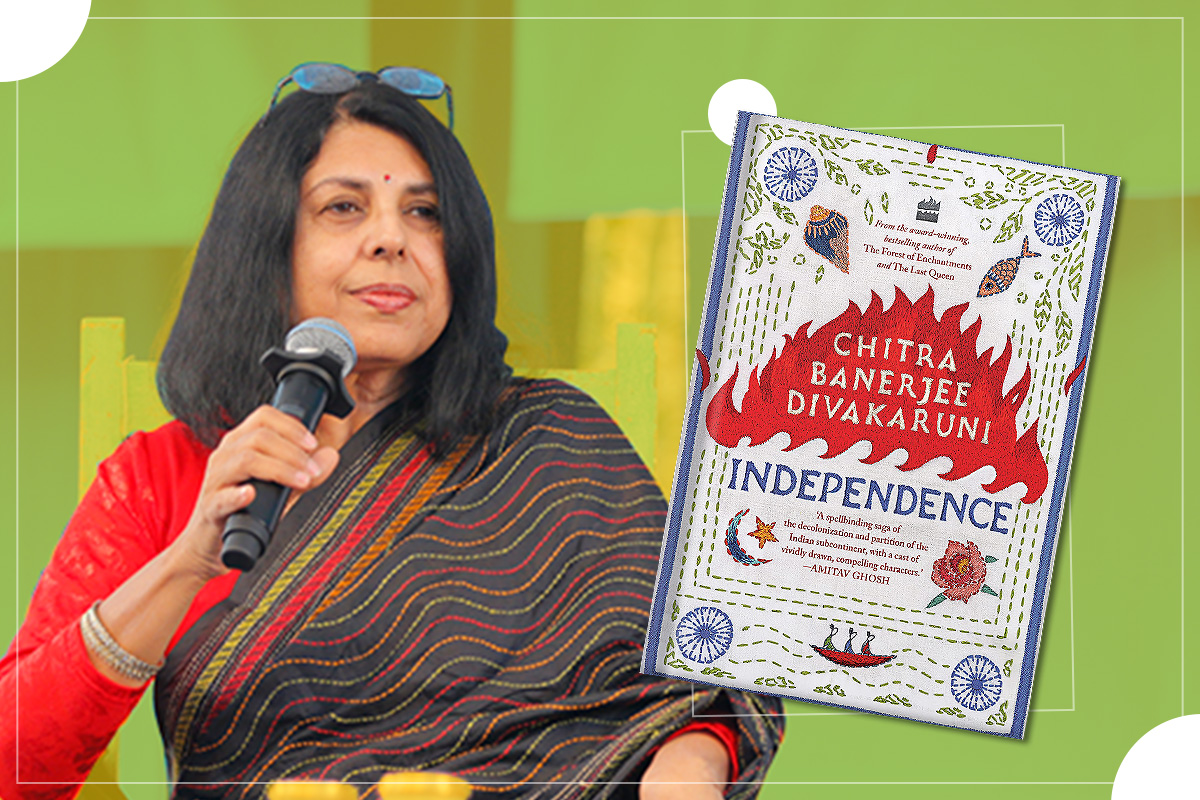
Chitra Banerjee’s Independence (2022) tells the story of three sisters, Deepa, Jamini, and Priya Ganguly, and their navigations of lives and choices at the dawn of Indian independence. At the start of the story, the author establishes how different the three women are in their perceptions of the world, their ambitions, and their place in society. The girls’ lives take a dramatic turn when their family ends up in Kolkata on Direct Action Day in August 1946. Their father, Nabakumar Ganguly is killed during the riots in Kolkata, leaving behind his widowed wife and three daughters to navigate their lives without a male presence in a patriarchal society.
As Chitra Banerjee explores the lives of the three sisters as they navigate grief, dreams, and ambitions, she ensures the reader gains the perspectives of all three girls throughout the book. She doesn’t pick one central character among the three sisters, through whose eyes the reader views the story. Each chapter switches perspective, giving the audience a chance to appreciate each character’s experiences and choices individually.
Deepa ends up falling in love with a Muslim man who is a part of the Muslim League. She meets him during her time in Kolkata and ends up eloping with him after her mother disowns her for wanting to marry a Muslim man. Especially in the wake of the circumstances that led to her father’s death. Priya, who wanted to study medicine at Calcutta University while also being engaged to her childhood friend, does not get admission at the university but does get admission abroad. Her fiancé demands that she choose between him and her desire to pursue medicine. With financial support and blessings from her fiancé’s father, Priya decides to end her relationship and move to America to study. Finally, Jamini begins to run a business with her mother, selling katha blankets to help the family become financially stable. She also ends up marrying her younger sister’s fiancé, after he saves her from being sexually assaulted.
Often in books with multiple female characters, authors choose to portray one character as the torchbearer of feminism. The rebellious girl who makes the most ‘unconventional’ decisions is the obvious choice for this archetype; in this case, it would have been Priya. However, Chitra Banerjee narrates each sister’s story with equal intent and attention. At no point in her storytelling does she indicate any of the sisters to be ‘better than’ or ‘braver than’ the other. Each of the girls’ stories is treated with equal importance. More importantly, the three sisters are shown to have a relationship in which they support each other as much as possible, even when they don’t always agree.
Literary Tools used in Independence
To be able to tell the story that Chitra Banerjee does, the primary literary technique that Banerjee uses is the shifting of perspectives. Across the timeline set for Independence, the chapter advances the overall narrative from each sister’s perspective. None of their emotions, reactions, or choices is weighted against the others. She also focuses on capturing the nuances of each sister’s perspective. This ensures that readers are as engaged with the life and development of one character as with the others.
In her interview with Vogue India, Chitra Banerjee mentions how she wanted to write about how the time (of independence) made ‘ordinary women into heroes.’ She has captured this idea very strongly in the book. As each sister makes different choices and faces different circumstances, Chitra Banerjee shows how women navigating everyday life can showcase resilience and resistance. Each sister navigates their unique experiences of intersectionalities and the challenges that it brings. While for Priya that is navigating the experience of pursuing higher education as a woman and further as a woman of colour in America, for Jamini that is navigating her disability and her unrequited love to her sister’s fiancé, while also running a business with her mother; and finally for Deepa it navigating and inter-religious marriage, especially in wake of partition, while losing the support of her mother. Each sister stands their ground and evolves into a better version of themselves as the story progresses. A reader would find themselves rooting for each sister’s success.
Chitra Banerjee also mentioned in her interview the importance of writing flawed women, “…I think it is harmful if society only portrays perfect, idealistic women, because what is it saying to all of us?” Even in stories with ‘well-written’ female characters, women are often presented as unidimensional and ‘perfect.’ A singular female character becomes the epitome of the ‘better’ woman, and to prove her to be this ‘better woman’, she is showcased against the flaws that other women in these stories have. However, Chitra Banerjee creates women who are human. They portray a range of emotions and often make wrong decisions. What Banerjee also does is give the characters enough room to make these mistakes and grow to mature versions of themselves.
Why are these narratives important?
Frequently, literature that has focused on creating ‘strong’ female characters ends up following an archetype. Unfortunately, the archetype inevitably builds on the narrative of being ‘not like other girls,’ even when it doesn’t intend to. The idea that only a certain kind of choice made by a woman makes her resistance worthy of being told is deeply flawed. It presents this idea of a ‘perfect’ feminist, who doesn’t exist.
Independence emphasises a narrative in which women can resist and rebel in different ways, none of them ‘lesser than’ the others. It acknowledges the myriad circumstances and intersectionalities that allow and restrict women’s rebellion, thereby making their rebellion unique. Most importantly, it stops encouraging the narrative of pitting women against each other to be the ‘better’ feminist.
To draw parallels to this narrative, two pieces of media that come to mind are Pride and Prejudice by Jane Austen and the Netflix TV show The Lincoln Lawyer (based on books by Michael Connelly). In Pride and Prejudice, while Jane’s character is supposed to be a foil to Elizabeth’s character, Austen ensures that the bond between the two sisters comes through clearly. This is important because, even though Jane and Elizabeth are two very different people with distinct hopes for life, they never look down on each other’s choices. In a similar vein, in The Lincoln Lawyer, Lorna and Maggie, both ex-wives of Mickey, are shown to be very different people, both still deeply involved in Mickey’s life in different capacities. They are both portrayed as powerful women in their own right, who even come together to protect Mickey from wrongful conviction.
Telling stories with multiple female characters who approach life differently, not better or worse than each other, is crucial. Sticking to one idea of ‘strong’ woman doesn’t end up breaking patriarchal narratives. It simply replaces an existing hierarchy of women with a new one. To tell feminist stories, we need to start by acknowledging that there is more than one kind of story to tell.