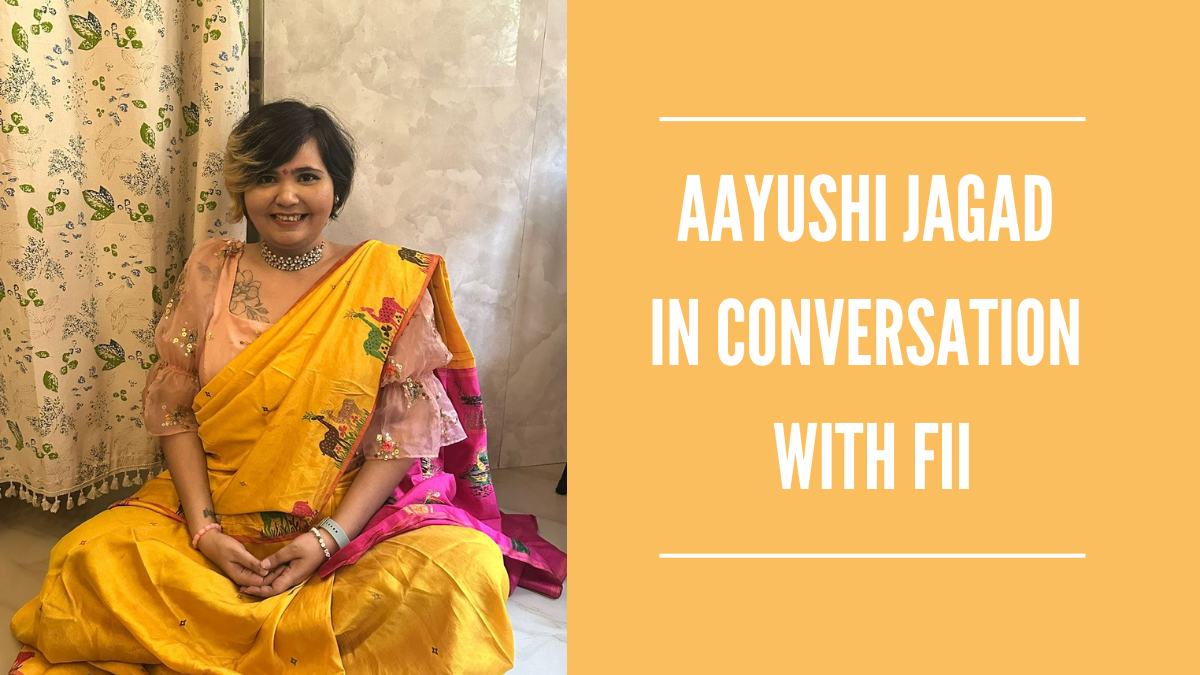
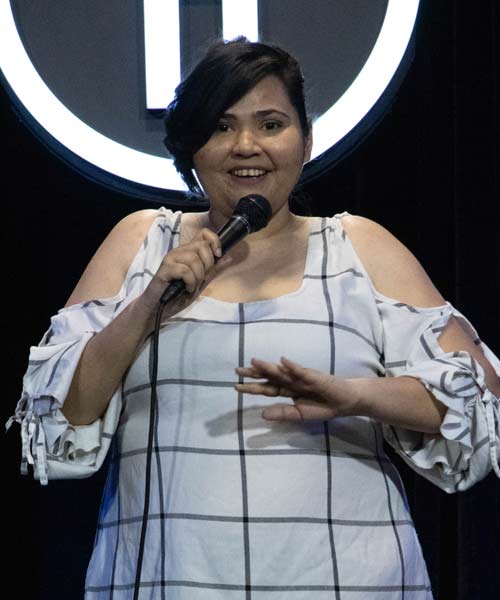
The audience turns to the right as Aayushi Jagad, the last act of the evening, sashays her way to the stage. She’s confident, playfully flirts with the women in the audience, and embraces the venue as her own. In her short act and my first-ever encounter with her, I can already notice how effortlessly Aayushi can engage the audience in a way I haven’t seen other queer comedians do. She struck a bond with the intimate gathering through her self-deprecating and dark jokes. In this interview, Jagad discusses the importance of a platform like Queer Rated Comedy and of positive queer representation that can exist in spaces outside literature and film too, and in the performing arts like poetry and comedy.
FII: ‘If feminism is cancer, it should spread better‘— this stood out to me in your piece! I also heard you say this in a set with Bombay Shaving Company. How did you come up with that?
Aayushi Jagad: That’s my favourite joke I’ve ever written! But its etymology is sad. I was having a heavy conversation with a friend about how my mom passed away from cancer when I was 18. She asked me what cancer Mom had and she had colon cancer which spreads fast. Coincidentally, we were talking about feminism just before this conversation. I just so happened to say that feminism should spread like cancer. She found that hilarious but that was my genuine answer!
FII: How did you start performing comedy?
Aayushi Jagad: In 2016, one of my friends, Sumedh, used to be the Head of Videos at BuzzFeed. He was making a video on Indians trying stand-up comedy for the first time and needed one girl on the lineup. I had also been making vines at the time. He had seen some of my vines and recommended that I try stand-up. Although I didn’t consider myself funny (sarcastic at best), he convinced me to have a go at it. Tanmay from AIB and Sumedh were friends. Tanmay saw my performance and contacted me to work in AIB. I then moved to Mumbai and started comedy.
I got fired from AIB six months later but everybody still encouraged me to get back on stage, learn the craft, and how to write.
FII: You’ve mentioned in an article by TOI: ‘Queer Rated Comedy is the brainchild of the one and only Navin Noronha, who in my opinion, is the reason a lot of other ‘baby queers’ feel comfortable trying comedy.’ How far back do you and him go and how did he approach you to become a part of QRC?
Aayushi Jagad: Navin and I met in 2016 and subsequently, he approached me to do an all-queer lineup. He said, ‘I really want you [on the line-up]. I want to design this comedy space because there are already few female comics.‘ That being said, when you use queer as a descriptor, the numbers are expected to reduce.
‘He said, ‘I really want you [on the line-up]. I want to design this comedy space because there are already few female comics.’ That being said, when you use queer as a descriptor, the numbers are expected to reduce.‘
FII: That’s a beautiful way to describe QRC! How do QRC’s shows come about and what does this platform mean to you?
Aayushi Jagad: He usually comes up with the monthly lineup. Navin gets queer comedians on the show and I’m like his second in command on the lineup maybe because I’m the only other one with that much material. The others are newer comedians who don’t have 20 or 30 minutes. They’re still learning but so am I. Navin’s our senior so he hosts. I’ll usually close the show because we have comparatively longer sets.

Working with Navin doesn’t feel like ‘work’ at all. But it does cost a lot to put up a show. QRC has become a passion project, not just for me but for all other comedians involved. We also invariably meet other queer people who attend our shows and it’s lovely to hear from them after the shows when they tell us, like you said, that the atmosphere feels safe and homely.
So QRC first kickstarted with an online show during the pandemic and after that, it’s just been one offline show after another.
FII: While brainstorming your sets, how much do you improvise and prepare beforehand?
Aayushi Jagad: It’s torturous and jokes don’t come easily! I like performing Queer-Rated because it’s safe for me, unlike male green room spaces. Those piss me off and affect my self-esteem. Many outside comedy ask me about my ‘creative process’ but comedy is about your worldview. If you have an opinion about anything, you can construct a format around it: a personal story with some audacity and word structure.
‘If you have an opinion about anything, you can construct a format around it: a personal story with some audacity and word structure.’
FII: Why comedy and not any other art form?
Aayushi Jagad: It’s observational and comes from your morals and feelings. People laugh at only two things. They laugh at something because it’s either so absurd that they’ve never thought about it or because they’ve thought it too but only you said it. So, when you view jokes with that lens, anything becomes a joke. Comedy is a sharp mental skill that has nothing to do with talent. You have to sit and write 20 funny things and repeat it tomorrow. Comedy is also the place I feel most myself in.
FII: You mentioned feeling uncomfortable in male green room spaces. What do you think people expect from comedy, given how in the Indian context, most comedy comes across as misogynistic or homophobic?
Aayushi Jagad: That’s the reality. India’s taste is male comedy. It’s to laugh at women and every other person.
FII: Then why is QRC, India’s first all-queer comedy lineup, important to India?
Aayushi Jagad: It’s about representation. We deserve a space where we don’t have to worry about what some man thinks.
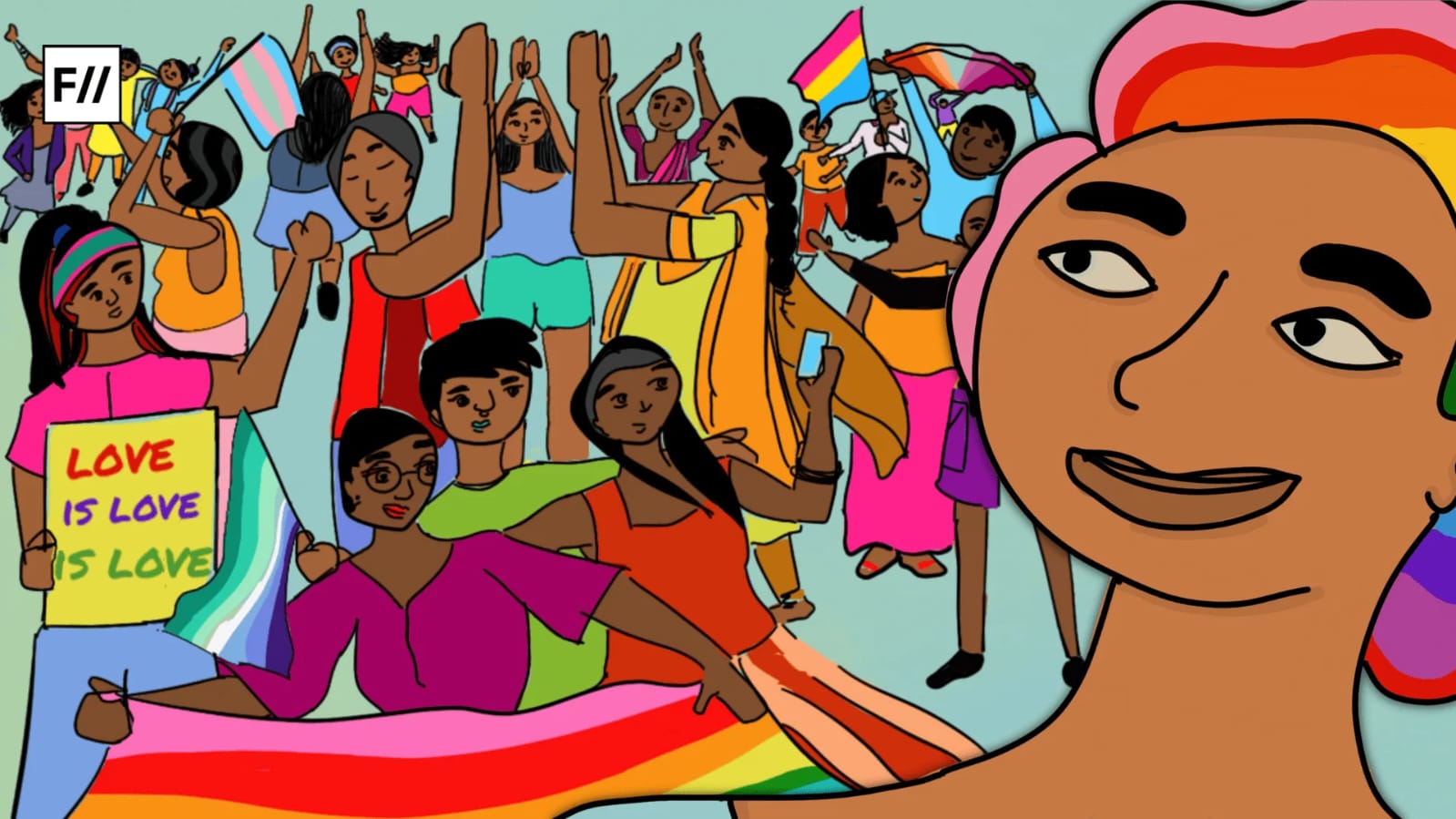
Even though we still get more gay men than non-binary, lesbian or even bisexual performers, that has changed in the last 4 years, and we continuously hope there can be performers who feel safe and welcome to perform at QRC. Representation is both important and specific and we always need more perspectives.
About the author(s)

Ayushi Pandey is a recent graduate from FLAME University, Pune and has a BA in Literary and Cultural Studies and Postgraduate Diploma in Interdisciplinary Studies and Research. They have a keen interest in queer literature, publishing and modern South Asian studies and aim to pursue these disciplines further.