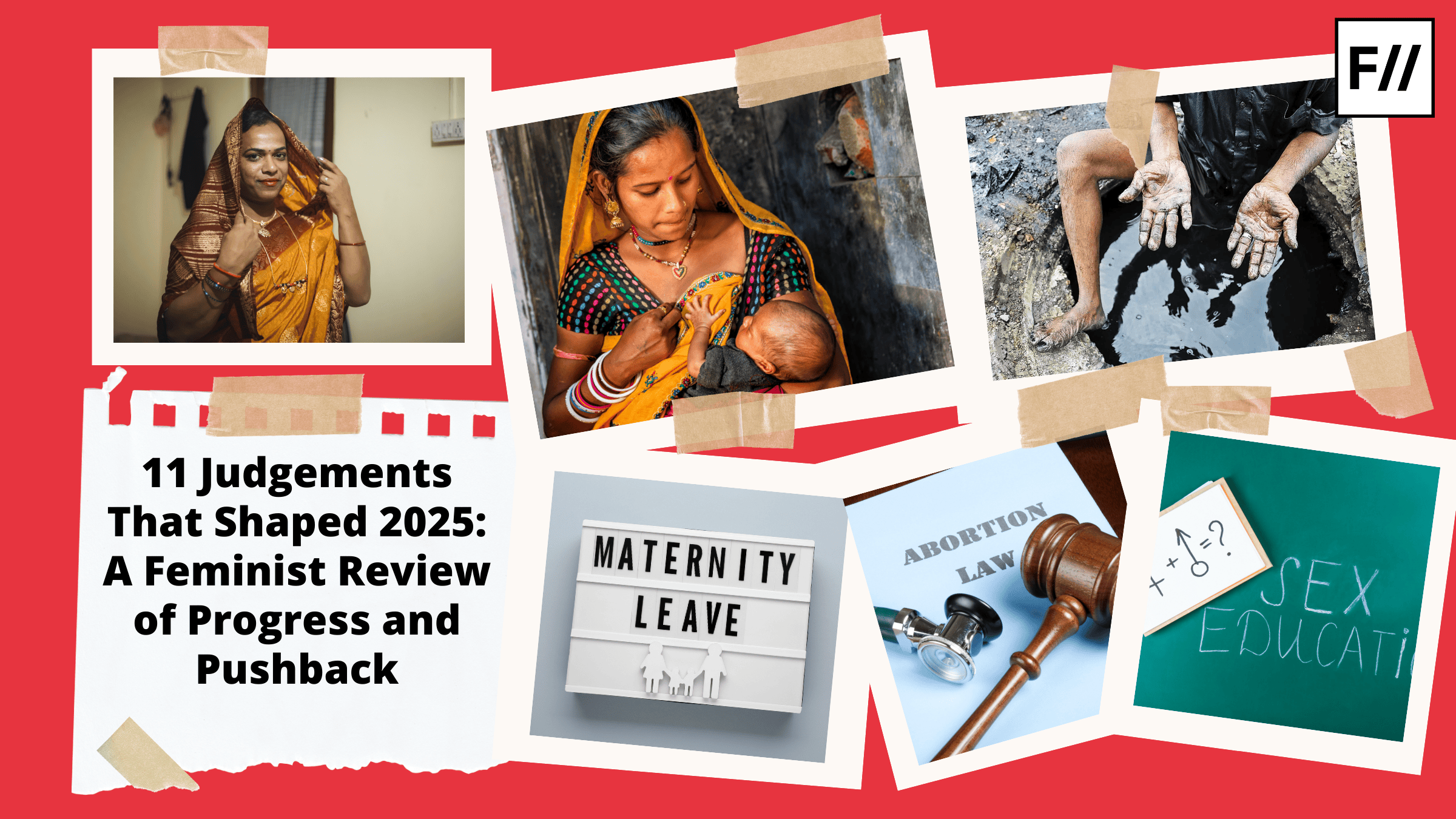
Each year, the courts in India play a decisive role in shaping how gender, autonomy, and equality are understood. In 2025, this role became even more visible. Some judicial pronouncements strengthened long-awaited rights for women, queer communities, persons with disabilities, and workers. Others revealed how deeply patriarchy and caste still influence judicial reasoning. This list looks back at the judgements that shaped headlines in 2025 and evaluates what they meant for feminist justice, social movements, and the everyday lives of people whose rights are shaped inside courtrooms.
1. Manual Scavenging Ban: A Long-Overdue Step Against Caste at the Bottom of the Sewer

In January 2025, the Supreme Court ordered a stringent ban on manual scavenging and manual sewer cleaning in six metro cities of Delhi, Mumbai, Kolkata, Bengaluru, Chennai, and Hyderabad, in response to a petition seeking complete eradication of the practice. While manual scavenging has been technically illegal since 1993 and criminalized under the Prohibition of Employment as Manual Scavengers and their Rehabilitation Act, 2013, the judgement recognized the state’s continued failure to protect Dalit and other marginalized workers from lethal workplace conditions. This judgement was a progressive step, re-asserting the right to life and dignity of workers whose labor has been normalized as disposable. Yet, as the FII article notes, the continuing death toll also exposes how landmark orders mean little unless translated into enforceable, caste-conscious policy and budgets.
2. Breastfeeding Rights and Public Space: Towards A More Supportive Legal Framework

In Maatr Sparsh an Initiative by Avyaan Foundation Vs. Union of India & Ors. (February 2025), the Supreme Court acknowledged the need for breastfeeding-friendly spaces and framed it as part of women’s right to non-discrimination and equal access to public spaces. The judgement rejects the idea that breastfeeding should be hidden or confined to private spaces and instead pushes institutions to accommodate it. This is a progressive step both for reproductive justice and for reclaiming public space. It recognizes that the shame around breastfeeding is a socially constructed problem, and not a neutral “public decorum” concern.
3. Maternity Leave as a Fundamental Right
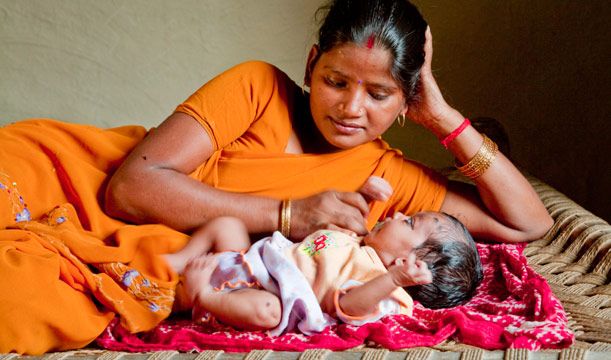
In K. Umadevi v. Government of Tamil Nadu (May 2025), the Supreme Court reaffirmed that maternity leave is a fundamental right flowing from Articles 21 and 42, not a mere benefit that the state can withhold. The case involved a government school teacher whose maternity leave for her third child was denied under Tamil Nadu’s two-child norm policy, despite the fact that her first two children lived with her ex-husband. By holding that denial of maternity leave violates women’s dignity and India’s commitment under the Convention on the Elimination of All Forms of Discrimination Against Women (CEDAW), the Court delivered a strongly progressive articulation of reproductive and labor rights. Yet the FII article also reminds us that this victory is uneven, as informal workers, domestic workers, and gig workers remain largely outside the protection of such fundamental rights.
4. “A Woman is Not Defined by Her Womb”: Trans Women and Legal Protection
An Andhra Pradesh High Court judgement in June this year explicitly recognized that a transgender woman is entitled to the same protective legislation as a cisgender woman, and that denying her legal status as ‘woman’ is unconstitutional. The FII article underlines how the Court located this recognition in the constitutional guarantees of equality, dignity, and identity, rejecting biologically reductionist notions of womanhood. This judgement pushes back against both medicalised gatekeeping and everyday transphobia by holding, in effect, that the understanding of ‘woman’ in legal terms cannot be policed by chromosomes or reproductive capacity. At a time when other courts, including those abroad, are trying to narrow the definition of woman, this ruling commendably chose affirmation over exclusion.

In contrast, an April 2025 ruling of the UK Supreme Court held that ‘woman’ under the Equality Act 2010 refers to “biological women” based on sex assigned at birth. This ruling effectively narrows protections for trans women and emboldens exclusionary politics. It sends a chilling message to trans communities worldwide, including in India, where courts are tentatively moving in the opposite direction.
5. Transgender Parenthood and the Fight to be Listed as Parent

The Kerala High Court’s judgement in June this year on a transgender couple’s petition for their child’s birth certificate marked another important step in queer family recognition. The couple asked that both be listed simply as ‘parent’, instead of being forced into ‘mother’ and ‘father’ boxes that did not match their identities. The Court agreed, directing authorities to issue the certificate in the requested format and recognizing the harm caused by rigid bureaucratic categories. This is a progressive judgement not only for trans rights, but for de-gendering parenthood itself. It decenters heteronormative family structures in state records and accepts that families are already more diverse than our forms allow. The real test, of course, will be whether such recognition spreads beyond one exceptional case to become standard practice.
6. Comprehensive Sexuality Education as a Constitutional Imperative

In Just Rights for Children Alliance v. S. Harish, while granting bail to a juvenile accused of the offence of rape, the Supreme Court took the opportunity to stress that sex education cannot be limited to older classes and must be integrated earlier in the curriculum. The Court cited and relied on research showing that comprehensive sexuality education (CSE) actually delays sexual activity and promotes safer practices, rejecting the claim that it is a Western concept incompatible with Indian values. The analysis reads this as a progressive judgement that implicitly treats CSE as flowing from the rights to life, education, health, and non-discrimination under Article 21 and 21A. In a context where sex is still treated as taboo, the Court’s clear endorsement of CSE as a right-based necessity, not a moral threat, is a significant shift.
7. Marital Sexual Violence and the Chhattisgarh High Court’s Regressive Turn
Against these steps of progression, 2025 also saw judgements that violently reinforced patriarchy. The Chhattisgarh High Court held that a husband’s act of non-consensual sex with his wife is not an offence under Section 377 of the IPC, effectively taking out marital rape from criminal scrutiny yet again. This decision entrenches the marital immunity that feminist movements in India have been fighting for decades, ignores lived experiences of violence within marriage, and sidelines the ongoing constitutional debates around criminalising marital rape.
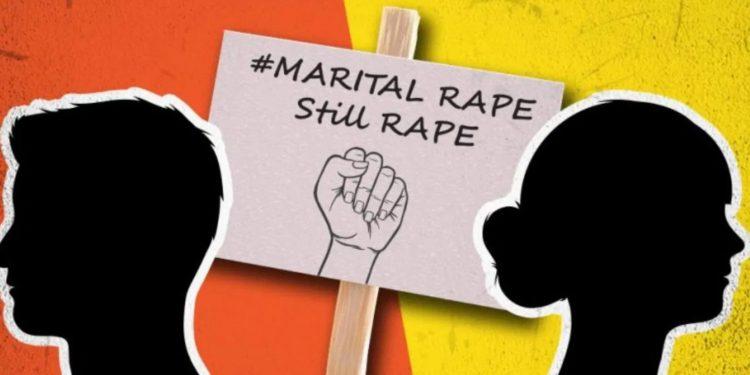
On December 5, 2025, Congress MP Shashi Tharoor introduced a Bill in the Lok Sabha to criminalise marital rape. With this legislative push, there is renewed hope that the question of marital rape will finally be resolved in favor of women’s autonomy and dignity.
8. Marriage Equality Review Petitions: The Supreme Court’s Continued Refusal

In January 2025, a five-judge bench of the Supreme Court rejected review petitions challenging its 2023 decision that declined to legalise same-sex marriage. The Court again refused to read the Special Marriage Act in a gender-neutral way, despite arguments that queer couples are being forced into the closet and denied basic family rights. The article notes that the Court’s stance here is one of restraint bordering on abdication, especially when compared with its past judicial activism on other issues. By deferring endlessly to legislature, the Court leaves queer couples in a legal limbo, granting symbolic recognition without the substantive rights of marriage, adoption, spousal benefits, or recognition of care work.
9. Reproductive Rights of Women with Disabilities: Ableism in the Courtroom

Earlier this year, the Bombay High Court delivered a judgement concerning a young woman with borderline intellectual disability who had been on antipsychotic medication since 2011. The outcome of the case may appear progressive because the woman was eventually allowed to continue her pregnancy, as requested. However, the Court’s reasoning treated her more as someone whose choices required supervision rather than as an autonomous rights holder. Its approval was tied to conditions such as the partner’s stated intention to marry her and the absence of congenital anomalies in the foetus. The judgment illustrates how even with laws like the Rights of Persons with Disabilities Act, 2016, disability is still viewed through a lens of deficiency, and protective narratives are prioritized over genuine autonomy.
10. POSH Limitation: A “Race Against Time” for Survivors

In a September 2025 ruling under the POSH Act, the Supreme Court held that sexual harassment complaints are bound by strict limitation periods, and late complaints can be rejected. The analysis shows how this insistence on timelines, without equally robust attention to workplace power dynamics, effectively punishes survivors for delays rooted in fear, stigma, and retaliation. While the judgement clarifies the law and acknowledges that limitation involves mixed questions of law and fact, its impact can be regressive, as it risks turning procedural deadlines into barricades to justice. For many women and queer persons navigating hostile workplaces, trauma does not operate on a three-month clock.
11. Abortion Jurisprudence: A Right Only on Paper

A 2025 study examined hundreds of abortion-related cases and found that, although courts allowed termination in the majority of petitions, the very requirement of court intervention has become a systematic barrier. Healthcare providers, fearing criminal prosecution, routinely send pregnant women to court even when the law does not demand it, resulting in delays, retraumatisation, and rights violations. What emerges is a regressive judicial trend, wherein abortion access is being judicialized instead of being treated as routine healthcare. The law may be comparatively liberal, especially after the 2021 MTP amendments and the 2022 Supreme Court decision extending abortion access to unmarried women, but the lived reality is still one of moral policing, where women’s decisions are second-guessed and filtered through stigma rather than medical need.
What Did 2025 Tell Us About the Judicial Stance?
The judicial pronouncements of 2025 show that the law continues to evolve through conflict, resistance, and constant negotiation. There were moments when courts affirmed dignity, choice, and equality in ways that strengthened feminist movements. There were also decisions that restricted autonomy, reinforced harmful norms, and left vulnerable communities without meaningful protection. Taken together, these rulings highlight a simple truth, that progress is never linear and cannot be assumed. It must be defended, expanded, and reimagined by the communities whose lives are shaped by legal outcomes.
As we move into 2026, the task is not only to remember which cases made news but to continue pushing for a legal system that recognizes every person’s full humanity and safeguards it with consistency and courage.
This is by no means an exhaustive or representative list. Suggestions to add to this listicle are welcome in the comments section.
About the author(s)

Mahi Agrawal is a B.A. LL.B. (Hons.) student at Hidayatullah National Law University, Raipur.