“At Saneki Weaves, the loom becomes a space for the women to build sisterhood and solidarity. It is a space that enables their agency to exercise their cultural, political, legal, economic, and ecological rights“, says Anurita P. Hazarika, Director, Northeast Network.
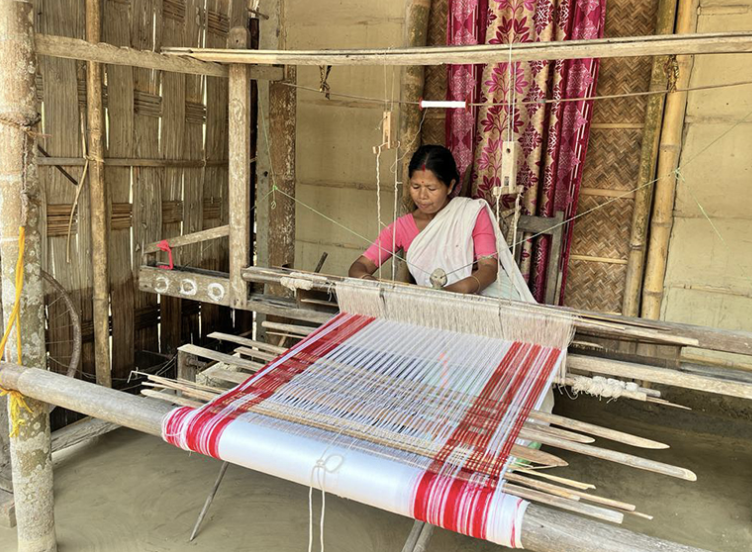
At Northeast Network, Saneki Weaves is the livelihood initiative conceptualised to empower and enable rural women in interior parts of Assam to be economically self-reliant while addressing issues around women empowerment including gender-based violence. Weaving therefore becomes a tool towards economic empowerment. It is a learnt skill in most households in the rural and peri rural parts of Assam. Women traditionally would weave mostly for personal consumption but Saneki’s vision was to use weaving as a tool to help local women weavers to feel confident and empowered with a skill they have known over generations. As one of the weavers, Monika Rabha, shared, “Initially, I could not understand anything, I was very confused but now I am able to provide for my family, support my son with his education, and feel confident.”
Weaving as a traditional practice can be dated back to the 10-11th century when Pala King Dharma Pal brought their weaving community to Sualkuchi in Assam, a small hamlet on the outskirts of Guwahati. However, weaving has not been limited only to Saulkuchi, but it spans across different indigenous groups in Assam living at the margins, far away from the capitalistic, market-driven demand for the handloom.
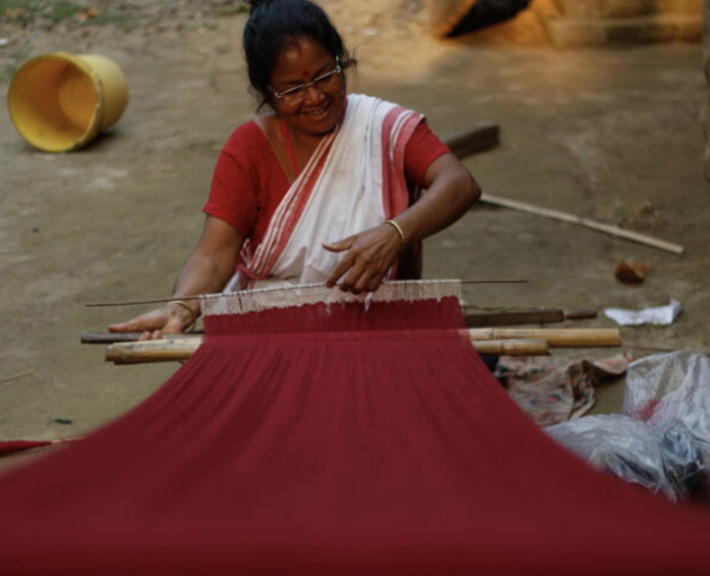
In the interiors of the region, a loom can be found in most households. Women would often use the loom for their own personal consumption or use it to help entrepreneurs and market-driven agents who, in the process, exploit the skills of the women by underpaying and overutilising their skills. With mediators and entrepreneurs, weaving often became the site for exploitation. They would identify a weaving community, visit the villages with their designs, get the finished product, and end up paying very little to the women weavers.
This systemically undervalues the women from the weaving community, making them passive contributors, denying them fair compensation, and autonomy over their skills. This indicates a hierarchy between the makers and the distributors who would sell the products as handmade without acknowledging the labour of women behind the products. Even though women weave the products, the education to decide the price, the design patterns, and the autonomy to sell is rarely found in the hands of women, explains Hazarika. For instance, if the market rate of a Gamusa (cotton stole) is 50 rupees, a woman’s labour would be paid between INR 5 and 10. The lack of knowledge in women about market prices contributes to their exploitation by mediators.
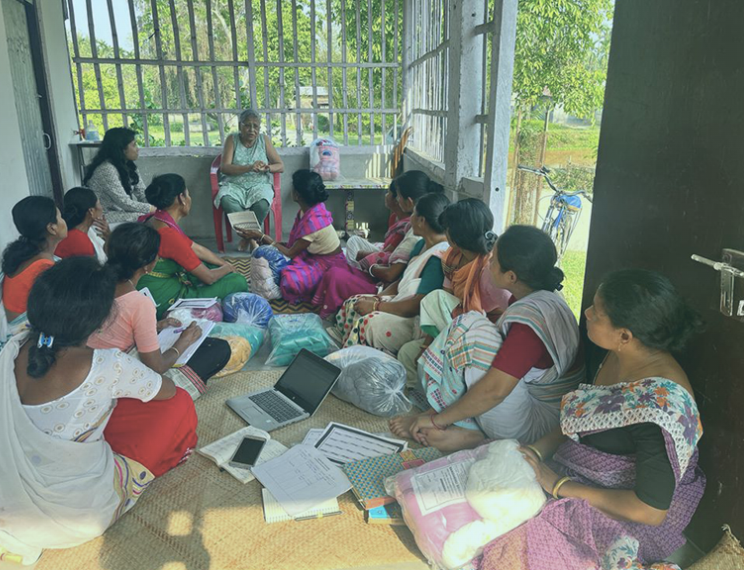
Saneki identified this gap and created a space that enables rural women weavers (traditional and interested weavers) to have control over their product. Through their grassroot mobilisation and training, traditional women weavers were empowered with the knowledge about handloom (measurement, and colour combinations to name a few), market price, and the wages for their work while getting trained to exercise their agency to speak for themselves and the needs of the community.
For Monika Rabha, it is a matter of pride that she was able to explain her creation to customers and visitors in exhibitions outside Assam. Her identity as a woman weaver explaining the process of weaving to customers from outside the state made her feel surreal as this was the first time for her interacting with people from outside her region to explain products that is indigenous to her culture. She shares this with a wide smile. Women stepping out of their homes to local haats (local markets) and mela’s gives them a sense of recognition and respect – something that was invisibilised by the passive treatment by most middlemen and entrepreneurs.
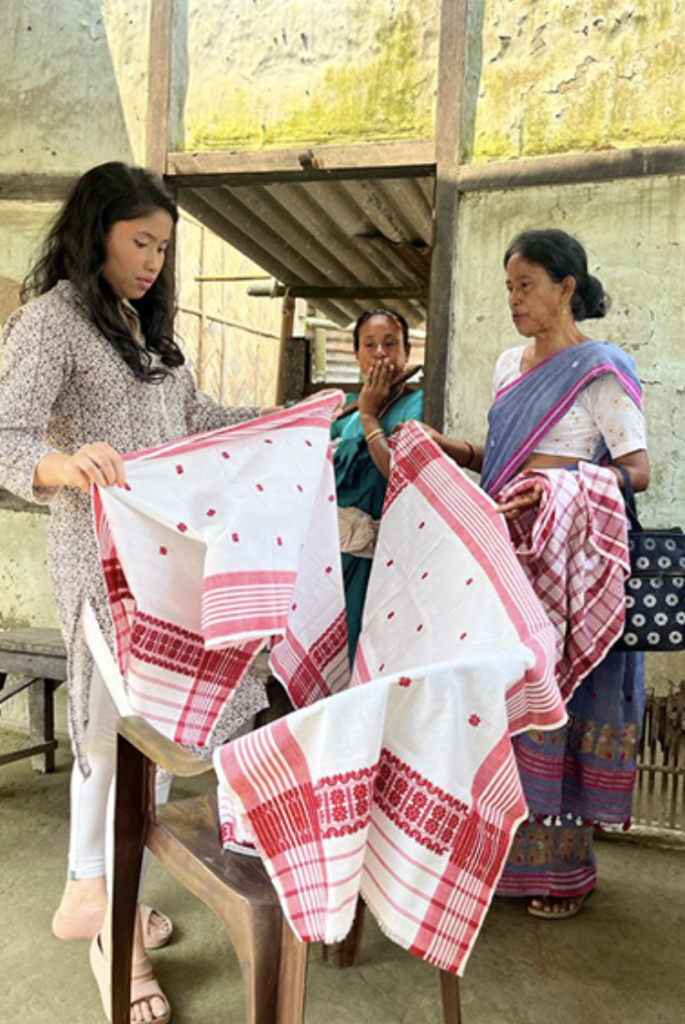
Over time, this economic independence builds in them the negotiation skills that are key to asserting their self worth. Parijat Borah, the community mobiliser at Saneki Weaves shares that to address concerns about fair pay, women collectively have meetings to self-advocate about their strengths to establish the proof towards a better pay for themselves. While the manager at Sereki, a 30-year-old family run collective shares, women weavers would ensure that they are paid a sufficient advance for them to begin the work, indicating their knowledge about the worth of their skills and the market demands for the product. This not only shifts the autonomy of the middlemen and mediators to women but also gives the power back to them, who now understand the process of not only producing the product but also the market and the consumer needs.
Through their initiative, Saneki creates a safe space for women including women who don’t weave to come together to discuss the needs of their community. As Deepali Baidew (Baidew – Sister in Assamese) shares, “Currently we are working towards organic farming in our village so that we become self-sustained.” The localised grassroot leadership model helps women to exercise their rights and agency in ways that they know, instead of them learning something completely alien to them. This process has subsequently helped the community see an increase in the rural income, and in many ways altered gender relations – men contributing to the weaving process, helping women in finishing products and supporting them with household chores too.
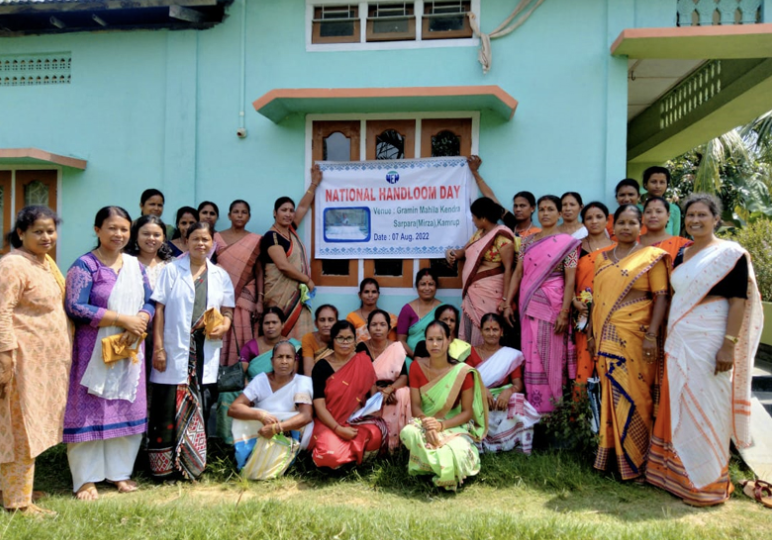
While their empowerment is a testament to their agency, financial independence also means getting educated to open bank accounts and having control of their earnings. At a local level, weavers started feeling empowered but they do face structural challenges in accessing banks to create their bank accounts, as they were situated far off. This points to the institutional and infrastructural inaccessibility for women that restricts their mobility and safety. However, over time, they learnt to cycle to the bank to deposit or withdraw cash, implying women’s resilience and adaptation to situational challenges and overcoming the same. Resilience here can be celebrated, however this comes at the cost of women taking the risk of being unsafe demanding informed political decisions.
Through a traditional skill, women weavers find a means to their independence and aspirations. As Xeuti Rajbongshi, a new generation woman weaver from Sereki, shares “I feel good that I am able to earn from this. I save a little for my son’s education, keep a little for my family and I spend a little on myself. I don’t know so much, but with the little that I have learnt in the last 3- 4 years I feel good that I am able to earn something.” While women weavers become independent with this skill, it is also observed that they are inclined to prioritise economic wellbeing of their families, placing their own needs last. This highlights the entrenched patriarchal expectations from a woman to be the caregiver, often trivialising their own needs. Such a phenomenon often makes the concept of choice ambiguous. It is open to argue how much choice an economically independent woman is left with within a patriarchal social setting. It required a lot of awareness building sessions for Saneki to help women realise that their personal needs are as important as their families.
Saneki and Sereki highlight that the loom for a woman is not just a skill but an arena that enables them to build sisterhood, solidarity, and autonomy. As they weave, they weave their way to their hopes and aspirations. Saneki’s localised livelihood model with Sereki’s weavers provides an insight on how weaving and the loom becomes a site of economic empowerment while also underscoring that empowerment is an ongoing sustained effort that extends beyond income generation to gradually creating systemic changes and shifting gendered attitudes, relations and norms. Creating a space that contributes to women empowerment is a collective effort involving multiple stakeholders, and a woman can fully realise her economically independence when it is accompanied by broader systemic changes.
About the author(s)