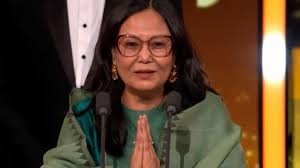
When Boong won a BAFTA Award back in February, its director Lakshmipriya Devi said, “A film that is not only rooted in a place which is very troubled, very much ignored and very unrepresented in India, my homeland Manipur. It’s a homage to my homeland…we pray for peace to return to Manipur.” Though BAFTA’s social media account had posted the clip of Devi’s acceptance speech, it was shortly deleted due to reasons unexplained before being restored after public criticism.
Cinema is known for serving as a medium through which marginalized stories, histories and perspectives find visibility. For the people of Manipur, the conflict which started in 2023 was not the only one they’ve seen in their lives. It has perpetually been a troubled state, with the Armed Forces Special Powers Act (ASFPA) still remaining active in the state despite local protests.
Boong uniquely stands as a movie emerging from conflict zones, completed just one week before the ethnic violence broke out in 2023. It is also fascinating that the young actor, Gugun Kipgen, who played the character of a Meitei boy, belongs to the Kuki-Zo tribe. Boong tells the story of a young boy travelling from Imphal all the way to Moreh which borders Myanmar, in hopes of finding his father and reuniting his family, set against the political tensions of the state.
Even in cinemas, where we seek representation, it often comes with a saviour complex. Paatal Lok Season 2 was based in Nagaland and while it brings local issues to light, it never trusts the locals to solve them by themselves.
Perhaps the unintentional irony is that the town of Moreh would later emerge as one of the most violently affected towns during the 2023 conflict. What was written into the film as a place of hope and reunion rather became one of the epicentres of displacement, destruction, and fear in reality. This overlap between fiction and reality makes Boong even more poignant, representing thousands of families who have been torn apart by violence.
The incident of speech getting omitted thus raises a question of whether a brief reference or mention about Manipur’s suffering appears “too political” to be spoken about within public discourse. If not this, then one wonders if this was an intentional attempt at shunning marginalised voices, if the latter and former weren’t the same, that is.
Is Bollywood the standard for India?
It does not end with the deletion of speech alone. Devi, in an interview, stated that she “wanted to bring back the Manipur of my childhood” while emphasising that modern songs have become Bollywood-ised in some capacity. For her, Boong was a medium to bring about Manipur’s everyday life and the lived experiences of its people.
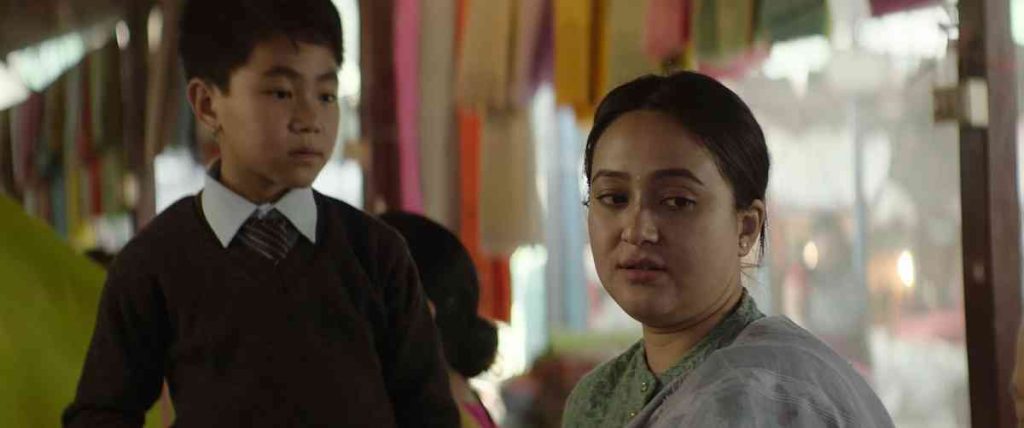
Yet, as she poured her soul into this film, congratulatory messages and headlines around the BAFTA Award by mainstream media highlighted Farhan Akhtar’s name instead. While this in itself is not problematic, the issue lies in to what extent we are crediting and discrediting one’s contribution to the film and what it tells us about recognising and acknowledging one’s message. When the mainstream media, such as NDTV, posts “Farhan Akhtar-Backed Manipuri Film Boong Wins BAFTA 2026, 1st Big Honour For India This Year” as the headline without any mentions of Devi, the framing infringes on the fact that the film is conceived and directed by a Manipuri woman telling a story which is rooted in her society and based on her lived experiences.
The idea that north-eastern people need people from the mainland to come and “save” them from issues within their society has been peddled for far too long. Even in cinemas, where we seek representation, it often comes with a saviour complex. Paatal Lok Season 2 was based in Nagaland and while it brings local issues to light, it never trusts the locals to solve them by themselves. Similar was the case with “The Family Man”, where it sought to highlight Tamilians in Manipur, specifically in the town of Moreh.
It is almost always a Man, who comes from the mainland, with suspecting eyes wearing sunglasses who goes on to “save” the people of north east while a heavy beat music is playing in the background.
A decade ago, we had the very well-accomplished actor Priyanka Chopra portray Mary Kom in a self-titled biopic. Kom is perhaps one of India’s most well-known athletes, and for good reasons, being a 6-time world champion and an Olympic medallist in boxing. The only issue, or one of the two, with the movie was that Bollywood’s Mary was a Punjabi woman who spoke Hindi instead of Manipuri. Not only Kom, but the on-screen casting of her husband and coach also went to Hindi-speaking non-Manipuri actors.
Achievements emerging from peripheral regions frequently become legible to a national audience only when associated with familiar metropolitan figures. Boong stands out in many ways, one of them being a film entirely made in the Manipuri language. To hear one’s own language playing out in major theatres across India will always be different than entire stories being portrayed in the language one does not speak, in a film about one’s own people.
The present reality of Manipur post-conflict
Since the conflict, around 60 thousand people have been displaced in Manipur who are now living in relief camps in a deplorable state. A piece by Yaqut Ali for The Wire revealed that several people have died by suicide or due to medical emergencies. There is no food, no employment, and no home to go back to.
Kajal, who met with the LoP in 2023, tells The Wire that nothing has changed since then. She says, “This is not the life we wanted. If the government truly wants peace in Manipur, we should be holding books in our hands, not guns to kill each other. Here, everything has become about blood, gunshots and bombs.” And for the families who have both Meitei and Kuki members, they not only have to have structural barriers but also that of emotional sentiments, as conflict runs deep.
Lakshmipriya Devi’s BAFTA acceptance speech, thus, has a special significance against this backdrop. By identifying Manipur as a “troubled, ignored and underrepresented” state and expressing her hope that the children who have been displaced in the conflict will reclaim their dreams.
For women especially, relief camps are unable to provide for safe menstrual utilities and hygiene. A FLAME University report reveals that over 500 babies were born in relief camps since May 2023, while mothers with high risk pregnancies were also living in relief camps. They are also prone to sexual assault, violence and health complications.
An E-Pao article highlights that families who were once capable of supporting their children’s education are now “struggling to meet tuition fees, transportation costs, and additional expenses… This has led to some students dropping out of school or college, a heart-breaking consequence of the crisis.”
Manipur’s ethnic violence has taken the shape of a humanitarian crisis where families are forced out of their homes, children are forced out of their classrooms and women are living in inhumane conditions. As the conflict continues with little resolution in sight, it is compounded by the fact that the state has completely failed in protecting its own people. Prolonged displacement has affected and eroded people’s livelihoods, identity and belonging.
Lakshmipriya Devi’s BAFTA acceptance speech, thus, has a special significance against this backdrop. By identifying Manipur as a “troubled, ignored and underrepresented” state and expressing her hope that the children who have been displaced in the conflict will reclaim their dreams, she drew a connection between a personal story about a missing father and a larger humanitarian crisis. By doing so, she also transitions from a celebration of cinema to the lived realities that have formed the very core and heart of Boong’s story, continuing to take place even beyond the screen.
About the author(s)

Mema is currently a Master's student at South Asian University (SAU). Hailing from Manipur, her lived experiences there have shaped a deep commitment to the feminist cause. She cares deeply about women and their future, which she tries to convey with her writing. She finds joy in reading, writing and cooking.