
Encountering the works of Haruki Murakami for the first time felt like being teleported into a dreamscape that draws heavily from surrealism and explores many psychological layers of human existence. Cult classics such as Kafka on the Shore, The Wind-Up Bird Chronicle, and After Dark have found an audience from around the world who are drawn to the quiet loneliness in these books, along with depictions of the fragile human psyche, magic realism, and introspective male protagonists.
However, as a woman reading Murakami, a sense of discomfort soon ensued. A discomfort originating from his portrayal of women characters. In many of Murakami’s works, women characters are situated within the emotional and psychological complexities of the male protagonists. It is disturbing how someone views women as little more than aesthetic props. A reader can’t help but perceive women only through the male gaze in Murakami’s stories.
Hypersexualisation and objectification
In a scene from The Wind-Up Bird Chronicle, Kreta Kano, the clairvoyant, is involved in an act of sexual intimacy with Toru Okuda. In this scene, he sits paralysed through fellatio; this scene was designed to bring the fragility of the character of Toru to life. However, this begs a question: At what cost is this fragility depicted?

Many other women characters, even when their stories take centre stage, are defined by their physical attributes. In 1Q84, for instance, the protagonist’s character sketch emphasises her physical appearance rather than her personality or interiority. This contrasts with how Murakami sketches his male characters, revealing their inner worlds and emotional lives.
Other examples include Norwegian Wood and Sputnik Sweetheart, where the women characters exist to provide sexual gratification or act as catalysts for the male protagonists’ self-actualisation. And this is done by sacrificing the development of women characters. This raises an important question for feminists: Can surrealism be used as a convenient literary cloak to reproduce sexual fantasies for men?
Desai’s rebellious women against Murakami’s submissive women
My silent act of feminism is to read more women authors. It’s as if they are able to reach into those corners of my mind that have been influenced by patriarchy and plagued by anti-feminist narratives. When I read The Inheritance of Loss, immediately followed by The Loneliness of Sonya and Sunny, I realised that Desai’s novels carry the same undercurrent of surrealism, creating a dreamlike landscape that explores fragility and psychology.
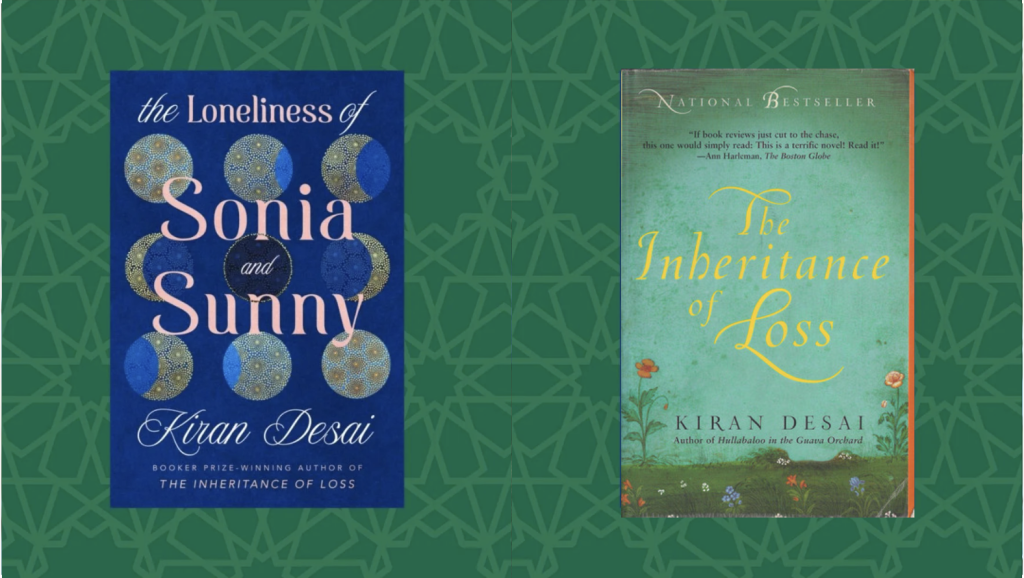
However, this time, the women characters have agency. They have depth and are emotionally complex, unlike Murakami’s women. In The Loneliness of Sonya and Sunny, women start out as narrative instruments to help the male protagonists, but evolve into independent characters, and are able to be introspective and identify patterns that compromise their integrity. They are able to learn to stand up for themselves and establish boundaries with men.
The scene from The Loneliness of Sonya and Sunny, where Sonya’s father casually body-shames his wife and stereotypes married women with kids, is an important example. Later in this scene, Sonya’s mother rebukes her husband and questions his perceptions of women, silencing his sexist opinions about women for the remainder of the book.
The scene from The Loneliness of Sonya and Sunny, where Sonya’s father casually body-shames his wife and stereotypes married women with kids, is an important example. Later in this scene, Sonya’s mother rebukes her husband and questions his perceptions of women, silencing his sexist opinions about women for the remainder of the book.
And on realising her own worth, she decides to leave him, forcing him to confront the emotional abuse he has been inflicting on the women of the family. Sonya, herself, walks out of a toxic relationship with Ilan, despite the latter’s several manipulations. And all the women characters in Desai’s novel exhibit strength without relinquishing their kindness.
Women are not a monolith
Treating women as a monolith is not Murakami’s problem alone; many male authors do the same. It is a problem of male-centrism. The danger of male-centrism is that it is so normalised in our society that even an acclaimed author like Murakami, who has a good understanding of the human mind, cannot look past it. This is precisely why Desai’s works are illuminating.
Desai’s books don’t just stand out for their strong women characters, but also stand out for their feminism.
Despite exploring similar themes, Desai’s narratives are more inclusive. Women in Desai’s fiction do not exist as devices for male transformation. Instead, Desai’s women have autonomy and exercise it loudly. And neither do men define their existence.
Desai’s books don’t just stand out for their strong women characters, but also stand out for their feminism. Her characters demonstrate how literary ambiguity does not have to necessarily erase women or strip them of their agency. This is especially necessary because it counters the idea pushed by male-centric narratives in literature that women can only exist when useful for the male protagonists’ character arcs.
About the author(s)



Such a powerful and nuanced read. This has genuinely made me curious to explore Kiran Desai’s work.