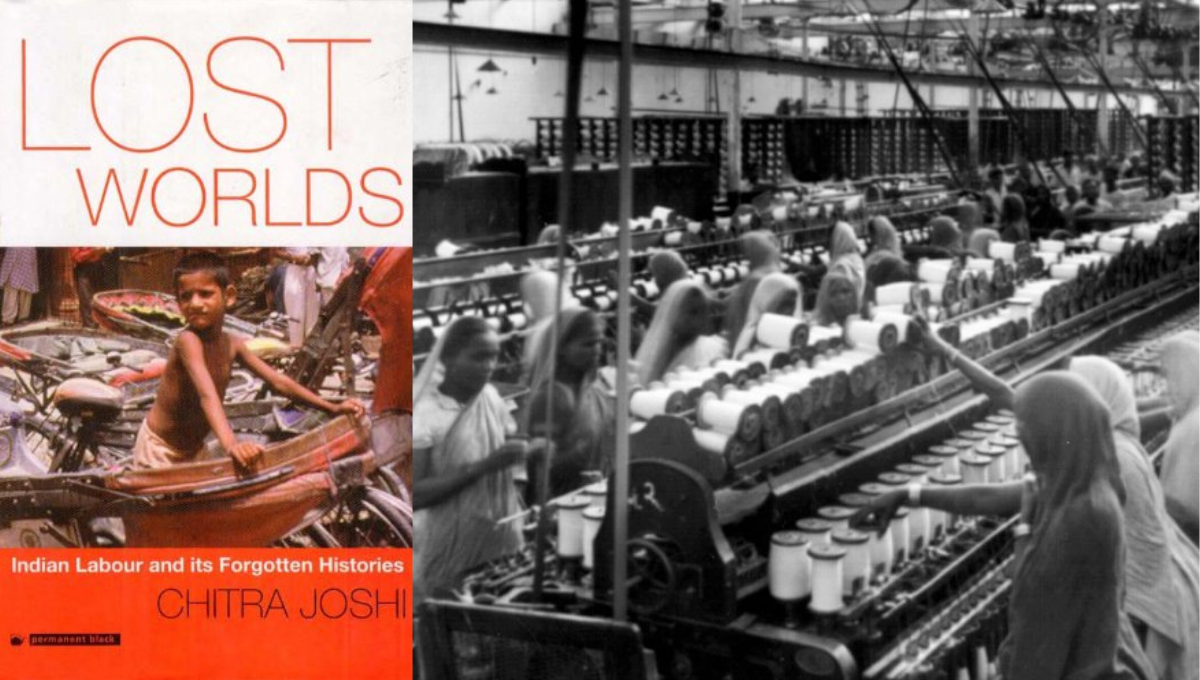
Chitra Joshi specializes in labour history in India and is known for her book, ‘Lost Worlds: Indian Labour and Forgotten Histories’. The book focuses on Kanpur and its workers who went through the processes of industrialisation and deindustrialisation and eventually faced the consequences of the decline of industrial units. In particular, it is important to shed significant light on the dominant narratives in the context of gendered labour that focus on male industrial workers, who developed class consciousness, which culminated in a revolution.
Joshi focuses on Kanpur becoming a commercially prominent urban centre, which was a large cantonment area until the middle of the nineteenth century. The cantonment area used to cover 90% of the land, and 690 acres came under civilians, eventually turning into an industrial area. Her ‘labour and its historiography’ remains significant, as it highlights shifts in studying labour in a historical context. Social history writings emerged in the 1970s and started dealing with social issues and identities. Labour historians detached themselves from colonial and sociological narratives and the histories of trade unions. They started studying the social identities of workers, such as caste, class, gender, and religion. She follows the same method, understanding different social identities shared by workers.
Joshi focuses on Kanpur becoming a commercially prominent urban centre, which was a large cantonment area until the middle of the nineteenth century. The cantonment area used to cover 90% of the land, and 690 acres came under civilians, eventually turning into an industrial area.
It is important to understand women’s position in the workforce in an industrial area that shifted from witnessing large-scale industrialisation to moving towards declining employment in large industries, the casualisation of labour, and the weakening of trade unions.
Importance of Gendered Labour in Chitra Joshi’s work
The traditional and dominant narratives focus on labour as masculine. As mentioned above, there are shifts in labour historiographies, tracing the neglect of the significance of social identities, such as gender, caste, and class, to incorporating them into research. Another reason for conventional histories focusing on the male workforce is that female workers are unrecorded in official records, or their labour remains invisible. This can stem from considering labour masculine in the eyes of employers and colonial officials. Chitra Joshi mentions that ‘a masculinist ideology’ that devalues female labour compared to male labour, deeming the former less productive. Employers and colonial officials considered men more efficient than women. According to them, men could have more energy, whereas women were deemed fragile and had tender health. Their traditional societal association with maternal duties gave employers a reason to restrict them to reduce their proportion in the textile workforce in Kanpur.
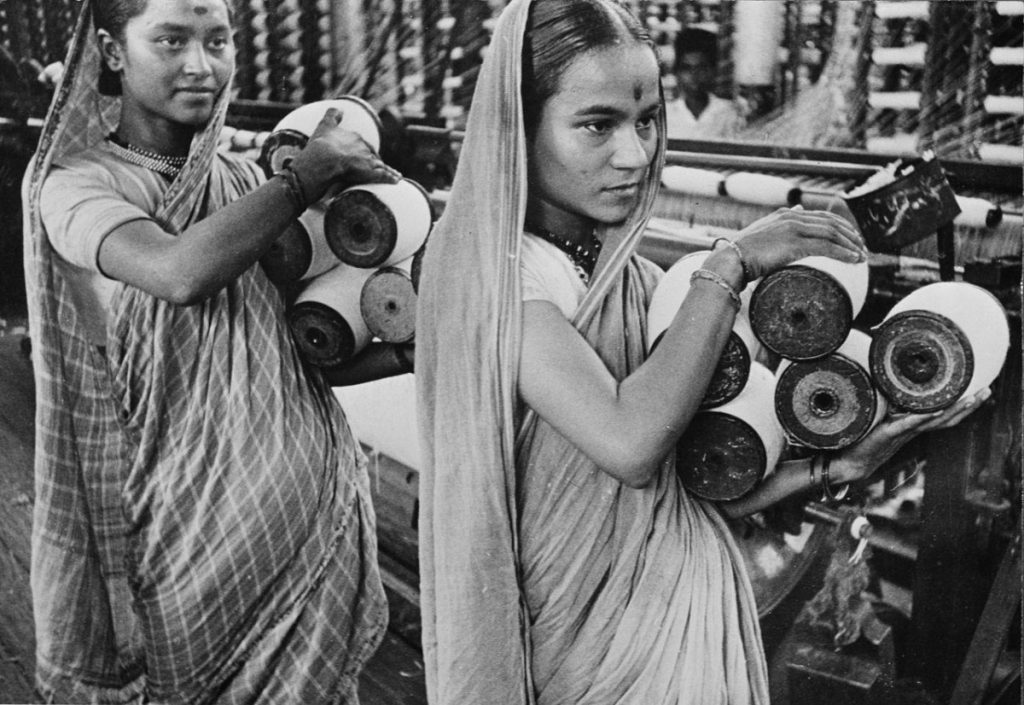
In the middle of the nineteenth century, there were growing concerns around laws that would restrict women’s working hours, leading to a labour shortage. These concerns built a notion around low-caste women who were considered naturally suitable for selling their labour power for rigorous working hours.
The unpaid labour of women as caretakers and homemakers was highly valued rather than being recognized as work. Note that men were considered masculine workers, not women because they were seen as taking care of male workers and raising children to become future workers in a capitalist society.
According to Chitra Joshi, by the late 1930s, these masculinist notions were implemented under the guise of the Maternity Benefit Act in most states. It became even more convenient for mill managers to reduce the female workforce. However, the decline of women in the textile industry after the 1920s did not mainly lead them to manage household activities; when it came to low-caste women, they were engaged in cottage industries both at home and outside. They worked as bidi makers or brush makers to earn a living.
The focus on women sharing multiple social identities such as gender, caste and class went unnoticed in mill and colonial records because they were, on a large scale, not considered workers. The male breadwinner model was adopted to assert that male workers were meant for full-time work for low wages, and women were meant for household work to take care of these workers without being paid.
This does not mean that women as workers went unnoticed in the past. In the present phase, women struggle to gain representation in trade unions, which are highly male-dominated. These trade unions do not support their demands such as better wages and the right to take breaks. The main problem lies in their reluctance to consider them workers.
It is very important to trace gendered labour in research to draw an interlink between the past and the present. This is how Chitra Joshi challenges the traditional narratives that focus on workers without their identities.
Historical Economic Transitions and the experiences of female industrial workers
In British India, there was large-scale industrialization in Kanpur, leading to low-wage male workers in large numbers in factories. This resulted in a reduction of the workforce of women who lived in bastis and Hatas. The word ‘Hata’ could be synonymous with a slum where75% of workers used to live. These male workers were migrants to the city who experienced struggles and wanted to go back to their village life. Most women wanted to live in the city that provided them with seclusion and freedom, to some extent, from patriarchal pressures. The working class in Hatas consisted of workers from a lower-caste background, and women who were excluded from working in factories used to engage in domestic industries and social communication.
It does not mean women did not have a self-perception. These women wanted to have a sense of pride as workers in factories. But in keeping with their economic transitions from work to non-work, they were losing a sense of dignity attached to their identity as workers.
When these women were given employment in mills, they were hired for low-paid activities like reeling, waste picking, and sometimes in carding, mixing and stitching departments. This indicates that keeping women confined to low-paid activities makes it convenient for the capitalist class to exploit them at a minimal level. It is also important to understand that women who worked in factories, considered their work more prestigious than what they did at home. In fact, they did not recognize managing household activities as unpaid work that they were forced into to take care of workers for free.
Despite Present De-Industrialization in Kanpur, Female Workers Consider Their Owners Divine
In line with fieldwork carried out in 2023 in a leather industrial unit in Kanpur, a female worker named Munni Devi, despite recognizing ongoing de-industrialization in the leather industry in Kanpur, considered her owner to be God or Saviour.
Chitra Joshi’s work is important for tracing female workers’ experiences, particularly through economic transitions from work to unwork. Workers at workplaces nurture a sense of identity and pride that they do not have at home. Female workers struggle to gain recognition for their work to live a meaningful life.
In times of distress, on the verge of losing their jobs, female workers who shared multiple identities like gender, class, and caste, start associating divine traits with owners. This can be seen as a way to gain protection from financial crises, undermining their prolonged exploitation. This is how Chitra Joshi’s work is significant for addressing gendered labour in factories to understand the plight of female workers in research discourses. It is quite evident that not recognizing women as workers is a form of exploitation meted out to them, and it still persists.
About the author(s)

Nashra Rehman finds her profound interest in addressing the plight of Muslim women and their unappreciated marginalisation. Her focus remains on bringing a novel argument to life.