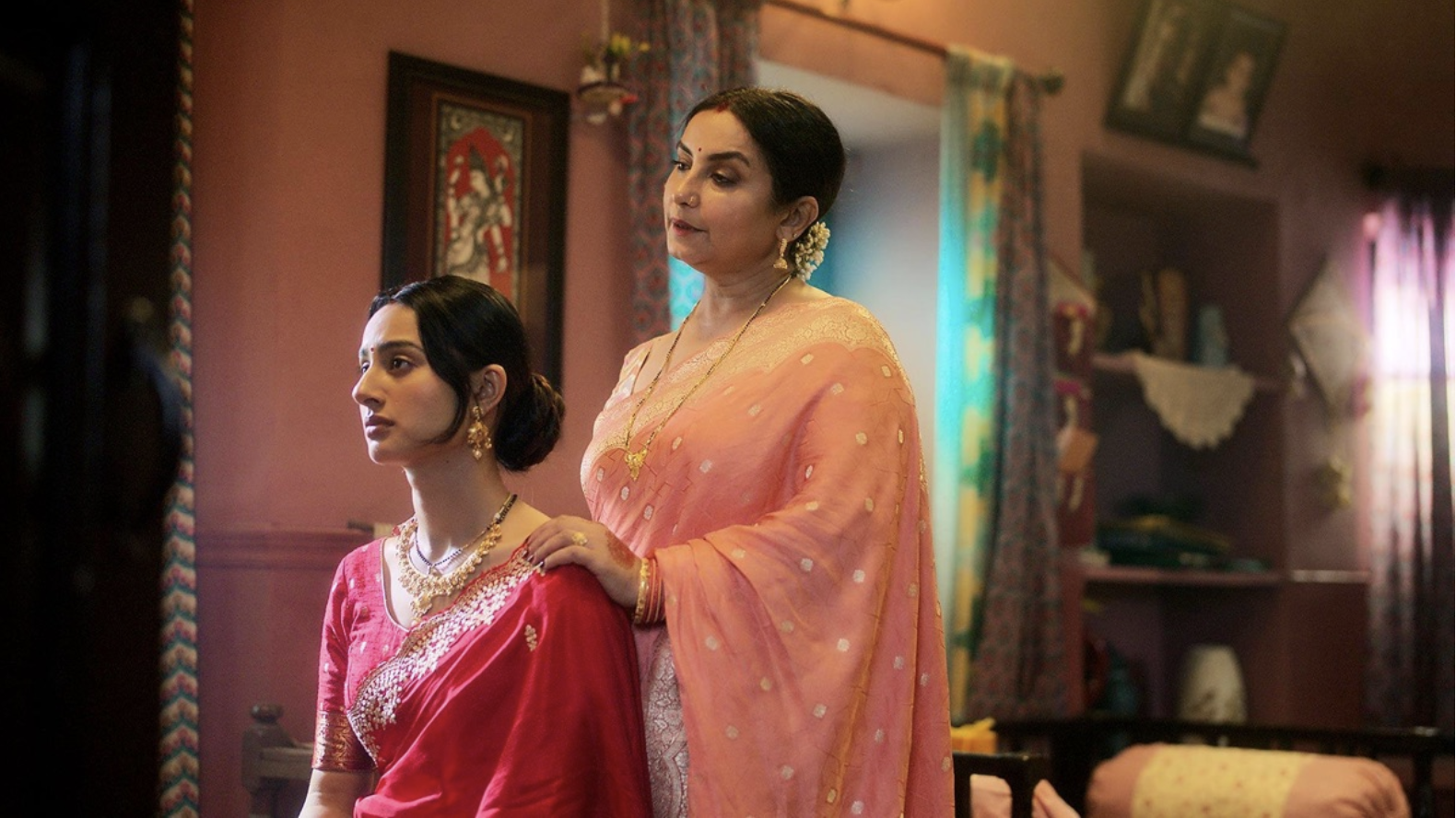
A woman wakes up around 4:00 A.M. and enters the kitchen. Half asleep and still tired, she begins cooking: parathas, eggs, tea, and other items as per the family’s wishes. She then wakes everyone up for sehri (the meal consumed before dawn by Muslims who are fasting for the month of Ramzan), and observes roza (fasting from dawn to dusk) herself. While everyone goes back to sleep after the morning prayers, she has to clean the kitchen and make breakfast for those who aren’t fasting.
Throughout the day, she has to care for the children and the elderly in the household, while she cooks, cleans, and observes her own fast and religious commitments alongside. If she works outside the home, she must also fulfil her obligations at her workplace. Iftar (the evening meal served to break roza) has to be a grand feast every day, bringing the family together around the dastarkhawn (a cloth on which food is laid out) after a full day of fasting.
While everyone enjoys the food, hardly anyone recognises the labour that goes into this process, let alone how all the work often falls on only one person. But the work doesn’t end here; it’s followed by rounds of cleaning, cooking dinner, serving food, and putting everyone to bed.
While she is the first to wake up, she is often the last to sleep after a long day of work. However, the same will happen again tomorrow and the day after that and so on. Who is this woman? She is you and me and countless other women toiling every day in their homes, without any recognition or equitable distribution of domestic labour.
Performing emotional, cultural, and culinary labour
The division of domestic labour is gendered, relegating women to the domestic sphere, wherein they are entirely responsible for the housework, caregiving, and affective labour. While today more and more women participate in paid work outside the home, they still have to do most of the unpaid housework, leading to a double burden and a lack of rest, sleep, and time for self-care.
However, this disproportionate burden is exacerbated during festivals. The romanticisation of Ramzan with its grand feasts, community gatherings, communal eating, and late-night markets conceals the everyday realities of the lives of Muslim women. Women who are responsible for preparing these elaborate spreads, enforcing a religious environment at home, and materially and emotionally enabling other members to observe their fasts, all the while fasting themselves.

The aesthetics of iftar form part of the tangible expressions of the social-religious performance. However, what facilitates this social performance is the unrecognised physical and emotional labour that women put into it, which is essential not only to maintain the ‘muslim family’, but also the community and religion. However, throughout this process, the women remain invisible.
The space, both physical and emotional, that religion can provide women to form social networks or friendships, which can enable their mobility and social reproduction, remains rather marginal.
While women and their labour are central to these socio-religious processes, this centrality of women within the community and social spheres is curiously absent. This leads to indiscriminate forms of oppression and exploitation in all spheres of existence, be that social, economic, familial, or even spiritual.
Feasts and gatherings also reinforce the public-private divide, which also restricts women’s mobility. While different sects follow different rules regarding women’s access to mosques, in a majority of cases, they are often denied access, citing infrastructural constraints. The space, both physical and emotional, that religion can provide women to form social networks or friendships, which can enable their mobility and social reproduction, remains rather marginal.
The religious underpinnings of unpaid domestic work
The experiences of sexual division of labour lead us to one question: How is such a skewed division governed and justified within a family or a community? The laws that govern our family or community lives are deeply marked by religious codes, or at least by the pretence of following such codes.
Subsequently, it is not uncommon for any system of law that exists today to have its foundations within highly racialised, colonial, imperial, and sexist theories. While the reason for this might differ from one system of law to another, based on the exact historical development and justification, one fundamental reason that can be traced through all of these systems is what Foucault later identified as pouvoir-savoir (power-knowledge). This posits that power and knowledge are not mutually exclusive. Those in political power define what is acceptable knowledge, and the knowledge they create reinforces who stays in power.
The disproportionate burden on women during Ramzan stems from an already existing sexual division of labour between men and women.
The disproportionate burden on women during Ramzan stems from an already existing sexual division of labour between men and women. When we examine religious justifications for such division, we must first note that in Islamic interpretation and theory-building, almost the entire corpus of tafseer (Qur’anic exegesis) is authored by male scholars.
It is rather unimportant to restate the patriarchal underpinnings of almost all societies across historical periods, which may have influenced the worldview of these scholars. Later Islamic muftis (legal experts who are most often men) use these interpretations to issue fatwas (ordinances meant to address problems the Quran and Hadith do not address directly), thus forming a continuous and coherent system of law that is disconnected from the lived realities of women.
If sweating in the kitchen is sawaab (returns for good deeds), why do only women receive such sawaab?
So what is the role of women in a household? Is she required to perform all the chores, or do men also have the same responsibility? If sweating in the kitchen is sawaab (returns for good deeds), why do only women receive such sawaab? In early Islamic legal thought, marriage was viewed through the lens of a transactional model where the wife’s primary legal obligation was sexual availability, not domestic service. Shafiʿī scholars in particular argued that a wife had no duty to perform housework because ‘what she had contracted to provide to her husband was sex’.
Other prominent jurists, including Ibn Qudāma and al-Shīrāzī, explicitly stated that ‘the object of the marriage contract is sexual intimacy; nothing else is required of her [the wife]’. While this notion itself is highly degrading to women because it reduces them merely to objects of sexual desire, it must be placed within the conceptualisation of sex itself within Islam, wherein the only legal avenue for sex is within marriage.
This position on housework is also reflected in the views of the second caliph, Umar. He noted that he bore his wife’s occasional ‘excesses’ because she voluntarily cooked, washed, and nursed, even though ‘she is not in the slightest degree responsible for this’. The Qur’an also clarifies that there is ‘no obligation on a mother to nurse or breastfeed her baby’, and if a mother chooses to fulfil this function, Qur’an (65:6) establishes that she is ‘entitled to payment from her husband for doing so’.
Religion, thus, becomes a smokescreen for recognition and redistribution of housework, care, and affective work.
We, therefore, find a fundamental difference between what has been prescribed, interpreted, and followed. Popularisation of religious piety in the form of unpaid work by women, which burdens and restricts them from social and political spaces, is a clear example of how knowledge and power construct each other. Religion, thus, becomes a smokescreen for recognition and redistribution of housework, care, and affective work.
The gendered experience of Ramzan
A reel about fasting during Ramzan, in which a woman discusses not being able to fast during menstruation, had a disparaging comment from a man claiming his mother fasted while on her period (people who are menstruating, pregnant, breastfeeding, receiving postnatal care, or are ill or travelling are exempt from fasting). This forces one to reflect not only on the gendered experiences of Ramzan but also on the unsaid obligations placed on women.
Men remain ignorant towards these experiences of women, which often stems from the stigma attached to discussing menstruation. Women, on the other hand, have to pretend to fast for the same reason. A person’s religiosity is also measured by their capacity to fast, pray, and engage in other religious practices. Thus, even when women are exempted from fasting, societal norms encourage keeping that fact hidden.
However, while women are exempted from fasting, labour is still expected of them. Women are still expected to wake up early to make sehri and prepare other meals. Such selfless and sacrificial behaviour is glorified, as in the abovementioned comment on the reel, and is also considered the epitome of religiosity.
Given the demands of unpaid labour placed on women, they have little time or energy to practise the core demands of their religion.
The month of Ramzan is characterised not only by fasting, but also as a time when believers practice discipline and spirituality, strengthen their bonds with the Almighty, engage in charity, and practice the sacrifice of nafs (greed). However, given the demands of unpaid labour placed on women, they have little time or energy to practise the core demands of their religion.
In such situations, the undue burden of housework and caregiving for the family is justified as being equally rewarding. Domestic work for women during Ramzan holds not just material but also spiritual significance. Often, the idea of sawaab is associated with women’s unpaid work, spiritually valorising such labour, which means efforts to distribute domestic labour more equitably are seldom made.
Authors’ note: While the purpose of this piece is to focus on the everyday experiences of women, particularly during Ramzan, we acknowledge the difficulties in achieving consonance between prescribed texts, the followed religion, and lived realities. Any such effort requires a thorough bibliography of original verses of the Quran and Hadith(s) that have been interpreted by different schools of thought. Hence, arriving at a single answer regarding the exact expectations of women in terms of domestic work in religious texts remains formidable and beyond the scope of this article.
About the author(s)

Tahseen Fatima is a PhD scholar at the Department of Political Science, University of Delhi. She has also been a research associate at the Centre for Labour Law and Advocacy, NLU Delhi. Her research interests include gender, labour, caste among Muslims, informality, and cinema studies.

Yameena Ahmad is a PhD scholar at National Law University, Delhi. She is an academic fellow at the Centre for Labour Law Research and Advocacy. Her interests lie in examining the aesthetics and invisibility of gendered work, migration, and gig work.