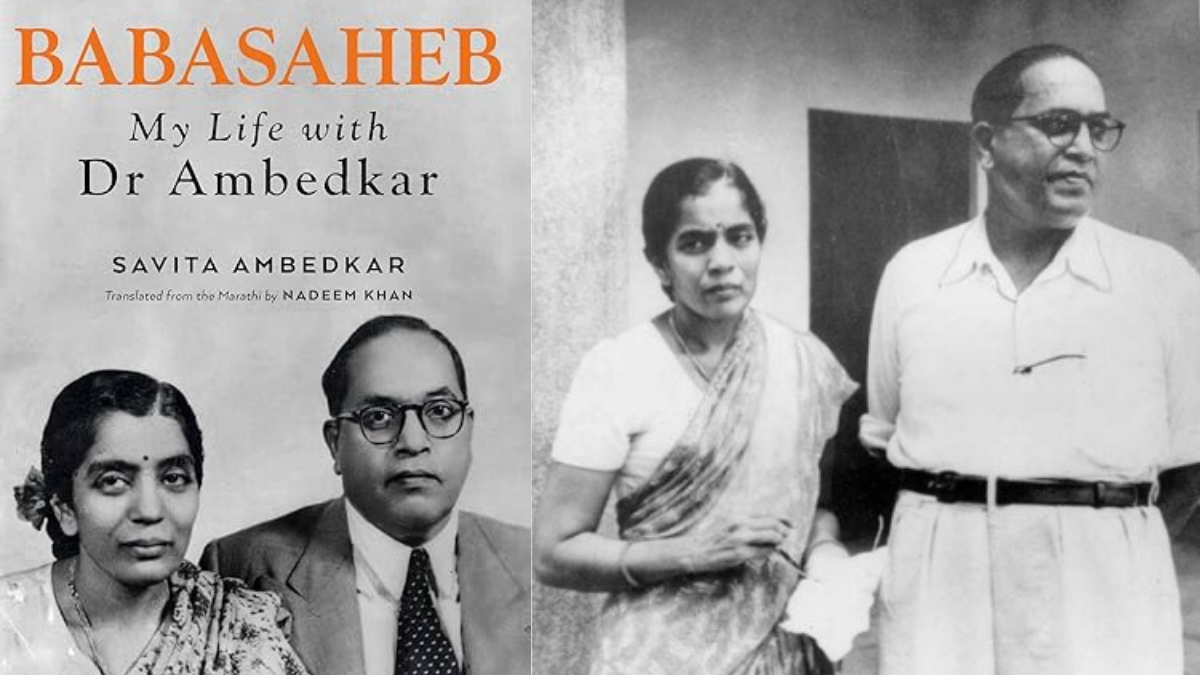
A plethora of writings on the life and work of Dr B.R. Ambedkar has discussed his scholarly and political legacy. Yet, most of them have never accounted for the labour of care that sustained his intellectual pursuits. Babasaheb: My Life with Dr Ambedkar (2022) is a deeply personal and intimate memoir written by his second wife, Savita Ambedkar, fondly called Maisaheb. It documents their relationship as well as the final years of Dr Ambedkar’s life, when his health took a turn for the worse. In doing so, it offers a poignant account of the round-the-clock care, labour and companionship she gave Dr Ambedkar upon becoming his wife. Further, in reflecting on her marriage to Dr Ambedkar, Savita candidly reveals the lesser-known details about her relationship with Dr Ambedkar and brings into view the love and care that shaped the last years of his life.
Savita Ambedkar’s Memoir
Savita Ambedkar was born Sharada Krishnarao Kabir in 1909, Mumbai, into a Saraswat Brahmin family. She was a medical doctor by profession. Her first meeting with Dr Ambedkar took place in early 1947 at the residence of S.M. Rao, another doctor who lived in Bombay. They got married soon after in 1948 and enjoyed a loving and fulfilling relationship till his untimely death in 1956. The text is a translation of her autobiography, Dr Ambedkaranchya Sahavasat (1990). It was translated from the original Marathi by Nadeem Khan and published by Penguin India in 2022. Notably, the book includes several previously unpublished personal letters exchanged between her and Dr Ambedkar, giving readers a glimpse into Dr Ambedkar’s late years, leading up to his death.
Savita’s memoir quietly resists her erasure from history – it is not simply a record of care, but is also an act of remembrance. As Dr Ambedkar’s health steadily declined, Savita assumed the role of his caregiver in an all-encompassing sense.
While public memory and popular culture alike have jointly showcased Ambedkar’s formidable political and intellectual contributions, Savita’s memoir quietly reveals a hidden, gentle dimension. Here, we encounter not only a man who single-handedly battled unimaginable discrimination and injustice day in and day out but also a man who suffered in silence — a man who had never known a mother’s love, a man who was ill, frail, vulnerable and utterly alone after the death of his wife and of four of their five children. Through Savita’s recollections, a new side of Ambedkar comes alive; a side profoundly broken by not only the prejudices and terrors of society but also by the brutality of life. Savita’s moving narrative does not diminish his stature – it deepens it. Her account is marked by a sense of respect and trust for Dr Ambedkar on every page – every word is imbued with love and mutual regard. The book is tinted with a shade of tenderness – the image of Ambedkar she paints holds together the public and the personal – the monumental personality and the deeply broken yet loving man.
Care, Companionship and The Labour of Love
When looked at through a feminist lens, the memoir has at its heart a form of labour that is both indispensable and persistently overlooked, namely the everyday labour of care. As Dr Ambedkar’s health steadily declined, Savita assumed the role of his caregiver in an all-encompassing sense. She was instrumental in Ambedkar being able to complete The Buddha and His Dhamma, as he himself acknowledged in an unpublished preface of the book (1956). The memoir, however, captures the gendered nature of Savita’s care labour and the ease with which it disappears from public memory and popular discourse. This labour is not incidental nor momentary – it is continuous, demanding, and almost always unseen, folded into the everyday in ways which alienate it from its political and economic significance. Even as we celebrate Dr Ambedkar’s life and work today, the care that went into making his work possible remains conspicuously missing. By recounting these experiences, the memoir subtly challenges the ways in which history is written and told. It questions what is often emphasised and, in the process, reveals what often goes unsaid. In rightly insisting that care is not peripheral but central, it reclaims a space for care labour that history has long rendered invisible.
Between Reverence and Suspicion: The Place of Savita Ambedkar
In Savita’s memoir, what emerges most strikingly is the quiet, relentless labour of care that made Dr Ambedkar’s last years peaceful and painless. Her care was not performed in an abstract or sentimental sense – it was ruthlessly exhausting, invisible, and undoubtedly physical. As his health worsened by the day, it was Savita who managed his medications, monitored his routines and provided him with endless emotional and spiritual support. Her labour was essential to Ambedkar’s intellectual and political contributions in his later years; yet, like most care labour performed by women, it far too often goes unacknowledged, obscured behind the life and work of her husband. By unmasking the ways in which care operates in everyday life – in gestures, in sacrifice and in quiet intimacy – Savita’s memoir compels us to rethink how we understand care labour. She, in her inimitably soft style, asks us to pay attention not only to what we achieve, but also to pay equal attention to what goes into making our achievements possible.
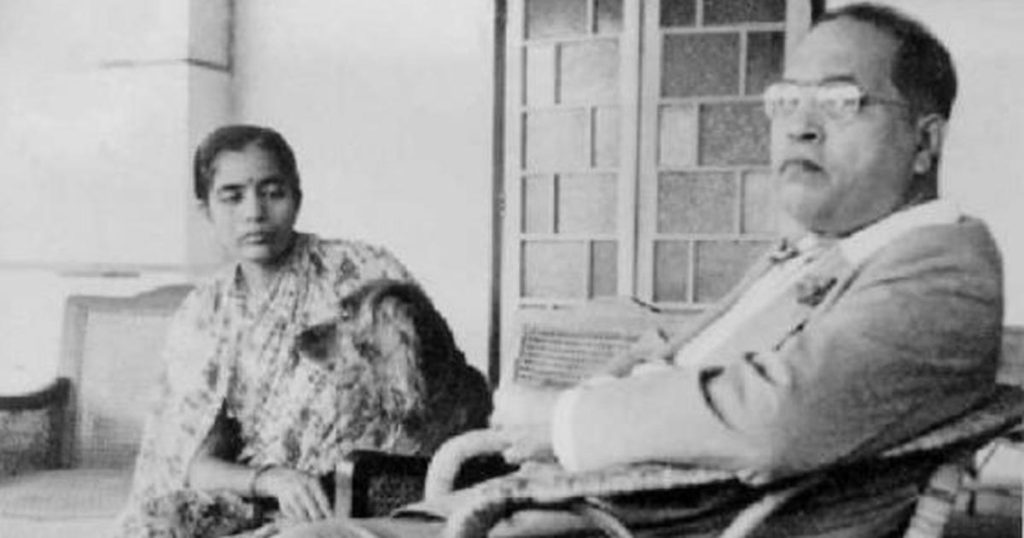
Savita’s memoir quietly resists her erasure from history – it is not simply a record of care, but is also an act of remembrance. In this sense, the book does more than recount events; it delicately yet incisively intervenes in the narratives around those events and clarifies her place in them. Her account is always keenly aware of her perception in public memory, dealing with her accusations of killing her husband on account of being a Brahmin, and her subsequent exclusion from the Dalit Buddhist Movement, to her re-entry into public life and the re-establishment of her (rightful) place within it. In this light, the memoir becomes more than a recollection of her life – it is a discreet assertion of reclamation and presence. It insists – as gently as the way she addressed her husband Raja – on her place within a history that has often refused to accommodate her version of her own story. As such, Savita does not redefine Ambedkar’s legacy; rather, she adds a never-before-seen texture and depth to it.
In the end, Savita’s text consciously encourages us as readers to reconsider not only how we remember Dr Ambedkar, but also how we picture those who stood beside him – the ones who are unfortunately absent from popular narratives, but just as essential in the making of the man as anyone else. The memoir does not seek to unsettle his legacy; rather, it gently draws our attention to the forgotten lifeworld that underscored the work of a man whose contributions need no discussion. Through its pages, the book takes us behind the scenes of Savita and Dr Ambedkar’s relationship, giving us a look into the constant care and devotion that goes into making a life of immense public consequence. In conclusion, the book leaves us with a seemingly simple yet enormously political question: whose labour do we choose to remember, and whose labour do the annals of history allow to evaporate into thin air? To this end, it is by centring the voices of those deemed insignificant and sidelined that we can arrive at a comprehensive understanding of care labour and better understand its gendered and often caste-centric dimensions. Only then, I argue, will we be able to appreciate its centrality to everyday economic and political life.
References:
Ambedkar, B. R. (1956). “Unpublished Preface”. Accessed 24 March 2026. https://franpritchett.com/00ambedkar/ambedkar_buddha/00_pref_unpub.html
Ambedkar, Savita. (2022). Babasaheb: My Life With Dr Ambedkar. Penguin Books. 2022.