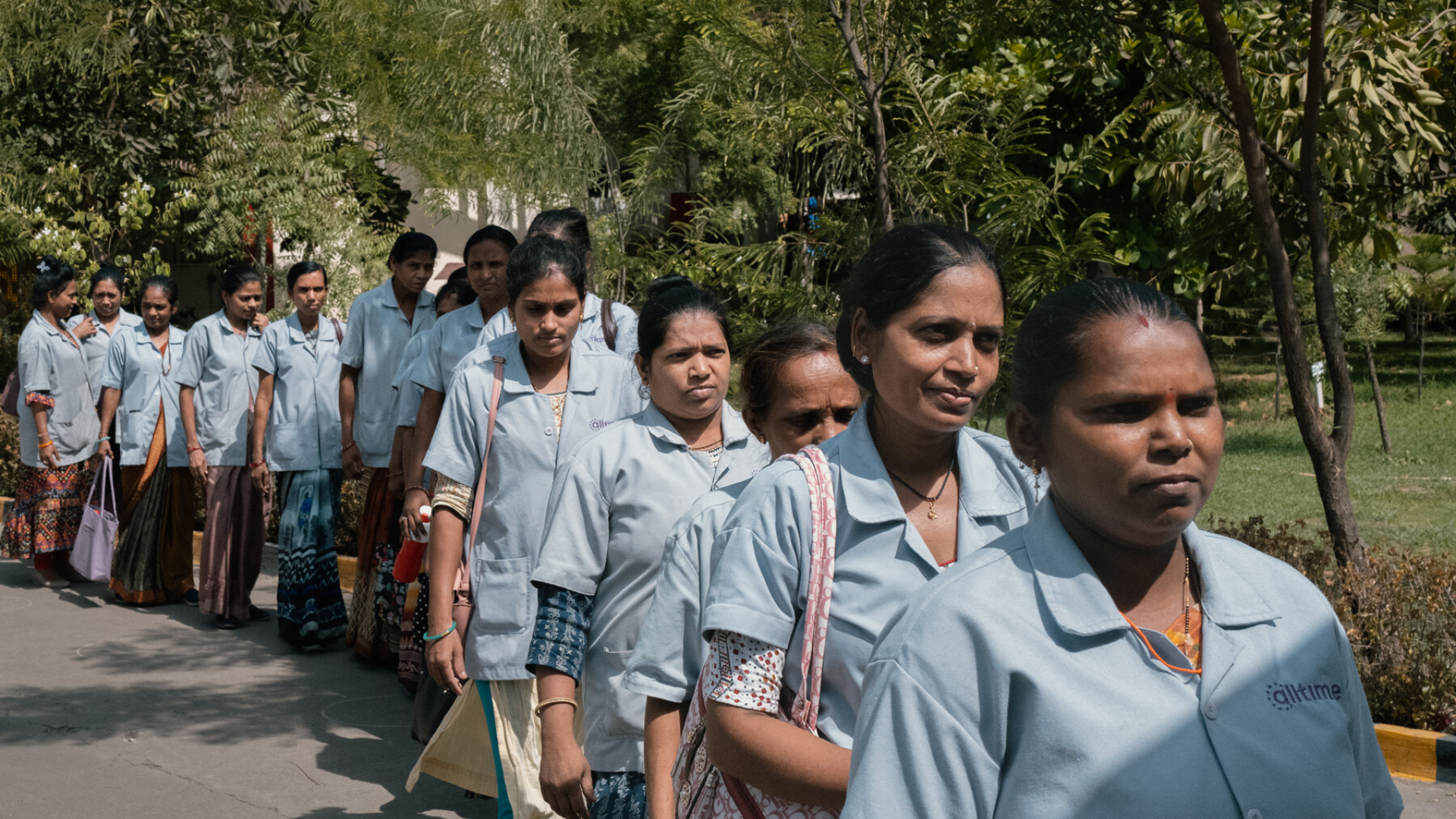
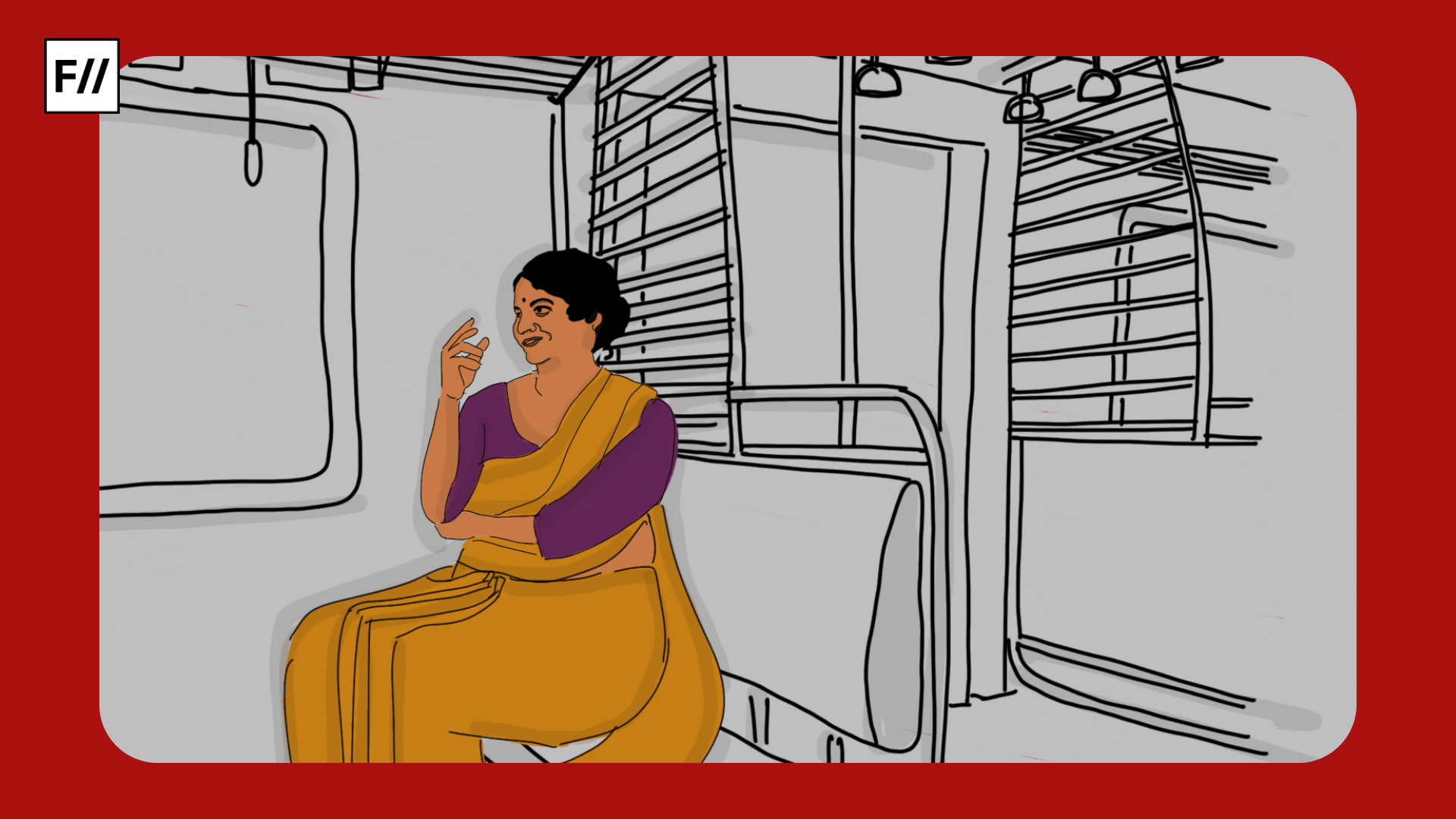
On a busy Tuesday morning in October in Bengaluru’s Attibele, the city is already awake. Among the hum of buses and noises of horns, Nagamma, a middle aged domestic worker in her bright pink saree, boards a bus around 6:30 in the morning with a small purse in her hand, sits at the corner seat of the bus and goes towards the first house where she works.
It’s a 30 minute commute for her. As the bus moves forward, she takes her phone out from the purse and scrolls through reels. ‘When I sit on the bus, I watch reels,‘ she says softly, not looking up. ‘That is when I get to rest my mind a little,‘ she adds.
Leisure as the Cambridge dictionary defines, is a time when you are not working or doing other duties. It is the time when you can relax. However, for women like Nagamma working in the informal sector, leisure looks very different from the conventional sense like a park stroll, an evening tea, or an hour of reading. It is a moment between chores, conversations with fellow women workers at the bus stop, or a few minutes of TV before sleep. Their days are unending, and their sense of time is not their own.
The International Labor Organization report (2021) notes that 81.8 percent of women’s employment in India is concentrated in the informal economy. The informal sector is often characterised by no formally recognised jobs, less or no social security, long working hours and the lack of a fixed schedule. In such a world, the idea of “free time” feels distant.
Everyday life without a break or leisure
Across the city, Shobha, 36, a fruit seller, arranged guavas at the back of a tempo parked near Sarjapura circle. She has never known a “holiday”. ‘For me everyday is a working day,‘ she simply says with a smile on her face. For a woman like her whose earnings are tied to daily sales, rest is a luxury that they can’t afford.
For a woman like her whose earnings are tied to daily sales, rest is a luxury that they can’t afford.
At the crowded Majestic bus stop in the afternoon heat of October, Ramadevi waits for her bus with four other domestic workers with a tiffin in one hand and her mobile in the other. They sit on the bench, talking, teasing and sharing snacks. ‘This is our time,‘ she says while laughing. ‘We talk and laugh here. Otherwise there is no time.‘
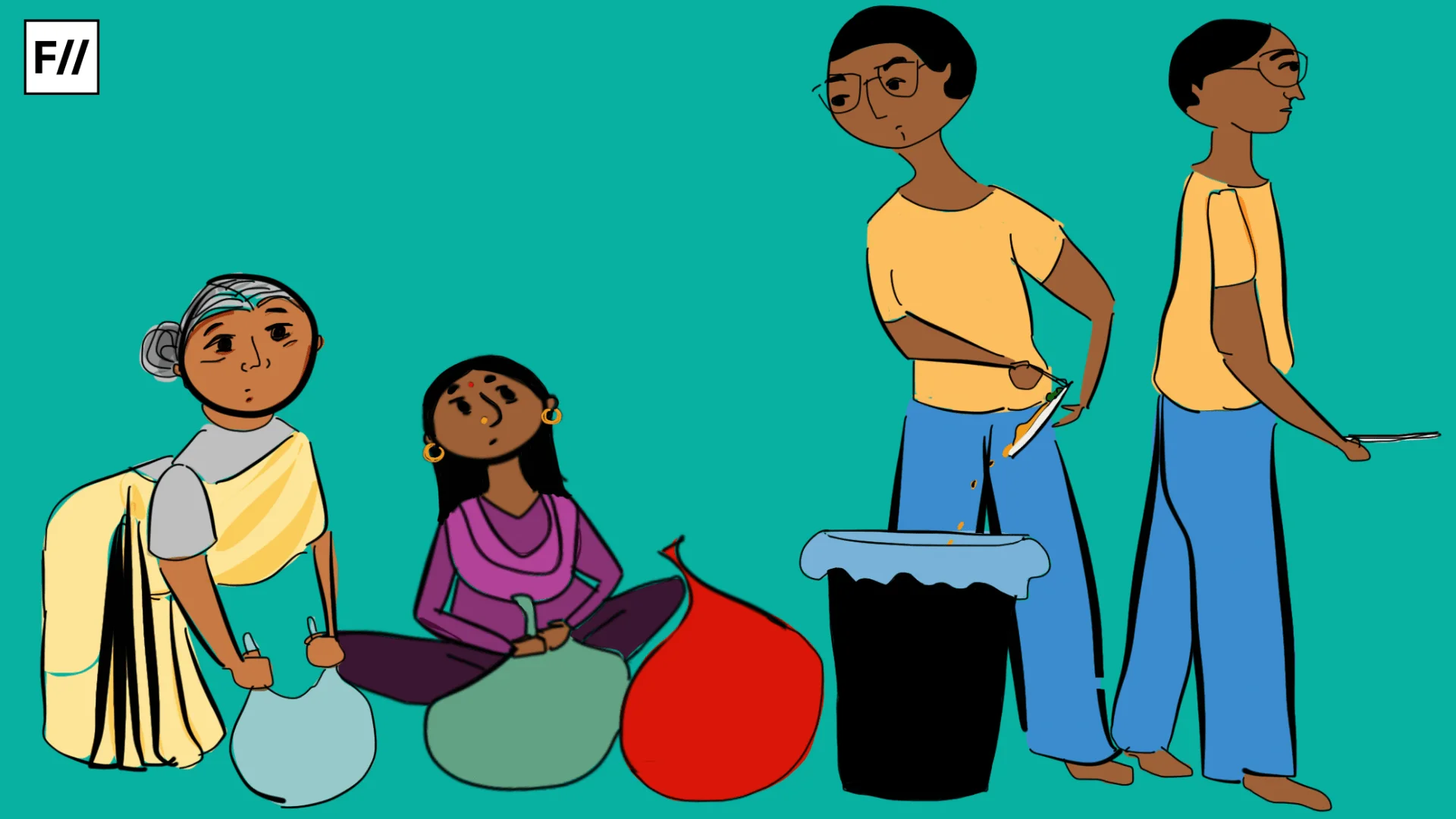
These stories reveal exhaustion but along with that they also show quiet adaptation to the denial of rest. Work and rest blur together. Their days are structured by necessity, not choice. The leisure happens not in separation of work, but in between cracks of it.
The double burden
Among the bright colours and fragrances of flowers at Bengaluru’s K.R. Market, one of Asia’s biggest flower markets, Devi Akka, in her early fifties, arranges garlands and flowers before dawn. The market comes alive at midnight, and by 2 a.m., she is already working.
‘Our day starts when it ends for others,‘ she says. By the time she returns home around 7 or 8 in the morning, the city is waking up. ‘My kids have to go to college, my husband goes to work. I still have to cook and clean. There is hardly any time for me to sleep, when will I watch TV?,‘ she says.
A few kilometers away, on a narrow road in Nayanda Halli, Gayathri, a 26 year old street vendor arranges the stack of cups, saucer and dishes on her blue tarpaulin sheet. ‘Even if we sit for a while, someone calls us for some work. There is always some work,‘ she says while gazing at the road looking for customers.
The Time Use in India Report of 2024 by the Ministry of Statistics and Programme Implementation reveals that women spend an average of 299 minutes per day on unpaid domestic and care work, compared to 97 minutes by men.
The Time Use in India Report of 2024 by the Ministry of Statistics and Programme Implementation reveals that women spend an average of 299 minutes per day on unpaid domestic and care work, compared to 97 minutes by men. Time is often interrupted or filled with invisible labour. Women juggle with employment and home responsibilities. This “double burden” hardly leaves them with some time for themselves. As sociologist Claire Vickery noted decades ago, women’s multiple roles create ‘time poverty‘ — long working days and impossible trade-offs.
Cities which exclude
‘Cities are built for men,’ says Shanthi, a domestic worker. ‘Parks are for men and children. Not for us,‘ she adds. Her words are echoed by Savita, a migrant construction worker from Bihar. There is a tea stall across her work site. ‘Sometimes I feel like going there and having tea and biscuits, but mostly men sit there. My husband told me not to go there.’
The National Annual Report and Index on Women’s Safety (NARI) 2025 released by National Commission for Women recorded 40% of women feel public spaces in urban areas as unsafe. Urban India promises opportunities and better standards of living but offers little space for women’s stillness. Public places feel unsafe and private ones are filled with unpaid labour.
Cost of constant work
‘Their lives move like machines. There is no life in their eyes.‘ says Geetha Menon, activist and founder of Stree Jagriti Samiti, a non profit working for collectivisation and rights of domestic workers. ‘Their bodies move, but their minds are tired,‘ she adds.
‘Sunday is the only day off,‘ says Yashodha, General Secretary of Munnade Social Organisation, a non-profit working for the wellbeing of garment industry women workers. ‘But even then they clean, cook, and do laundry. If there is time left, they watch TV or visit a temple on some rare occasions. That is their leisure.’
‘Their lives move like machines. There is no life in their eyes.‘ says Geetha Menon, activist and founder of Stree Jagriti Samiti, a non profit working for collectivisation and rights of domestic workers.
Article 24 of the Universal Declaration of Human Rights states that everyone has the right to rest and leisure, including reasonable limitation of working hours and periodic holidays with pay. Yet informal women workers rarely see that right reflected in their days. In their world, rest is not about recreation but about recovery.
Finding leisure in between working and waiting
As the afternoon sun shines overhead, the bus that carried Nagamma to work now carries her back. She slips through the crowd and manages to get her corner seat among the fleeting crowd, takes her phone out from her purse and scrolls through it. She scrolls by a funny video, a song, or a recipe and lets herself smile.

The bus slows down near her stop, she tucks her phone in her purse and stands up. The moment ends here.
For millions like her, leisure is a distant dream — a stolen pause between two labours, fragile and often unnoticed. Yet, in every pause and in every shared smile, lies an act of reclaiming the right to leisure.