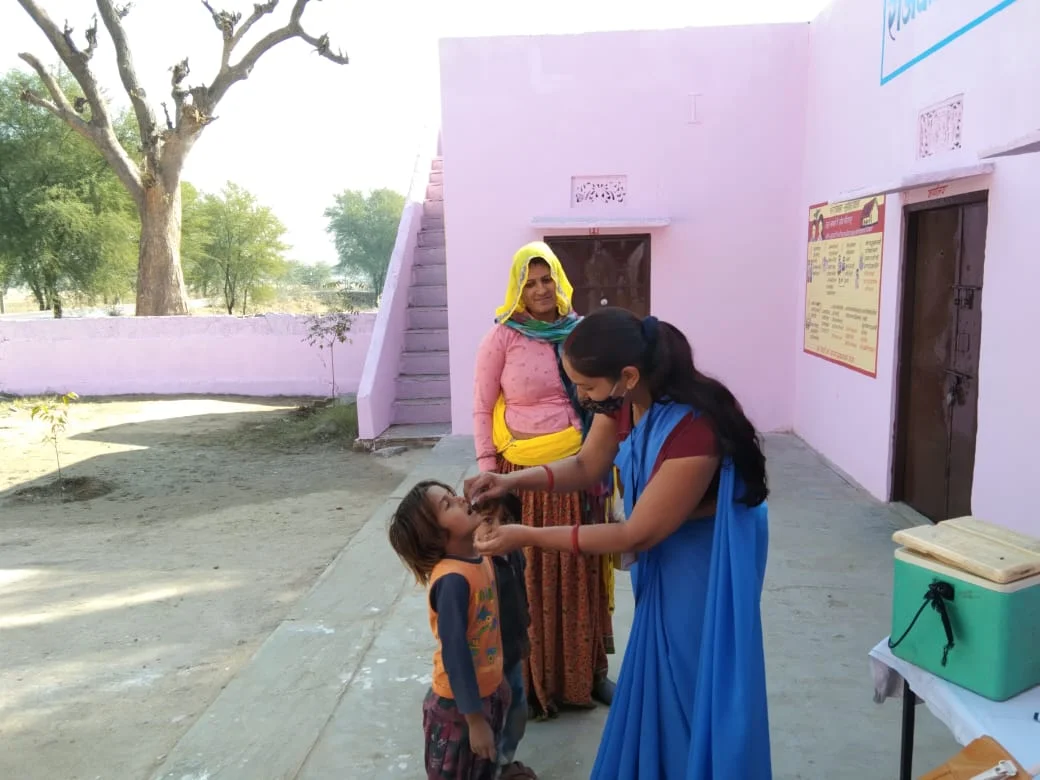
The last mile of India’s public health system is a women-run space. That is a reality which is largely consistent across India and recognised by the world. In 2022, at the 75th Global Health Assembly, ASHA workers received one out of six Global Health Leaders Awards. Today everywhere in India’s villages one can find ASHA workers – the first point of access to basic health services at the village level – promoting universal immunisation, counselling on antenatal and postnatal care practices, home-based care for newborns etc. Then there are the Anganwadi workers who as their name suggests are responsible for the Anganwadi Centre – a unit under the Ministry of Women and Child Development which is responsible for 5 key services – supplementary nutrition, non-formal pre-school education, immunisation, health checkups of pregnant, lactating mothers, growth monitoring of children under 5 and referral to health facilities.
The ASHA and the Anganwadi are two of the most vital elements of India’s public health system which connect communities to health systems and enable access to primary health-care services. They are the friendly neighbourhood ‘superheroes’ who want your child to eat better and grow into capable human beings who can contribute to their nation’s growth. Evidence from studies conducted by the Lancet has proved that community-level awareness work done by the ASHAs and Anganwadi workers has reduced neo-natal mortality by more than 30%.
The ASHA and the Anganwadi are the friendly neighbourhood ‘superheroes’ who want your child to eat better and grow into capable human beings who can contribute to their nation’s growth.
But unlike Superheroes, responsibility and power do not go hand in hand for our frontline heroes. While the webbed wonder had much power in his search for responsibility, ASHA and AWWs have more than enough responsibility but struggle for power every single day.
ASHA: The everyday struggle begins from day one
The problem begins at the root: women who assume these roles are under-trained and under-qualified for the work they are supposed to do. In major states, fundamental orientations and training do not take place regularly; the ones that do lack in quality of knowledge transferred or equipping workers with the skills they would require in their day-to-day. Additionally, as government abhiyaans and missions pile up, there is very limited scope for refresher training in an already busy calendar. Eventually, frontline workers are left to learn on the job, where rebuke, insult and at times even verbal abuse from supervisors or beneficiaries are rewards for a job not well done.
ASHAs and AWWs are essential in improving critical indicators like mother and child mortality, high-risk pregnancy, malnourishment and immunisation yet they also face the most severe lack in high quality equipment and infrastructure. Even light rains expose leaking roofs of Anganwadi centres where children come to get their education, immunisation and nutrition. ASHA kits run on poorly functioning thermometers, weighing machines and hope, while Anganwadi workers fight against malnutrition with non-functioning monitoring tools and an undersupply of meals and take-home rations. Despite this when an inevitable critical case comes up, frontline workers are first on the receiving end of fire from block and district-level officials who threaten to cut their marginal salaries. In the worst cases of mortality or lack of timely intervention, village-level workers face suspension and termination.
Searching for empowerment
It is true that while appointment to these roles makes them important stakeholders in the village, especially in matters of health, it still does very little for empowerment. Many who argue that incompetencies of front-line workers lie in an inherent lack of motivation and complacency give examples of success stories and celebrate ASHAs and Anganwadis who command a strong voice in their village, as they should. Yet they tend to miss that the small section of these workers who do command a stronghold come from families or sources that already enjoy a sense of empowerment in their region which grants them access to relatively better education and knowledge over their counterparts.
ASHAs and AWWs do a major portion of the brunt work in public health delivery which includes maintaining countless registers and surveys for important data points related to their work. While many posit their roles and work as empowering, the truth is that they do work which the men of the village consider themselves too superior for and which health officials consider too inconsequential. And yet despite this lack of reward in pay or promotion, quality equipment, training and most importantly dignity and respect, ASHAs and AWW save lives, spend out of their pockets to accompany mothers and critical children to hospitals, and walk across hamlets spread kilometres apart to visit a neonate who is at risk or check up on a mother who has not visited the Anganwadi for weeks. All this while they also look after their homes, cook meals, clean and manage expenses because, just like at work, if anything goes wrong at home, they would be first in the line of fire.
ASHA And Anganwadis: A united front
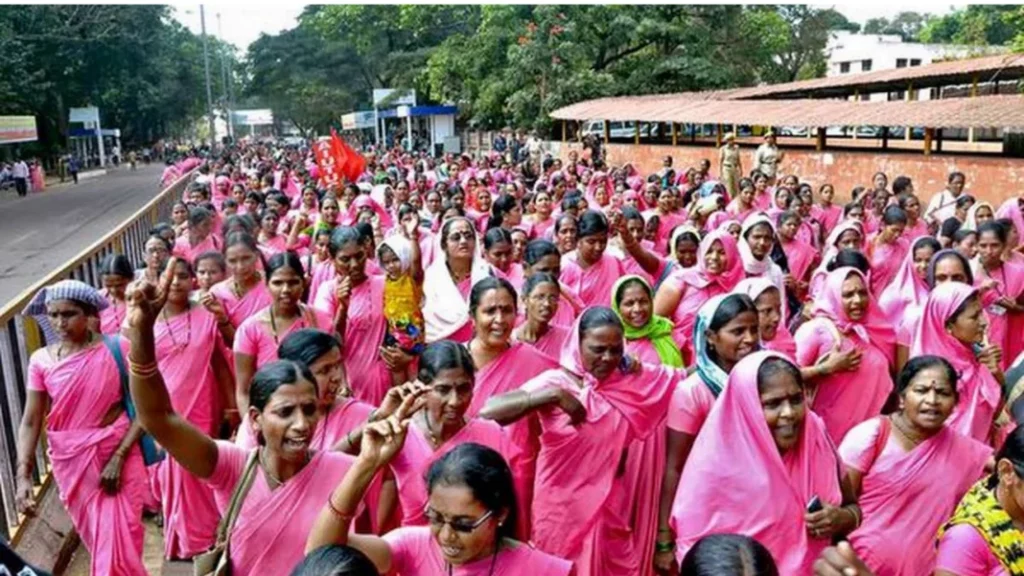
Eventually community health workers have to rely on their own for support in crucial times. These workers have strong unions across states and districts who regularly struggle for increases in pay, protective equipment, better infrastructure and most importantly fixed tenure. The recent 265 day strike of the Kerala ASHA workers union is an example of the sense of community that exists between ASHAs nationwide. Yet in many states such as Delhi, Haryana and Madhya Pradesh workers are also criminalised in their fight for justice. In many instances in Madhya Pradesh, ASHA workers were terminated for going on strikes, served show cause notices from block in-charges or district officials or had police cases filed against them.
For India’s community health workers adversity is not an exception but a defining feature of their professional lives. Lives that are marked by structural constraints and persistent challenges. The solution to their problems may not be a set of one-dimensional reforms but can start with something as simple as dignity of labour.
For India’s community health workers adversity is not an exception but a defining feature of their professional lives. Lives that are marked by structural constraints and persistent challenges. The solution to their problems may not be a set of one-dimensional reforms but can start with something as simple as dignity of labour.
To improve the state of our public health delivery, we must critically look at the state of our frontline workers. The system at the end of the day is only as good as the last person who is responsible to administer it and be its ambassador. Currently it is powerless, unskilled and suffers from a critical inadequacy. Which is why the last mile of public health delivery would always be “women-run” and not “women-led” until ASHAs and AWWs are given better wages, structures of promotion, equipment and capacity building through rigorous training. Spiderman’s powers had Tony Stark to support him with his multi-billion dollars’ worth of assets; we can perhaps start by giving our superheroes some power, dignity and benevolence for their truly life-saving work.
About the author(s)

Tusshar Yadav is a writer and a development practitioner with experience of working in maternal and child care systems, public health and agriculture across the tribal hinterlands of Madhya Pradesh and Marathwada region in Maharashtra. His writing draws from the people he meets everyday.