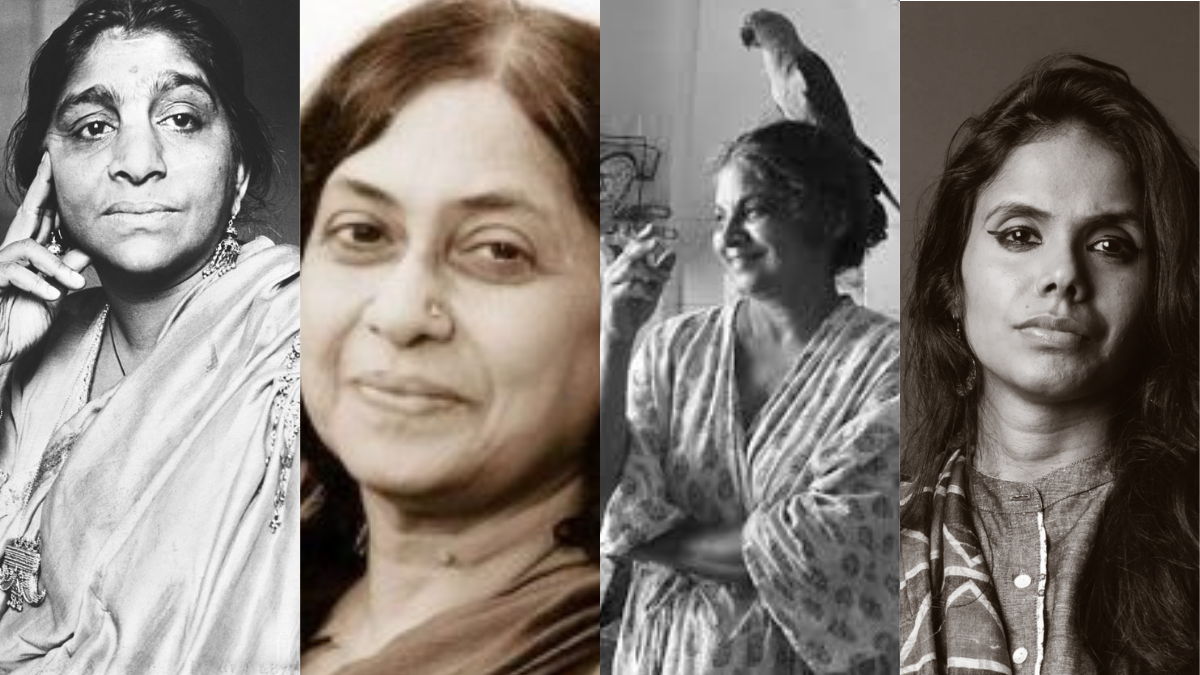
The evolution of feminist thought in India can be traced through the writings of female writers who, whether consciously or not, carried the spirit of their epoch into their writing. This essay situates the feminist thought in the Indian context through four major female writers: Sarojini Naidu, Kamala Das, Eunice De Souza and Meena Kandaswamy. Read together, their literary work maps the journey of Indian feminism from struggle for visibility to an explicitly intersectional feminism.
Sarojini Naidu, writing in colonial India, embodied the spirit of colonial India’s reformist feminism. Her work is often remembered more for her political career and lyrical style than its feminist thought. The patriotic and nationalist themes prevalent in her poetry overshadow subtle feminist undercurrents which possess her poetic thought. The poetry of Sarojini Naidu isn’t overtly feminist in its portrayal. Her poems are not overtly confrontational and don’t foreground gender politics or dissect patriarchy in the way contemporary feminists do.
At times, however, her poetry touches on controversial themes that require critical reflections. Palanquin Bearers, for instance, romanticises the image of a young bride. When read against the backdrop of colonial India where social reforms sought to increase the age of marriage after the demise of numerous girls subjected to child marriage, such romanticisation becomes complicated. Naidu, was, in many ways, a product of her epoch.
However, it is to be noted that the expectation of finding overt rebellion in the writing of a pre-independence woman is futile. Instead, it is the job of the critic to find the subtle nuances of feminism in the text. In colonial India, the very act of writing and publishing as an Indian woman carried feminist weight. Sarojini Naidu broke away from the domestic space and entered into ‘the world of men’ to conquer achievements that were closed off to most women.
Her poetry frequently relied on feminine imagery and the recurring image of Mother India or Bharat Maata led to feelings of patriotism towards the feminine. She uses this imagery to subtly re-center womanhood within the independence struggle. In poems such as Pardan Nashin, she used her pen to condone the practice of purdah and gave voice to those hidden behind the shadow of the veil. While she may not fit the modern intercultural definition of the word ‘feminist’, she reflects an early stage in the struggle for women’s visibility and participation in public life.
Kamala Das, in contrast, captures the spirit of post-independence feminist thought. Her poetry situates itself within the climate of ‘free love’, making the reader aware of a new acceptance of female sexuality and a more overt rebellion against patriarchal norms that emerged after independence. She often writes of a desire to assert, dominate, and conquer—an emotional and sexual intensity that feels absent in colonial women’s writing.
In poems such as Composition and Substitute, her assertion of sexual freedom presents the image of a woman who has explored her sexuality openly and without apology. Yet this exploration does not erase her longing for emotional security and domestic fulfilment. In I Shall Some Day, she reveals an undercurrent of uncertainty about sexual freedom and expresses a desire for monogamous marital bliss.
Thus, although Kamala Das departs from the confined themes of colonial writing—domesticity, nationalism, and social reform—her poetry remains shaped by its historical moment. Women were granted greater space for personal expression and rebellion, but they continued to be judged through the lens of marriage. This tension produces the central contradiction in her work: a bold claim to autonomy alongside a persistent longing for marital stability.
Eunice de Souza, through her poetry, breaks away from this tradition and instead writes about the possibility, and even the relief, of being unmarried and self-defined. In Marriages are Made, she sharply criticises the arranged marriage system, shining a light on how a woman’s worth is assessed and negotiated as if she were a livestock in a marketplace. She questions the transactional logic behind marriage and the idea that a woman’s identity must be tied to her husband.
Her poetry symbolises the modernist feminist struggle for visibility without the validation of a male partner. Her poem Advice to women, contextualises the need for more overt social reforms where women carve out a space for themselves as independent individuals. Her poetry, therefore, offers a glimpse into a modern feminist movement that centres the woman as an autonomous being, existing not in relation to a man, but in her own right.
However, contemporary feminism places strong values on intersectionality. Although earlier writers touched briefly towards the layered forms of oppression, it is in the poetry of Meena Kandasamy that Indian feminism moves away from the largely Savarna framework into an intersectional one. Her poetry allowed for the visibility of the struggle of Dalit women and foregrounds the experience of living outside the privileges of upper-caste Hindu identity.
Kandasamy’s poetry identifies with the contemporary understanding of feminism that recognises the multi-layered hierarchies within the feminist movement. In her poems like Touch and We Will Rebuild Worlds, she sheds light onto the double marginalisation faced by Dalit women in India. By centering caste alongside gender, her writing expands the scope of feminist discourse and insists that any meaningful feminism must account for these layered realities.
By tracing the poetry of these four writers within their respective time periods, the evolution of feminist thought in India becomes glaringly visible. The poetry of Sarojini Naidu grapples with representation and visibility for women within male dominated public and political spaces. Kamala Das, in turn, reclaims bodily autonomy from the hands of the patriarchal society who denied women sexual autonomy, while simultaneously engaging with the concept of free love. Yet, her work remains marked by the shackles of marital expectations put upon women.
It is through the poetry of Eunice De Souza that the inevitability of marriage is rejected firmly. In her work, the woman emerges as an independent being who doesn’t need a male figure to reaffirm her identity. However, these feminist positions, though significant, largely operate within the boundaries of caste privilege and do not fully engage with the lived realities of Dalit women. Meena Kandaswamy shines a light onto the experiences of Dalit women and in turn, articulates a feminism that is layered, political and deeply intersectional.
Thus, although these four writers belonged to different generations and never shared a common space, their works remain deeply interconnected. Together, they chart the shifting contours of feminist thought in India, each building upon and complicating what came before.
References
- Women before Feminisms: Contextualising Sarojini Naidu
- The Intersection of Nationalism and Feminism in Sarojini Naidu’s Poetic Vision: A Narrative Research Approach
- Modern Indian Poetry in English


Amazing writing.. very beautifully established the relation between four different era…