The year opened with yet another theory about why women are raped or should be raped or even better behave when the said crime is being inflicted upon them. In short drop, roll and play dead. Or even better, enjoy. In January 2026, Madhya Pradesh Congress MLA Phool Singh Baraiya offered what he called his “theory” of rape. Women from Scheduled Castes, Scheduled Tribes, and Other Backward Classes are raped, he claimed, because religious scriptures promise “spiritual merit” to men who violate them.
“If a man cannot go on pilgrimage,” Baraiya explained in a media interview, “it is said that if you engage in sexual relations with their women, you will receive the same merit. So what will such a person do? He will try to catch them in the dark.”
He went further, claiming that “a man cannot rape a woman” and attributing even the rape of infants to this supposed religious motivation. “That’s why four-month-old and one-year-old girls are raped,” he said. “He does it for a reward.”
The backlash was swift. Chief Minister Mohan Yadav condemned the statement. BJP leaders called it “anti-Dalit thinking.” Even Baraiya’s own party distanced itself. But the performance of outrage obscures a more uncomfortable reality: Baraiya didn’t invent this logic. This thought has long functioned as an open secret in Indian politics, that rape is not an aberration to be condemned, but a tool to be deployed and appropriated for political benefit.
A disturbing pattern of normalisation
Baraiya is hardly alone. India’s political class has historically normalised justified, or trivialised sexual violence. In 2014, Samajwadi Party leader Abu Azmi declared: “Rape is punishable by hanging in Islam. But here, nothing happens to women, only to men. Even the woman is guilty.” His party colleague Mulayam Singh Yadav went further: “Boys commit mistakes. Will they be hanged for rape?“
In 2012, as protests erupted after the brutal gang rape and murder of Jyoti Singh in Delhi, spiritual leader Asaram Bapu blamed the victim: “The girl should have called the culprits brothers and begged before them to stop. This could have saved her dignity and life.”
In 2012, Haryana’s Dharamvir Gandhi claimed that “90% of rape cases are consensual,” as if consent could coexist with force, as if the very definition of rape hadn’t already settled that question. In 2014 Chhattisgarh’s then-Home Minister Ramsewak Paikra offered this gem: “Such incidents do not happen deliberately. These kinds of incidents happen accidentally.” Accidentally. As if rape were a car crash, an unfortunate collision of bodies rather than a deliberate act of violence.
RSS chief Mohan Bhagwat took a different approach in 2013, locating rape not in patriarchy or power but in geography. “Such crimes hardly take place in Bharat, but they occur frequently in India,” he said, carving the country into moral territories where the “real” India, the rural, the traditional, remained pure while the urban, the modern, the Westernised India became the site of degeneracy. West Bengal Chief Minister Mamata Banerjee, meanwhile, simply dismissed the problem altogether in 2012: “I have my doubts about the alleged rape cases. Some are true, some are false.” Doubt as default. Disbelief as policy.
Perhaps most chilling was former BJP MLA Raghvendra Pratap Singh‘s 2025 statement where he promised jobs to Hindu men who “bring ten Muslim girls and make them Hindu,” explicitly framing the abduction and forced conversion of Muslim women as a reward-worthy act. “In exchange for two (Hindu girls), people bring at least 10 Muslim girls… How many young men are ready? Raise your hands.” These aren’t slips of the tongue. They reveal a deliberate normalization of sexual violence as a political instrument.
Religious foundation of violence
Religious texts are often invoked to justify violence against women’s bodies. These hierarchies and scopes are created by religion itself. The Manusmriti, an ancient Hindu legal text that still shapes contemporary social attitudes, doesn’t just acknowledge rape, it categorizes it. Different punishments for sexual violence depending on the caste of perpetrator and victim. A hierarchy of whose bodies matter, whose violation counts as crime.
The framework doesn’t accidentally permit sexual violence against marginalized women, it systematizes it. Rape stops being a crime and becomes a caste prerogative. A feature, not a bug. When rape is framed as spiritual duty, as merit-earning act, the woman ceases to be a person whose body and consent matter. She becomes territory. A means to an end. Simultaneously, this framing normalizes the violence itself, not as aberration or breakdown, but as inevitable. Natural. Part of how things work.
When rape becomes scripture, it stops being something to prevent. It becomes something to accept, to manage, to look away from. And accountability? That becomes blasphemy. To demand justice for these women is to challenge not just individual perpetrators but the entire ideological scaffolding that makes their violation possible, even permissible. This is how sexual violence becomes political strategy, how it gets dressed up in the language of tradition and duty while functioning as pure, calculated terror.
When rape becomes scripture, accountability becomes blasphemy.
The intellectual blueprint
The ideological foundation for rape as political strategy was laid decades ago by Vinayak Damodar Savarkar. In his book ‘Six Glorious Epochs of Indian History’, written before his death in 1966, Savarkar didn’t just justify sexual violence against Muslim women, he prescribed it. Openly. As legitimate political retaliation.
Savarkar criticized Maratha ruler Shivaji for his “perverted chivalry” in returning the daughter-in-law of a defeated Muslim governor. He imagined “the souls of those millions of aggrieved women” urging Hindu rulers to ensure “Muslim women too, stand in the same predicament in case the Hindus win.”
His message was explicit: “If they had taken such a fright in the first two or three centuries, millions and millions of luckless Hindu ladies would have been saved all their indignities.”
From theory to practice: the Kathua horror
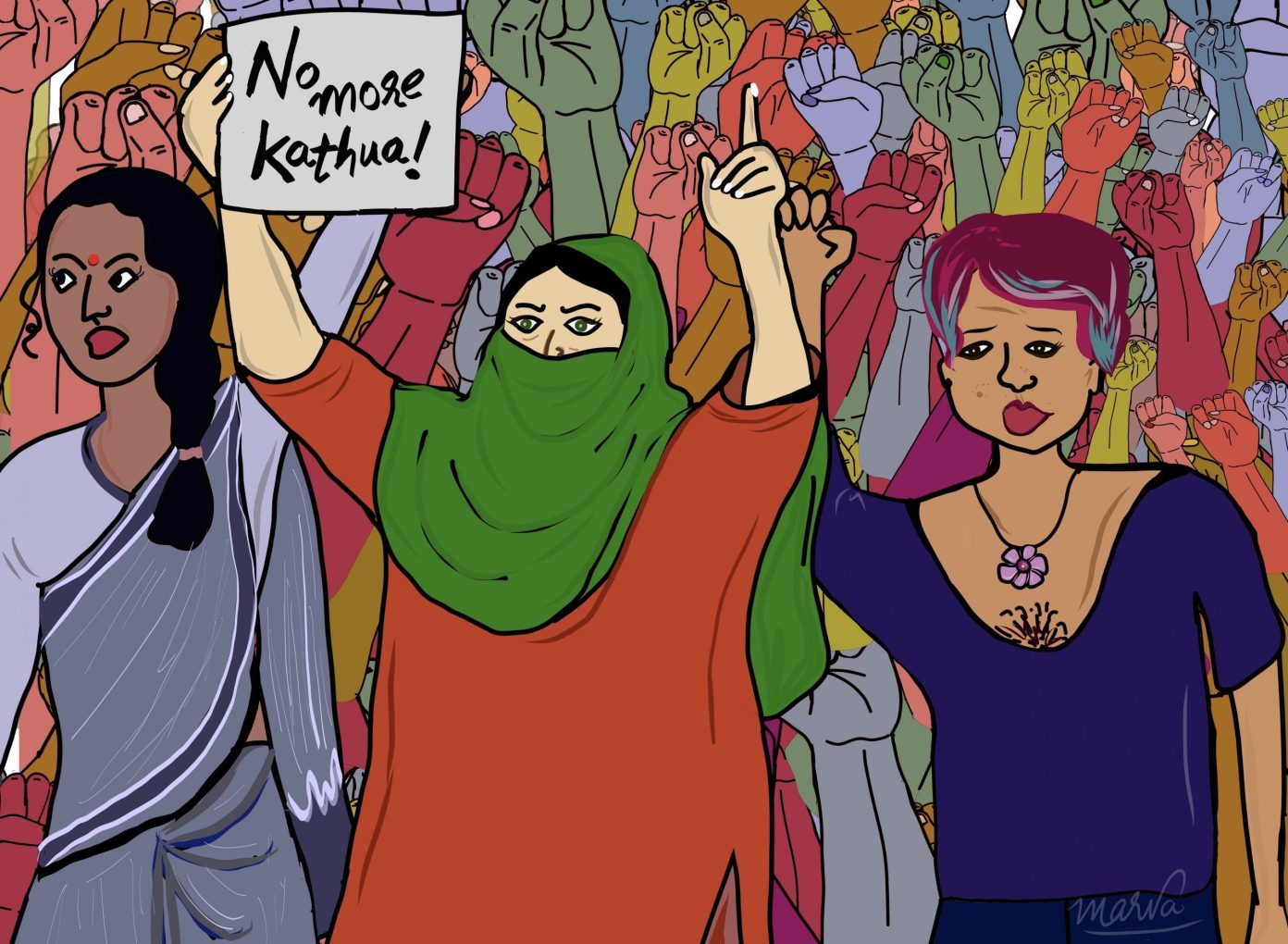
This ideology found brutal expression in the 2018 Kathua case. An eight-year-old Muslim girl from the nomadic Bakarwal community was kidnapped, held captive in a temple, gang-raped over several days, and murdered.
The charge sheet was explicit about motive. The accused “were against the settlement of Bakarwals” and had “discussed this issue…to chalk out a strategy for dislodging the Bakarwals from the area.” The community believed “Bakarwals indulge in cow slaughter and drug trafficking.”
What followed was equally revealing. Thousands marched demanding the release of the accused, organized by the Hindu Ekta Manch and attended by BJP state ministers. It took Prime Minister Modi four months to issue even a general statement.
Meanwhile, the girl’s family was threatened into silence. When they tried to bury her body, locals blocked them. They had to take her remains to another village. Some community members fled early for the mountains, understanding the message.
As scholar Mariya Salim wrote: “To turn a blind eye to the events that took place before and after her murder and to her belonging to the Bakarwal nomadic minority would be grossly unfair.”
The political utility of sexual terror
Sexual violence serves specific political functions that other forms of violence cannot and it accountability is even more complex.
In Kathua, the goal was displacing the Bakarwal community. Rape makes land uninhabitable for those you wish to remove. When women are assaulted during riots, entire communities receive the message that they are vulnerable, that the state will not protect them. As activist Ajna Jusić, herself born of wartime rape in Bosnia, observed: sexual violence is “the cheapest weapon of war.”
Leaders who defend accused rapists signal to their base which lives matter. This creates solidarity through shared transgression. From Savarkar’s obsession with population ratios to contemporary “love jihad” rhetoric, anxieties about women’s sexuality fuel political projects.
The evidence is in the impunity. Of 20,000-50,000 women raped during the Bosnian war, fewer than 1,000 have received official victim status. In India, not one suspect in the 2013 Muzaffarnagar gang rapes remains behind bars.
Beyond performative outrage
When BJP leaders condemned Baraiya’s statement as reflecting “Congress’s anti-women mindset,” they engaged in political theater. Their own ministers stood with Kathua protesters. Congress suspended Baraiya but didn’t expel him.
The bipartisan outrage is performative. The structure is permanent.
After hashtags trend and candles are lit, what changes? The ministers who protested in Kathua weren’t expelled. Baraiya explained his remarks but kept his seat. The systems that enable this violence, the fragmentation that prevents accountability, the calculations that treat certain victims as expendable, the ideological frameworks that justify rape as strategy, remain intact.
The real question
The question isn’t whether Baraiya’s remarks were offensive. We already know they were. The real question is why, in 2026, a sitting MLA feels comfortable constructing elaborate theories about why certain women deserve to be raped. Why he can invoke religious scriptures, demographic anxieties, and caste hierarchies without fear of real consequence. Why the outrage cycle, predictable as it is, changes nothing.
Because here’s what happens every single time: Initial shock. Condemnation from all sides. Hashtags trend. The politician issues a clarification or gets suspended, not expelled. Media moves on. And the structures that enabled him to say it out loud, the ideological foundations that made his “theory” legible as theory rather than incitement to violence, all of it remains. Intact. Celebrated, even.
As Ajna Jusić notes about Bosnia’s fragmented state, “Most of the affected women are still far from receiving compensation, reparations, or recognition as a victim.” The same holds in India, where fragmentation and polarization make accountability nearly impossible.
When politicians theorize rape in religious terms, when thousands rally for accused rapists, when leaders remain silent, choosing to name the violence becomes not documentation but resistance.
If we don’t defend the right to call rape what it is, a political tool with ideological lineage and structural enablers, we risk normalizing a country where sexual violence isn’t an exception to condemn, but a virtue to celebrate.
The cost of silence is always higher than the cost of speech. In this moment, when violence is made into virtue, insisting on justice for all victims, regardless of faith or caste, becomes the ultimate dissent.
About the author(s)

She/they is an editor and illustrator from the suburbs of Bengal. A student of literature and cinema, Sohini primarily looks at the world through the political lens of gender. They uprooted herself from their hometown to work for a livelihood, but has always returned to her roots for their most honest and intimate expressions. She finds it difficult to locate themself in the heteronormative matrix and self-admittedly continues to hang in limbo

You have forgotten to mention use of rape at large genocidal events like 1984 killings of Sikhs in North India.