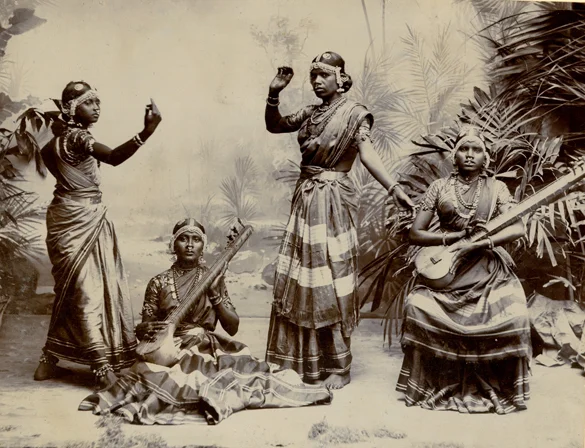
In Tamil Nadu, generations of women lived ritual, music, and dance lives, especially in the temple towns. As the name suggests, Devadasis (also known as servants of the gods) were committed to serving the temple and used to sing, dance, and fulfil ritual obligations as a form of religious worship. The Devadasi institution is said to have been in existence since at least the 9th–10th centuries and the job of the temple women was defined as doing the rituals, singing devotional compositions and dancing during temple celebrations and at the court of the royals.
Devadasis were not only performers but also the repositories of artistic knowledge in the temple centres like Thanjavur, Kanchipuram and Chidambaram. They were trained in classical music, poetry and even dances like Sadir, which became the precursor of what later came to be known as ‘Bharatanatyam’. These women were usually members of matrilineal groups in which property as well as artistic knowledge was transferred between the mothers and the daughters, and this provided them with a sort of economic independence that was not usual for many women in the precolonial society.
The Devadasi women played intricate roles in South Indian society for centuries. Most of them were regarded as nityasumangali, women who were always fortunate because they were married symbolically to the deity and consequently never remarried.
However, there is very little written record of the lives of the vast majority of Devadasi women and their personal histories. The names of temple servants and sometimes the gifts donated by them appear in temple inscriptions; however, the personal speech of the women is seldom preserved in writing. Rather, the remnants of their pasts survive in the discourse of the oral, family heritage, and performance arts through the generations. This omission is not just by chance. Historical records in South Asia tended to favour royal histories, “upper-crust” male academicians and colonial rulers. Even the women of artistic groups, including the ones subsequently socialized against by social reform movements, were seldom thought worthwhile subjects of formal historical account. This creates a paradox because despite how much the Devadasis were at the heart of cultural life in temples and courts, their own experience is still scarcely visible in traditional historical archives.
Revered artists to social stigma
The Devadasi women played intricate roles in South Indian society for centuries. Most of them were regarded as nityasumangali, women who were always fortunate because they were married symbolically to the deity and consequently never remarried. Their art was part and parcel of the temple festivals and royal rituals and temple inscriptions, terming ‘Devadasis’ as patrons of the religious establishments and as sponsors of the cultural life.
But this state of society started to change in the late nineteenth and early twentieth centuries under the combined influences of colonial morality and Indian social reform movements. The British colonial administrators characterized the Devadasi ways with the Victorian morality involving the act of prostitution. Indian reformers, especially those of the new urban middle classes, started to campaign against the Devadasi system, which they trumpeted as a symbol of social decadence.
Such campaigns witnessed numerous legal reforms in the twentieth century, which eventually led to the abolition of the practice of dedicating women to temples. Although these reforms were to solve the issue of exploitation and gender inequality, their result was also a backfire where the whole colonies of Devadasi artists were deprived of both occupations and social connections.
Meanwhile, the dance culture related to Devadasis was radically changed. The temple dance Sadir was revamped and renamed Bharatanatyam and introduced as a classical dance suitable for performance on a modern stage. Paradoxically, as this form of dancing gains international recognition, the groups of women who have kept the dance alive over the centuries tend to be pushed to the periphery of history.
Between memory and archive
Although this historical erasure has persisted, we have some insights on the personal lives of some Devadasi women through the occasional historical documents and oral records. A representative of them is the famous Carnatic musician and cultural campaigner Bangalore Nagarathnamma, who lived at the beginning of the twentieth century. Nagarathnamma was born in a household of Devadasi and stood out as a key music patron and helped in the creation of the Tyagaraja Aradhana festival at Thiruvaiyaru. She was also a champion of women performers playing in a musical arena that had become a male-dominated field.
A less famous personality is Kumbakonam Balamani, who originally was a Devadasi and later came on to perform in the first theatre in the early twentieth century. Balamani created a theatre company of all women who gave jobs to the ex-Devadasis whose means of living had been taken away through social reform laws. Her dramatics and entrepreneurship show the way in which Devadasi women went with the evolving economic culture in colonial India.
Likewise, Kumbakonam K. Bhanumathi, who was born in a family of Devadasis, preserved the dance traditions of performers in temples even in the twentieth century and was honoured with the Sangeet Natak Akademi Award. Her work is the transitional point whereby hereditary performers tried to maintain their artistic cultures in the newly institutionalized world of classical dance.
Some of the Devadasi performers who were members of the early twentieth-century dance and music establishments were also recorded historically. Already in the 1930s, dancers like Varalakshmi, Saranayaki, and Sabharanjitham, as well as artists like Tirunelveli Muthurathnambal, were performing classical dance in cultural institutions in Madras. But there is very little known about their own lives, artistic experience, or social life that does not revolve around these few brief remarks.
The presence of these fragmented names sends us the message that, under the overall term Devadasi, there were thousands of personalized women, their lives, gifts, and dreams, and thousands of them have stayed off the record of popular history.
Reclaiming Devadasi histories of feminism
Over the last few decades, feminist historians, anthropologists, and artists have begun reading and thinking again about the history of Devadasi communities. Instead of defining the Devadasi system only as a social issue, researchers are unravelling the system as a multifaceted institution with the influence of religion, art, caste hierarchies and the colonial invasion.
This has underlined the necessity to rescue histories of Devadasi by other archives, such as oral testimony, community memory, performance traditions and local histories. Genealogies of families preserved by Devadasi frequently provide extensive artistic information between generations of musicians, dancers and composers. In a lot of instances, these women were instrumental in defining the repertoire of South Indian classical music and dance.
For example, the Devidasis families played a leading role in preserving musical and dance traditions in the Thanjavur area. Artists and their heirs compiled performance collections and wrote songs, and these collections were the basis of classical arts. But when such arts became institutionalized in academies and urban cultural venues, the groups that had helped create and sustain them were often overlooked and marginalized when it came to allocating power.
An example of the rebranding of Sadir into Bharatanatyam actually entailed the aesthetic rebranding as well as the social rebranding. Even the elements of performance that had to do with sensuality and female agency were sterilized when dance was re-conceptualised as a spiritual and national art.
Reclaiming Devadasi histories does not mean merely listing names of the forgotten ones. It requires a more far-reaching rethink of how the archives are built and of whose opinions are historically valid. By hearing oral traditions, reading inscriptions on temple walls, and consulting the artistic community, such as the Devadasis, scholars are beginning to reclaim these women as part of the cultures they helped form.
The tales of Devadasi women in Tamil Nadu are preserved through dance, music, and the memory of communities handed down to new generations, reminding us that history is not necessarily documented. Recalling these women into history is not just a recovery process but also an acknowledgement that the classical arts of South India would not have been founded without the labour, creativity, and endurance of women, whose contributions were often left unwritten.
About the author(s)

Dharanesh Ramesh is a native of Coimbatore and a postgraduate student of Gender and Development Studies at the Tata Institute of Social Sciences, Hyderabad. Rooted in the belief that stories shape structures, his study and work explore the intersections of gender, caste, and public policy through an intersectional feminist lens. He is particularly drawn to understanding how power, privilege, and policy weave together to define inclusion and equity in everyday life. Inquisitive by nature, Dharanesh often turns to drawing, painting, photography, and writing as extensions of his reflective practice. His work seeks to bridge thought and experience, analysis and art, in the pursuit of justice and representation.