
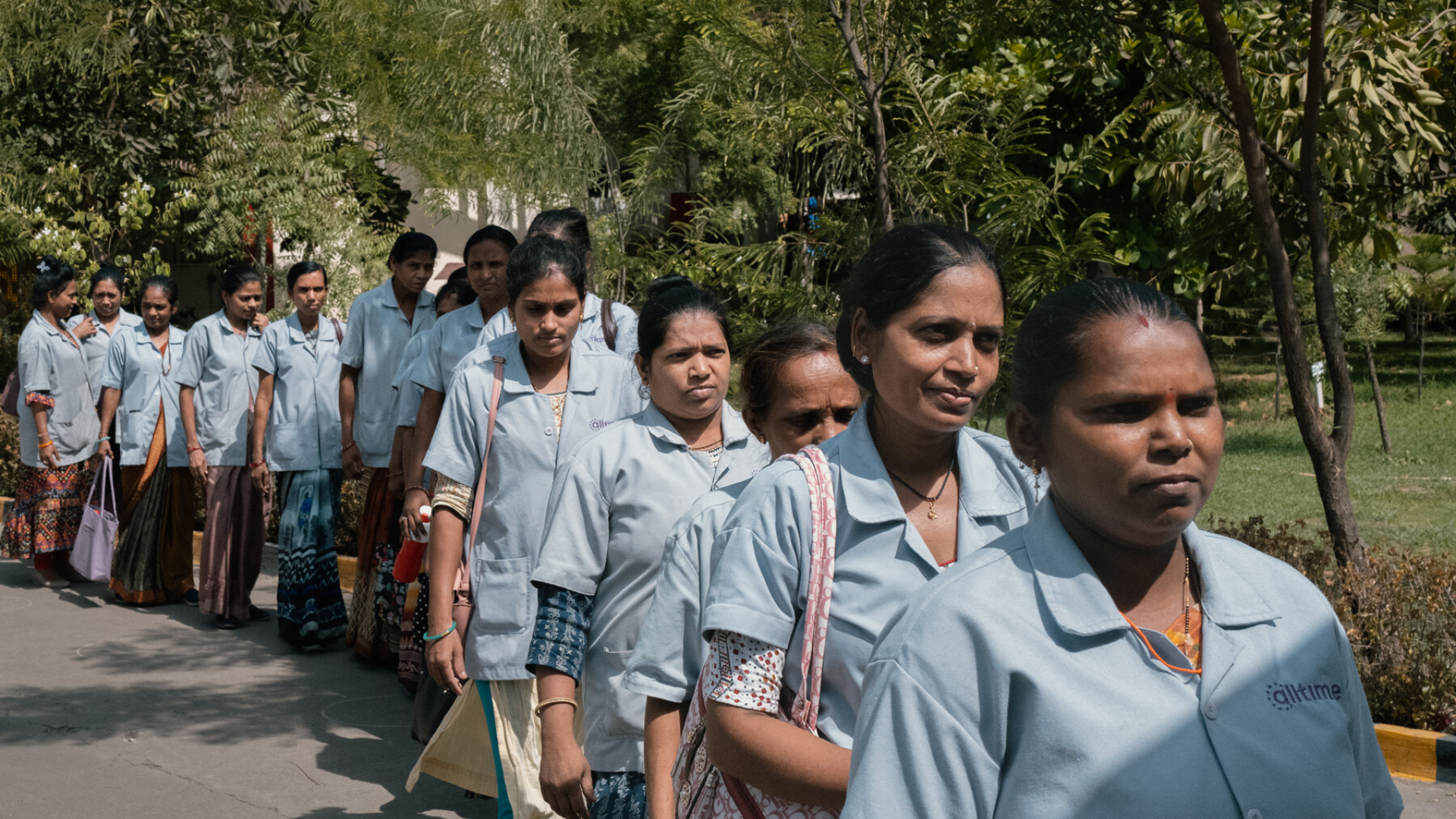
India’s retail economy is one of the largest in the world – with a workforce of over 40 million people, contributing more than 10% of GDP and roughly 8% of total employment. It is also an intensely feminised industry, with women making up roughly 60% of the workforce.
Female workers are seen most prominently in textile showrooms, jewellery stores and hospitality outlets across the country, the very sectors where standing labour is most rigidly enforced. Most of these women spend the majority of their day standing while attending to customers and work beyond the legally mandated 48-hour work week.
The health costs of this are extreme and almost entirely absent from policy conversations. Prolonged standing (more than four hours continuously) is associated with chronic back pain, varicose veins and long-term joint damage. For women, who bear the brunt of this, the consequences go further. Research on dysmenorrhea among working women links long working hours and workplace stress to severely painful menstruation, and recommends, as a first step in the intervention, a place to sit down during shifts. Yet, workers today are still forced to trade their health for work. Seating is rarely provided in most establishments, from high-end coffee shops to small textile outlets, and employees are required to complete their 12-hour shifts entirely standing.
Why is standing so rigidly enforced in the first place? A seated worker can fold clothes, attend to customers, or process transactions just as effectively. A standing worker is demanded not just for business efficiency but also because it signals deference and availability. It is required of women to be attentive, available, subservient and in a constant mode of service. Being endlessly at the customer’s disposal is obligatory for a retail worker. The dominance of women in such customer-facing roles is not accidental; they are exclusively chosen for their assumed capacity for deference and subservience. Their vulnerability in the informal labour force is further exploited, as the threat of replacement implicitly enforces compliance. The job requirement of being on their feet for 12 hours is not incidental to females. It is female by design.
What Does the Law Say?
India does not have any national legislation enforcing workers’ right to rest. Under the Constitution, labour falls on the Concurrent List, meaning both the Centre and the States can legislate. On the question of seating, the Centre has chosen not to. The Occupational Safety, Health and Working Conditions Code, 2020, India’s most recent central legislation on workplace conditions, contains no seating provision and applies only to establishments with ten or more workers, immediately excluding the vast majority of small shops and commercial establishments where most retail women workers are employed. Parliament was asked directly in 2022 whether the government planned to incorporate the right to sit into this code. The response confirmed that, as far as the Centre was concerned, the matter was for states to handle.
The matter, in most states, has not been handled.
Only two states have specific seating provisions: Kerala, which amended its Shops and Commercial Establishments Act in 2018 following years of sustained protest, and Tamil Nadu, which followed in 2021. As the Deccan Chronicle reported as recently as May 2025, Telangana — which extended commercial establishment operating hours in 2024 to benefit businesses — made no corresponding provision for the workers who would be standing through those extra hours. Uttar Pradesh, Rajasthan, Maharashtra, and Delhi have no specific seating requirements for retail and commercial workers. A worker’s right to rest her body during a twelve-hour shift is determined not by any national standard of dignity, but by which state she was born in.
And even where the law exists, compliance is another matter entirely. In Kerala, The Wire reported that salespersons in textile and gold showrooms remain largely unorganised, and that shop owners routinely take action against employees who make contact with unions. In Telangana, union organisers describe CCTV cameras installed specifically to catch workers attempting to sit, and workers are forced to remain silent for fear of salary cuts or termination. In Tamil Nadu, five years after the amendment, workers in large retail chains like PVR and Pothys are still resting on staircases between shifts.
Meena has worked at Trends clothing stores across different parts of the city for over four years, cycling through six-day, nine-hour shifts. Between those hours, sitting down requires permission. On days when period pain makes standing unbearable, she takes painkillers and asks the store manager if she can use the lunch area. The alternative, she says, is to take leave.
Yasmin’s nine years at Smart Bazaar have given her a sharper arithmetic of rest: a thirty-minute lunch break and a ten-minute tea break. That is the sum of her sitting hours in a nine-hour shift.
The situation is even starker for workers with no seating at all. John, twenty-eight, came to Chennai from Manipur four years ago and has worked at an upscale coffee outlet since. In that time, he has never had a chair at his station. When told of John’s situation, a labour inspector in Mylapore was unmoved. “In coffee shops and all, how will they do their jobs sitting down?” she said. “It’s not practical.”
The Cost of Claiming a Right
The reason most workers do not complain is not that they do not know their rights. It is that they cannot afford to exercise them.
Organised retail in India is almost entirely unorganised from a labour perspective. There are no unions in most large showrooms and chains. Workers are hired on informal terms, often without written contracts, which means there is no grievance mechanism, no documented employment relationship, and no clear path to recourse. Shop owners routinely take action against workers who contact unions – even in Kerala, the state with the most progressive track record on this issue.
It is also important to understand the household context of retail workers in India. The majority are women between eighteen and thirty, earning between six and fifteen thousand rupees a month, often from lower-income households where this salary is essential for sustenance in an urban setting. Moreover, after a twelve-hour shift on the floor, there is a second shift waiting at home in the form of household chores. The double burden is not incidental to this story. It is the reason that rest, in any short form, carries so much importance. The denial of such an essential workplace right compounds the weight of the exhaustion that millions of women in India are forced to carry daily.
While the burden does fall disproportionately on women, the right to rest is not a gendered issue alone. Male employees in retail and hospitality endure the twelve-hour shift without chairs, the same fear of retaliation for resting, and the same constant surveillance. In states lacking even the most minimal of sitting provisions, which is the majority of states in India, the right to sit and rest at work is an equal opportunity denial. It is not discriminatory on the basis of gender but on the basis of class.
Those who are required to stand do so because of their place in a social hierarchy that has always deemed some bodies suitable for service. In India, this hierarchy cannot be divorced from caste. An overwhelmingly large percentage of workers who earn low wages in retail and hospitality are members of Dalit and OBC castes, whose history of exclusion from other forms of work makes service work more than a choice but a necessity within the urban labour market, which operates outside the purview of reservation policies.
In the absence of affirmative action, caste continues to play a significant role in deciding labour and wage conditions for the most vulnerable sections of society. Various studies (Deshpande and Newman (2007), Madheswaran and Attewell (2007), Thorat and Attewell (2007)) describe discrimination embedded in the urban private sector, showing that social identity shapes labour market outcomes even when there is no difference in educational qualifications or skills.
The retail sector is not an exception, but the most visible expression of this structure – a space where the least protected and most physically demanding roles are held by people from lower castes.
The Right to Rest
Ultimately, the denial of rest reveals something deeper than a legislative failure. Feminist theorists of social reproduction (Silvia Federici, Tithi Bhattacharya, etc) have long argued that capitalism depends on the unwaged labour that happens outside the workplace: the cooking, the cleaning, the caring. The retail floor extends this logic into the wage relation itself: the body that has spent itself serving others all day returns home to serve again, with no boundary recognised between the two. Capitalism, in this sense, does not merely extract labour hours; it extracts the person.
This extraction is disproportionately female. And it is invisible precisely because it is treated as natural, as something women simply do, rather than something that requires time, energy, and rest to sustain. The denial of something as basic as a right to rest is the logic of that system made visible; a system that has always assumed the female body to be endlessly available, endlessly absorbing, and endlessly able to continue. To demand the right to sit is, in this sense, to demand something more than a chair. It is to insist that the body has limits, that those limits matter, and that the woman inside it is not simply a resource to be utilised for maximising profit margins.
Rest cannot be viewed as a favour an employer grants on a good day. For working-class women and men in India’s retail economy, it remains what it has always been: something stolen in between, on stairs not meant for them. Until the state treats that as a problem worth solving – not for two states, not for establishments above a threshold, but for every citizen standing on every shop floor in the country, the right to rest will continue to exist exactly where it does now. On paper, and nowhere else.
The names of all retail staff mentioned in the copy have been changed for privacy and job security concerns.
About the author(s)

Abirami holds a Master's in Development Studies from IIT Madras and currently works within the space of public policy, driven by a pursuit of a more inclusive and equitable world. She approaches her work as a continual process of learning and unlearning, grounded in the belief that meaningful change begins with asking the right questions.


Amazing explanation. the information shared here is very valuable. Have a great day and thanks for sharing.