When Amisha, a JNU student, arrived at the Jantar Mantar protest on July 20, she tried to stay out of sight. Coming from a politically conservative family that did not support the demonstrations, her first instinct was not to avoid police surveillance, but the countless phones and cameras around her. ‘I was hiding my face. I was trying not to be visible at the protest because I thought my family would see me online,’ she says.
Coming from a politically conservative family that did not support the demonstrations, her first instinct was not to avoid police surveillance, but the countless phones and cameras around her.
However, as the protest unfolded and she saw police chase and baton-charge students, Amisha’s attention then shifted from being seen to staying safe. ‘At that moment, I only thought about my safety and the safety of my friends. I didn’t care about the cameras anymore.’
The question of being watched surfaced repeatedly in conversations with women protesters. Hansika Madan, a recent graduate from IIT Delhi, said, ‘I would have felt a little less conscious if cameras weren’t present. I would have been able to focus more on the protest.‘
During interviews with five women who attended the protest, a recurring pattern emerged. Some worried that their parents would discover their participation in the protests, while others feared appearing on camera because they believed it could affect their future employment. However, nearly all distinguished between ordinary filming and the possibility of state surveillance.
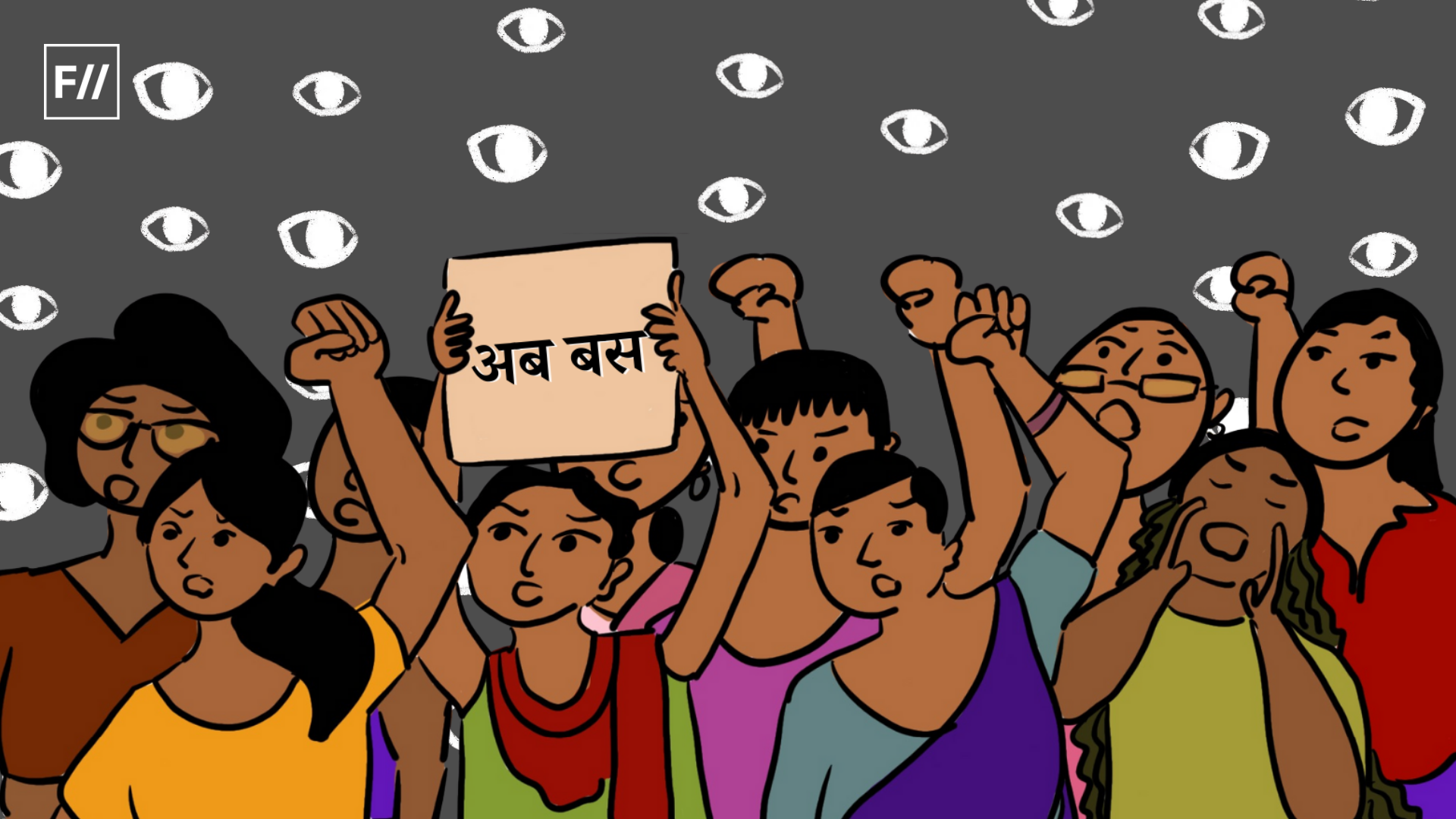
For many women at the protest, the question was not simply whether they were being watched, but by whom, and what that visibility might mean once the protests were over.
For many women at the protest, the question was not simply whether they were being watched, but by whom, and what that visibility might mean once the protests were over. Some feared that videos circulating on social media would reach their families. Others worried that police footage could remain in official records, affecting future job prospects or inviting scrutiny long after the protests ended.
Under constant watch
Throughout the weeks-long protest, cameras became part of the landscape. Television crews moved through the crowd looking for interviews, independent journalists and content creators live-streamed speeches, while protesters documented events on their phones. Alongside that, several women described repeatedly seeing police personnel recording demonstrators.
Alongside that, several women described repeatedly seeing police personnel recording demonstrators.
These accounts were consistent with observations made during my own reporting at the protest site. On the evening of July 20, police prevented protesters from entering the demonstration site for nearly two hours, keeping them behind barricades as they raised slogans demanding entry and access to medical supplies. Amid the standoff, a man standing alongside police officers filmed the crowd with a large video camera.
When protesters were eventually allowed inside, Abhijeet Dipke and Ashutosh Ranka addressed those gathered. From within the crowd, another man in civilian clothing wearing a vest marked ‘Delhi Police’ continued filming the protesters throughout the speeches.
And this was not the only such instance. On an earlier visit to the protest site, I observed another individual in civilian clothing filming demonstrators. Protesters later identified him as being associated with the police. Neither individual interacted with protesters; throughout the evening, they continued filming those gathered for speeches and those raising slogans.
On an earlier visit to the protest site, I observed another individual in civilian clothing filming demonstrators. Protesters later identified him as being associated with the police. Neither individual interacted with protesters; throughout the evening, they continued filming those gathered for speeches and those raising slogans.
For many women interviewed for this story, these moments reinforced the notion that participation in the protest was being documented beyond the ordinary presence of journalists and social media creators.
For Bhoomi, an IIT Madras student, the concern extended beyond the protest itself. She wondered where the footage might eventually end up and who would have access to it. She told FII, ‘They have our data, and they could use it to blackmail us.‘ She also believes some police personnel were wearing Meta smart glasses equipped with facial-recognition technology. While this claim couldn’t be independently verified, she said it heightened her concern that recordings from the protest might be used to identify demonstrators later.
She also believes some police personnel were wearing Meta smart glasses equipped with facial-recognition technology. While this claim couldn’t be independently verified, she said it heightened her concern that recordings from the protest might be used to identify demonstrators later.
A UPSC aspirant, who wished to remain anonymous, described a similar dilemma. She feared that if police retained footage from the protest, it could someday affect her recruitment. She told FII, ‘My family doesn’t know I’m here. They think that instead of going to the protest, one should study for the exams. I don’t come from a privileged background, but my parents gave me the best education they could. Right now, I’m preparing for UPSC CSE. If the police have my data through recordings, I’m afraid it might be used against me in my selection, and my career would be hampered. This is why I’m wearing a mask.‘
Protesters’ fears about long-term consequences are not unwarranted either. According to The Times of India, a professor from Uttar Pradesh’s Bareilly, Dr Mohit Bhardwaj, alleged that he was unjustly dismissed from his position as an Assistant Professor at Ganna Utpadak (Postgraduate) College after participating in the protest at Jantar Mantar. Bhardwaj claimed that the college management terminated his employment without notice or a proper inquiry, an action he believes was directly linked to his involvement in the protest.
A legal challenge to surveillance
The experiences described by these women unfold alongside an ongoing legal challenge to police surveillance at the protest site. On 15 July, former JNUSU president Aishe Ghosh filed a plea before the Delhi High Court, alleging that the Delhi Police had established a permanent surveillance tower at the site and had continuously photographed and filmed protesters, including during routine activities such as eating and resting. The plea further argues that there is no publicly disclosed legal basis for this surveillance and that no procedural safeguards are in place.
Former JNUSU president Aishe Ghosh filed a plea before the Delhi High Court, alleging that the Delhi Police had established a permanent surveillance tower at the site and had continuously photographed and filmed protesters, including during routine activities such as eating and resting.
The petition also alleges that police threatened some student protesters. It says police told protesters that their photographs would be sent to their parents, and also threatened to send the photographs to their educational institutions. The plea argues that this created a chilling effect and discouraged participation in the protests. The plea further alleges that women protesters were photographed and filmed while in wet clothing during heavy rainfall. It argues that this amounted to an intrusion into their bodily privacy and dignity.
Outlook reported that Delhi Police had stationed AI-enabled surveillance vehicles near the protest site, including the Ikshana van, which can process live CCTV footage using facial-recognition software. According to the report, police officials said the technology is intended to identify wanted individuals by matching faces against existing criminal databases.
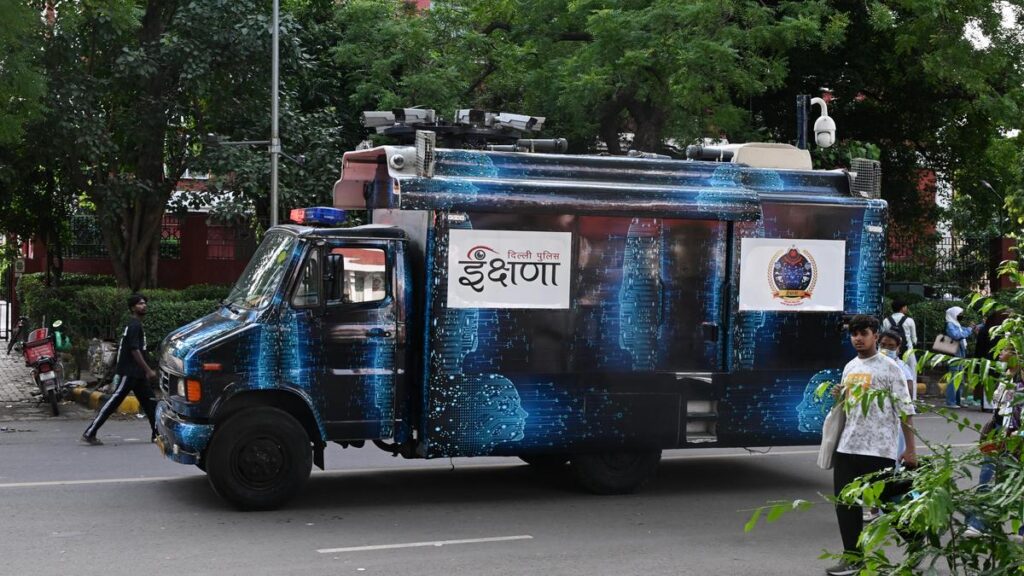
Although the Delhi Police has rejected allegations of unlawful surveillance. Before the High Court, Solicitor General Tushar Mehta argued that videography is carried out to maintain law and order and ensure public safety, not for ‘snooping’ or surveillance.
Their concerns centred less on the legality of employing facial-recognition technology than on a more immediate question: who might eventually see those images, and what consequences might follow.
For the women interviewed for this story, however, the legal debate often felt secondary to the uncertainty created by being recorded. Their concerns centred less on the legality of employing facial-recognition technology than on a more immediate question: who might eventually see those images, and what consequences might follow.
Concerns over the use of facial-recognition technology and police videography at protests are not new. During the 2019 anti-CAA protests, reports indicated that Delhi Police used facial-recognition software to identify protesters from video footage, prompting criticism from privacy advocates and digital rights groups.
Being seen meant different things
The conversations I had revealed that the experience of surveillance was not the same for everyone. Some protesters, like Tanushree, an MA student from Bareilly, regarded filming as an inevitable part of contemporary protests, where journalists, YouTubers, and protesters themselves constantly document public events.
‘Everyone was doing that. It wasn’t just the police; it was happening from both sides. But the thing is, if the police have your video, they can track you down in the future. They already do that, and that’s the whole point of surveillance. These things can come up later in life, even if you were only standing at the protest, even if you didn’t say anything controversial or raise any objectionable slogans. Even if you only said the right things, how someone chooses to portray you is up to them. And that’s a privacy concern,’ she said.
Some women returned home knowing their families still had no idea where they had been. Others carried questions about whether their face had been captured in police footage, a live-stream, or an Instagram reel.
By the time the crowds dispersed and the slogans faded, the cameras, however, remained.
Some women returned home knowing their families still had no idea where they had been. Others carried questions about whether their face had been captured in police footage, a live-stream, or an Instagram reel. And none of them knew where those images might travel or how they would be used.
What emerged from these conversations, however, was not a story of women being deterred from protesting. It was a story of women who chose to participate despite uncertainty.
What emerged from these conversations, however, was not a story of women being deterred from protesting. It was a story of women who chose to participate despite uncertainty. They arrived knowing they might be watched, recognised, and recorded. But they came anyway. For these women, surveillance didn’t silence dissent; it simply became another risk they carried with them.
Some of the quotes in this article have been edited for clarity and length.
About the author(s)

Rashi Choudhary is a Delhi-based journalist and an alumna of the Indian Institute of Mass Communication (IIMC). She has worked with The Times of India and is interested in stories about people, policies, and movements that shape society.