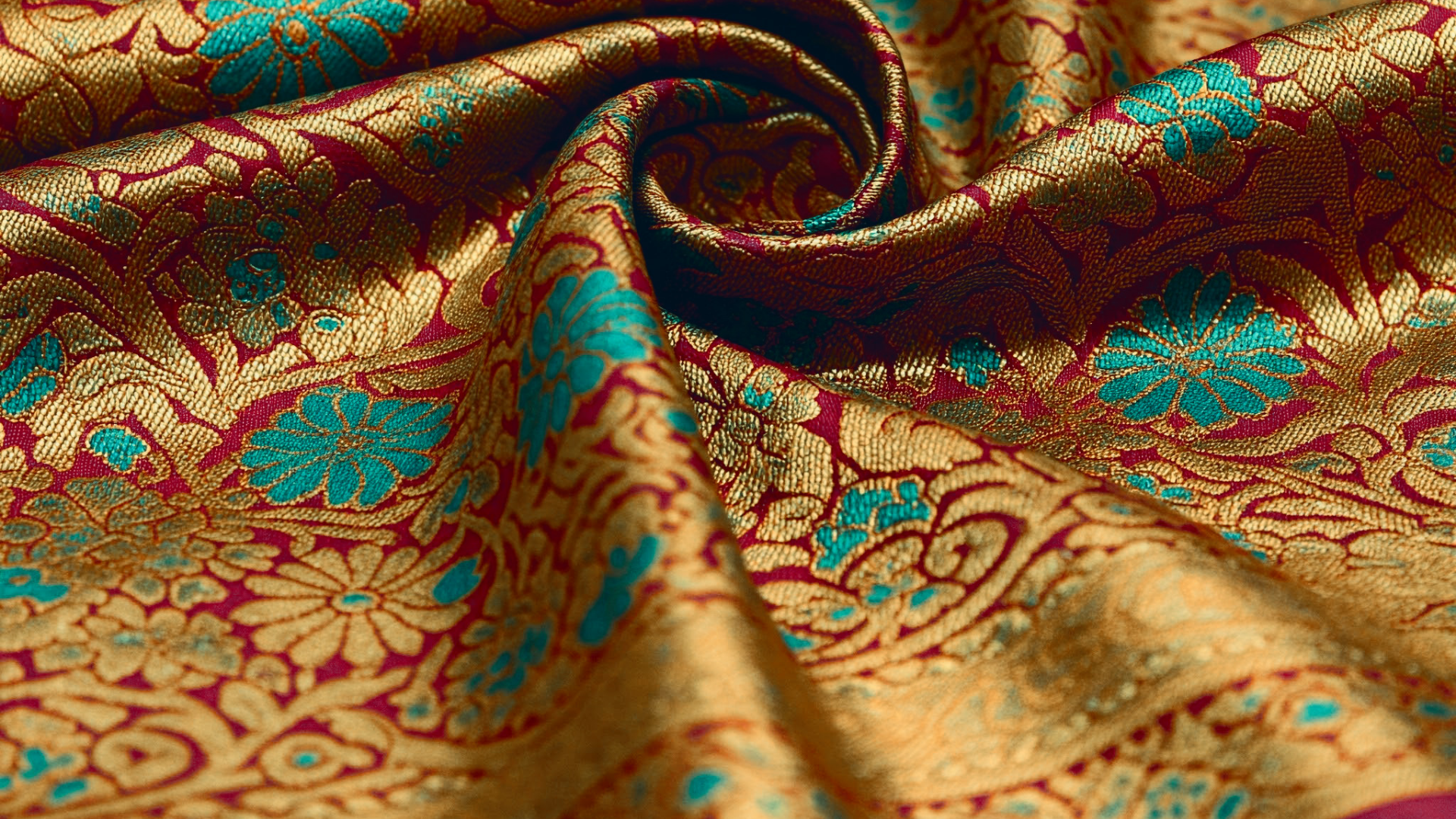
Lately, one of my favourite hobbies has been rummaging through my mother’s closet and picking out sarees to try on. While it now seems fun, I imagine my 10-year-old self looking at me with disappointment, and justifiably so. She promised herself she would never wear a saree, and here I was breaking that very promise.
Growing up in six yards
I grew up in a very small village on the Maharashtra border. Where I come from, you had to wear a saree with a pallu covering your head at all times if you were a married woman. Anything else, even a kurta or a kameez, would put your ‘character’ up for debate. And so I grew up watching the women in my family drape themselves in six yards of silk or cotton every morning. It felt like watching them constrain themselves, making themselves immobile, so that they were aware of their limits.
From a very young age, I could see how the garment was used as a marker of obedience. As a result, I associated sarees with patriarchy and promised myself I would never wear one; I would never limit myself.
I was observant enough to notice the red lines on their waists and the suffocation of their blouses as they worked in the kitchen. From a very young age, I could see how the garment was used as a marker of obedience. As a result, I associated sarees with patriarchy and promised myself I would never wear one; I would never limit myself. I swore I would be liberated from this cloth and fight my battles in my skinny jeans. And I kept that promise for years.
The politics of choice
The policing of women’s clothing has never been about the garment itself. Tradition and rules have long been used to dictate what women can and cannot wear, often under the guise of culture or modesty. But what remains the same is the message: your body does not belong to you. It belongs to the family, the community, the society, the village; they are the ones who get to decide what is appropriate.
What remains the same is the message: your body does not belong to you. It belongs to the family, the community, the society, the village; they are the ones who get to decide what is appropriate.
Similarly, the rules around the saree were not about the saree at all. They were about keeping women in their place, making sure we knew that we were constantly being watched and judged. I realised there is patriarchy at play here, and it wants to control what I wear. However, swearing off sarees would mean I had let it do exactly that.
So I tore this six-yard-long garment away from the clutches of patriarchy and started wearing it on my own terms. I went to my mother and asked her to teach me how to wear a saree. It did not feel repressive. In fact, surprisingly enough, it made me feel empowered.
What women pass down
The feeling of sitting in a corner and watching your mother get ready for a function, adorning herself with a gajra and bindi, letting herself feel beautiful before the judgment arrives, is a remarkable one. The camaraderie that exists in a room full of women, each passing around safety pins or a secret pleating hack, whispering jokes about sex, pleasure, and everything they aren’t allowed to experience, is its own kind of girlhood.
Now, when I throw the pallu over my shoulder, I think of my mother’s mother, and her mother before her. I think of all the women in my line who wore these same fabrics, who sweated in them, who cried in them, who danced in them. I think about Savitribai Phule, Tarabai Shinde, and all those who fought before me, for me. I’ve inherited the weight of this fabric. I don’t want to pass down this garment as a six-foot-long cage. I’d rather it be read as a scroll of our collective stories.
When I think about the ten-year-old girl in that small village who swore she would never wear a saree, I don’t think I have broken a promise. This is because I have finally understood that what I was really rejecting all those years ago was not the saree; it was letting the entire village make rules about my body.
When I think about the ten-year-old girl in that small village who swore she would never wear a saree, I don’t think I have broken a promise. This is because I have finally understood that what I was really rejecting all those years ago was not the saree; it was letting the entire village make rules about my body. Now that I am the one who decides when to wear it, how to pleat it, and which blouse to pair it with, I feel like a rebel all over again. I am still as much a feminist as I was back then, I am still trying to overcome gender norms imposed on me, I am still fighting, but I am choosing to do it in a saree. I am reclaiming what was once used to contain me and wearing it as a symbol of my autonomy.
About the author(s)

Yukta Chaudhari is an intersectional feminist, writer, and communications professional based in Mumbai. Her work sits at the intersection of culture, identity, and social impact. She writes on feminism, gender and politics from a rural gaze, and believes in the power of the written word to drive positive change and create a more inclusive world, one word at a time.


That was so good to read. I too shunned the saree as a young one but have chosen to wear it as an act of rebellion at times. I only own 2 sarees and am pleased with them, even though one is stained. They both look beautiful to me and remind me of my dear mother and all our ancestors and folk in India and around the globe who wear them. I also like them because they are literally a length of material worn and wrapped around us and so simple clothing which is very hard to find in the world with the cultures and fashion these days.