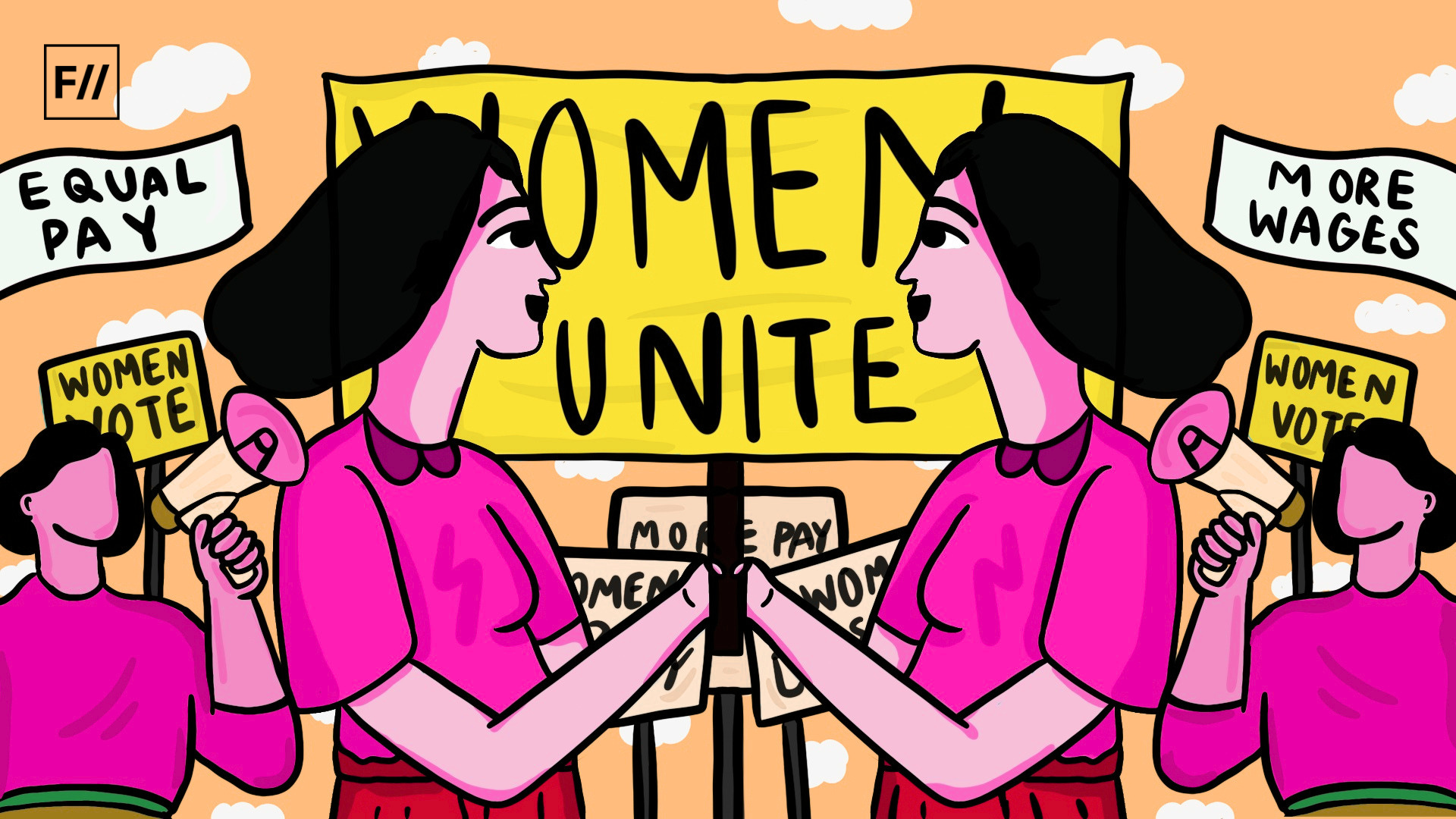
In her foundational work Gender in International Relations (1992), J. Ann Tickner, a feminist scholar of international relations theory, advocated for a feminist security model as an alternative model of national security in place of existing ones that, in her view, typified ‘militarised masculinities’. The former offered an expandable, multi-layered, and multi-dimensional security structure, while the latter was a survivalist and existential one.
More than two decades later, in the days following the launch of the world’s first Feminist Foreign Policy (FFP) by Sweden in 2014, the country’s Foreign Minister Margot Wallström argued, ‘[Feminism is] about standing against the systematic and global subordination of women‘ and that ‘It’s time to become a little braver in foreign policy.‘ Situating Sweden’s FFP within Tickner’s academic framework births the world’s first full-fledged feminist model of security, which often counts as a subset of foreign policy in the 21st century.
As a rupturing international order fails girls and women from Ukraine to Sudan, it’s time for the world — and especially India — to draw inspiration from this decade-old initiative and course-correct before it’s too late. According to subsequent Global Gender Gap Reports by the World Economic Forum (WEF), the world lags behind by hundreds of years in closing the global gender gap. Although there is no singular FFP model or resulting definition that could appeal to all its prospective adopters at once, recent academic literature on the subject has witnessed significant convergence on what ought to be a universally acceptable definition and scope of an FFP.
Scholars Lyric Thompson and Rachel Clement have said, ‘Feminist Foreign Policy is the policy of a state that defines its interactions with other states and movements in a manner that prioritises gender equality and enshrines the human rights of women and other traditionally marginalised groups, allocates significant resources to achieve that vision and seeks through its implementation to disrupt patriarchal and male-dominated power structures across all of its levers of influence (aid, trade, defence, and diplomacy), informed by the voices of feminist activists, groups, and movements.’ While other supplementary definitions also exist, the broad-based ingredients delineated by Thompson and Clement remain static throughout.
The global rise of feminist foreign policy
The Swedish feminist foreign policy announcement was followed by Canada’s Feminist International Assistance Policy (FIAP) in 2017; France’s own feminist foreign engagement policy in 2019; Mexico’s in 2020; Spain, Germany, and Luxembourg’s in 2021; Chile’s in 2022; and Slovenia’s in 2023.
A common thread connecting these country-specific models is the three principal nodes mentioned in the original Swedish framework: Right, Representation, and Resources. Recently, a fourth node, ‘Reality’, has been proposed in some of these models. States that have declared an avowed FFP are members of an international grouping called the FFP Group Plus, which regularly organises Ministerial Conferences on Feminist Foreign Policies.
Indian scholar-thinkers have long argued for a feminist reorientation of the Indian Foreign Policy (IFP), and External Affairs Minister Dr S. Jaishankar has recently vouched for a ‘gender-balanced foreign policy‘ which focuses on ‘getting more women to engage with foreign policy issues, reflect women’s interests in foreign policy, and bring in a feminist perspective to foreign policy.‘
The proposition for an Indian Feminist Foreign Policy (IFFP), in my view, has acquired greater urgency in 2026 in light of three emerging factors. First, at a time when women have become a crucial cross-cutting politico-welfare constituency in India, an IFFP would capitalise on their importance and perspectives at a tangible policy level. Second, India’s stagnating global soft power could be salvaged by employing an IFFP as an instrument of global engagement. And third, in an era of a deep moral void on the international stage, an IFFP would allow India to reclaim its righteous voice in both the Global North and the Global South.
Institutional gaps in India’s foreign policy architecture
But in order to bring the vision of an IFFP to life, several institutional deficiencies must first be addressed. Women now make up about 37- 40 per cent of recent recruits to the chronically understaffed Indian Foreign Service (IFS), but hold only 12 – 13 per cent of leadership positions around the world, and that too primarily at the multilateral level. Even within the Ministry of External Affairs (MEA), only 29 per cent of women are employed at the under-secretary level. At the parliamentary level, women MPs comprise merely 14 – 17 per cent of the total members across both houses. A breakdown of gender representation across any institution of the Indian state would reveal this abysmal record: the near-complete absence of women’s perspectives.
Therefore, working on these numbers should be a priority to address the issue of representation. The absence of a National Action Plan for the implementation of the Women, Peace, and Security (WPS) agenda under UNSCR Resolution 1325 of 2000 is also reflective of the broader gender malaise within India that stymies any feminist agenda. Another example is the non-ratification of the Optional Protocol to the Convention on the Elimination of All Forms of Discrimination against Women (OP-CEDAW), which enables survivors to approach the CEDAW Committee to seek remedies when domestic frameworks for justice have failed them. Hence, the fulfilment of its international feminist obligations must accompany India’s march towards an FFP.
Key recommendations for an Indian Feminist Foreign Policy (IFFP)
An IFFP must be domestically reformatory and internationally exportable for it to meet Indian needs. Therefore, it must:
- Address the representation gap in diplomatic institutions and cadres, which includes promotional quotas for women in the MEA and diplomatic postings, and also the inclusion of LGBTQ+ people and other gender minorities.
- Include strengthening and repositioning domestic institutional mechanisms in all walks of life towards a feminist orientation, which comprises long-term capacity building, gender sensitisation, and holistic inclusion with a whole-of-government (WoG) approach.
- Not only result in tokenistic representation of women, but also incorporate their perspectives, lived experiences, and specific needs into policy-making.
- Involve greater engagement with NGOs, INGOs, civil society, and multilateral bodies (such as FFP Group Plus) to learn best practices, identify its objectives and scope, and align it with international standards.
- Primarily focus on gender mainstreaming, women-only peacekeeping forces deployable to conflict zones for rehabilitation, confidence-building measures (CBMs), and peace durability (especially in the Global South).
- Factor in the specific needs and issues of the Global South for it to be widely exported, which could include free technical assistance for PoSH mechanism implementation, youth-focused gender sensitisation campaigns, anti-SGBV training for communities, among other things.
- Integrate a gender component in development aid disbursement, trade and climate deals, and bilateral engagements.
- Enhance cooperation on combatting Sexual and Gender-based Violence (SGBV) and Technology-facilitated Gender-based Violence (TFGBV) in bilateral and multilateral engagements.
- Adopt a proactive voice in advocating for the rights of girls, women, LGBTQ+ communities, and other gender minorities for enhanced visibility on the global stage.
The future of foreign policy is feminist
In conclusion, the time is ripe for India to develop and implement a feminist foreign policy — inspired by Western frameworks but modelled at home — to empower and harness the potential of the other half of its population, long mistreated and marginalised, and set new norms of global engagement as it confronts new challenges and opportunities in an ever-changing world. And an Indian feminist voice enriching global discourse wouldn’t be a first-of-its-kind. The pathway to an IFFP is already illuminated by pioneering Indian women diplomats, including Vijaya Lakshmi Pandit, Hansa Mehta, C. B. Muthamma, Chokila Iyer, and countless others.
During its time as chair of the G-20 grouping in 2023, India established a Working Group on Empowerment of Women and successfully integrated gender discourse into the broad-based agenda of the world’s largest economies. The momentum around women-specific policy agendas must continue as India hosts the 18th BRICS Annual Summit in September 2026, and it must outline its goal of adopting a ‘gender-sensitive’ foreign policy in a predominantly non-Western coalition. And India must heed the clarion call of Kristina Lunz, the Executive Director of the Centre for Feminist Foreign Policy, who succinctly argues, ‘The future of foreign policy is feminist.’
About the author(s)

Yash Chandan is a final-year student of law at National Law University, Sonepat. Their main areas of research include gender and international relations, queer politics, foreign policy, and Global South perspectives.

Wanted to let your readers know of another resource — Susan Markham and I wrote this book, outlining the pillar of feminist foreign policy and its origins. It might be helpful to navigate the landscape on this issue.
https://www.amazon.com/gp/product/1032281669/ref=ewc_pr_img_1?smid=A1C79WJQJ5SBBJ&psc=1
-Stephenie Foster