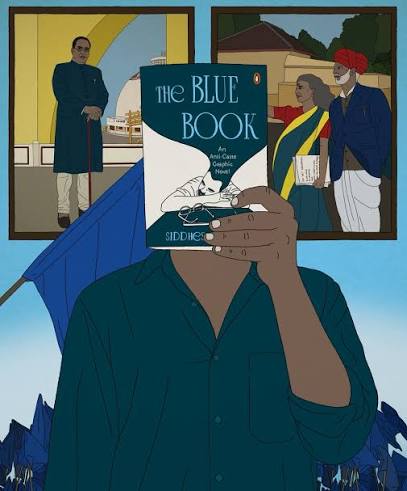
In his debut anti-caste graphic novel The Blue Book, writer-artist Siddhesh Gautam aka @bakeryprasad brings to life both the visceral reality of the caste system and his dreams for an equitable future. With his poignant words and striking illustrations, Siddhesh weaves together a moving narrative and offers a refreshing perspective on the institution of caste. Through interconnected dreams strung together with an anti-caste thread, Siddhesh explores themes of resistance, courage, and hope, and confronts the caste system in his inimitable, genre-bending style. Taking us along on a voyage through his dreams, Siddhesh intimately introduces us to his own heroes, and outlines his vision for a casteless future.
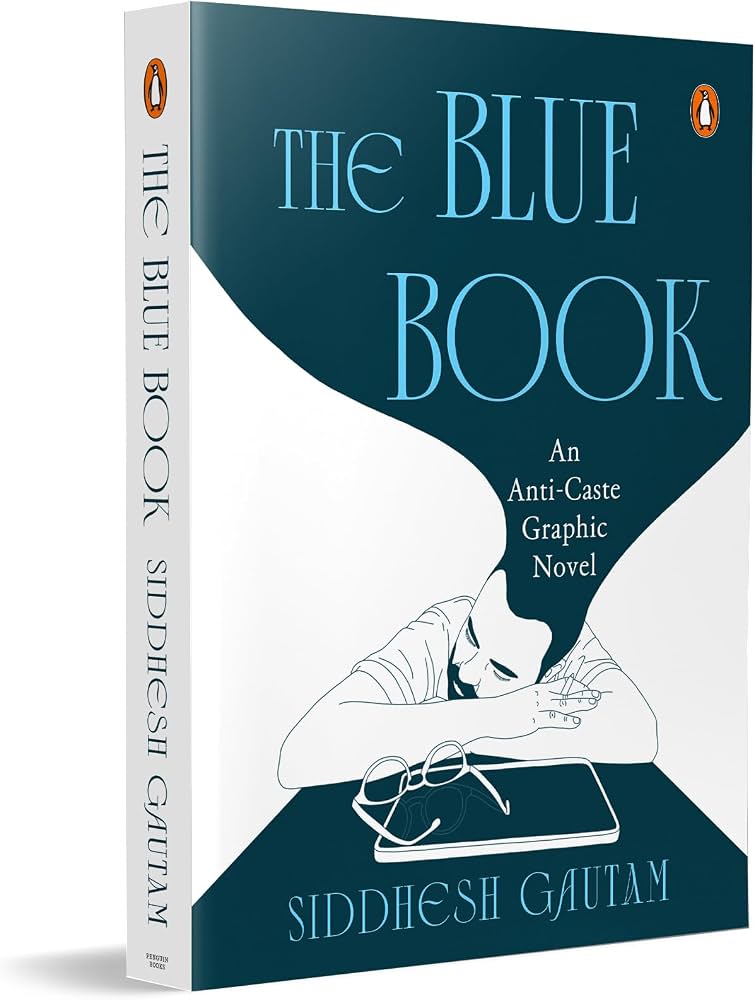
Imagining Otherwise: A World Beyond Caste
Chapter 1 begins with Siddhesh’s reimagination of the caste system as a spinning top, in sharp contrast to the way it is commonly construed in popular culture. He points out that caste is not, in fact, culture – it is an instrument of social control. Siddhesh powerfully contrasts the vegetarian, spiritual, peace-loving version of India the world sees with the version that constitutes his life experiences – the India where people are “manufactured with a label of caste.” It is this version of India, the India where the caste system creates servants instead of creating citizens, that drives Siddhesh to pick up his pen and dream of a new India.
In the second chapter, a dreaming Siddhesh comes face to face with India’s first woman teacher, Savitribai Phule. He visualises their meeting with an evocative illustration of her saree shielding and lifting them both. She tells him that caste is not just a structure, it is a lie given form. Advising him to expand his imagination instead of shrinking it, she urges him to not let the shadow of caste fall on our children. Siddhesh, sitting with his legs folded in the palm of Mai’s hand, tells her that he feels he isn’t doing enough as an artist, as a person, to combat the violence that caste brings about. Mai places her hand above his head, and says that the only rule is to bring others forward as we move ahead. We are encountered with Siddhesh’s artistic brilliance in the pages that follow, with a beautiful illustration of the spinning top of caste beginning to crack.
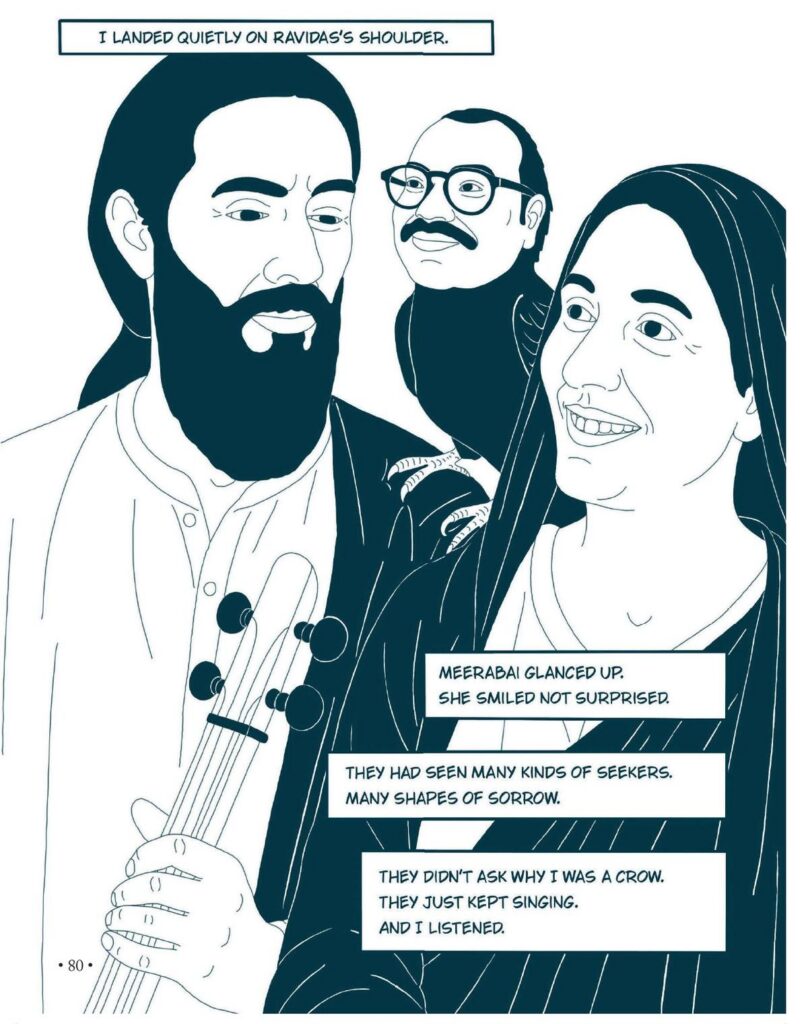
Chapter 3 introduces us to two more of Siddhesh’s heroes, namely Sant Ravidas and Meerabai. Now transformed into a crow, Siddhesh flies towards a sound he hears, where he meets Meerabai and Ravidas. Meerabai tells him that “to breathe is enough, but to care is revolutionary.” Sant Ravidas tells his that the vision of Begampura is not a promise, but a plan – one we all must collectively work towards. In keeping with Meerabai’s words, Sant Ravidas teaches Siddhesh that creation is resistance and resistance is creation; to create is not to decorate, but to disrupt gently. Through his illustrations of Sant Ravidas and Meerabai, Siddhesh breathes life into them, and gives wings to his own creative excellence.
The Histories We Carry: The Work of Remembering
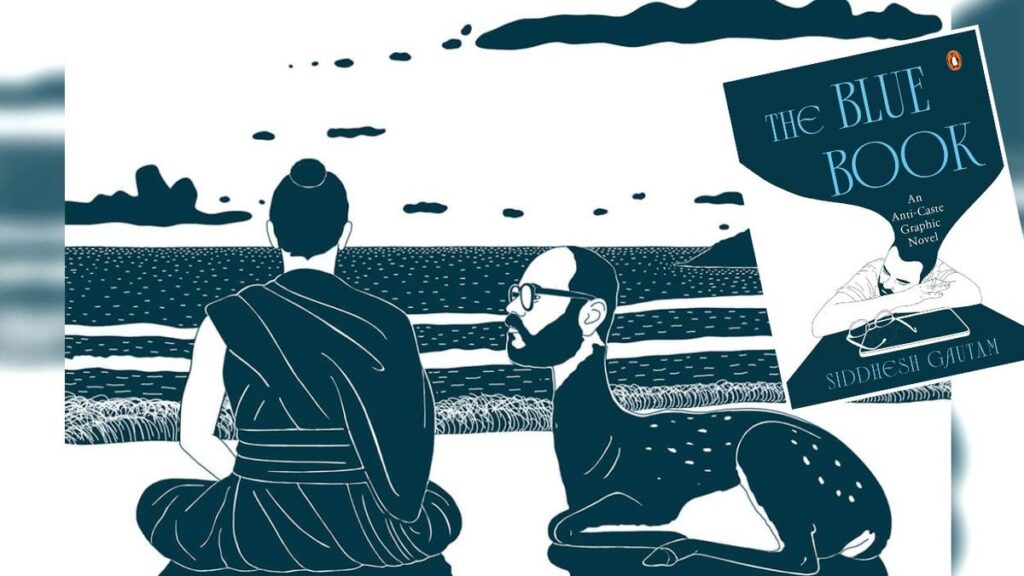
Travelling across time, space and history, Siddhesh meets Gautama Buddha in Chapter 4. Together, they retrace the Buddha’s footsteps across Sarnath and Bodh Gaya, and eventually find themselves in Thailand. As they walk, the Buddha tells Siddhesh that being a Buddha not as much about statues as it is about the practice of presence – of how the self relates to the world. Siddhesh then asks the Buddha if an oppressed person must overcome oppression before they can reach enlightenment. The Buddha replies: “one cannot ask someone with an empty stomach, and no dignity, to meditate on the self”. Through the Buddha, Siddhesh tells us something worth paying attention to: being human means ensuring humanity for others – for everything that breathes.
Chapter 5 sees Siddhesh’s dreams shift to a new room, where he encounters Dr. B.R. Ambedkar, who is cooking in the kitchen. Now half-man, half-ant, Siddhesh notices faceless guests sitting at the dining table. When he asks Babasaheb why the guests have no face, Babasaheb tells him that it doesn’t matter who the guests are, “to serve is to lift”. With these words, Babasaheb falls quiet, and reminisces about the fact that he could never make custard for his late wife, Ramabai. Siddhesh tells Babasaheb he is privileged to be having this dream. Babasaheb instructs him not to only tell stories but to build storytellers, so that no child of ours feels orphaned of their history. As Babasaheb and Siddhesh prepare to serve the meal, they turn to see that the faceless guests, all of them, had transformed into Ramabai. Upon seeing her, Babasaheb starts to shed tears, Siddhesh illustrates this magnificently with an image of Babasaheb on his knees, offering a bowl of food to Ramabai. As they begin to talk, Siddhesh starts disappearing into reality.
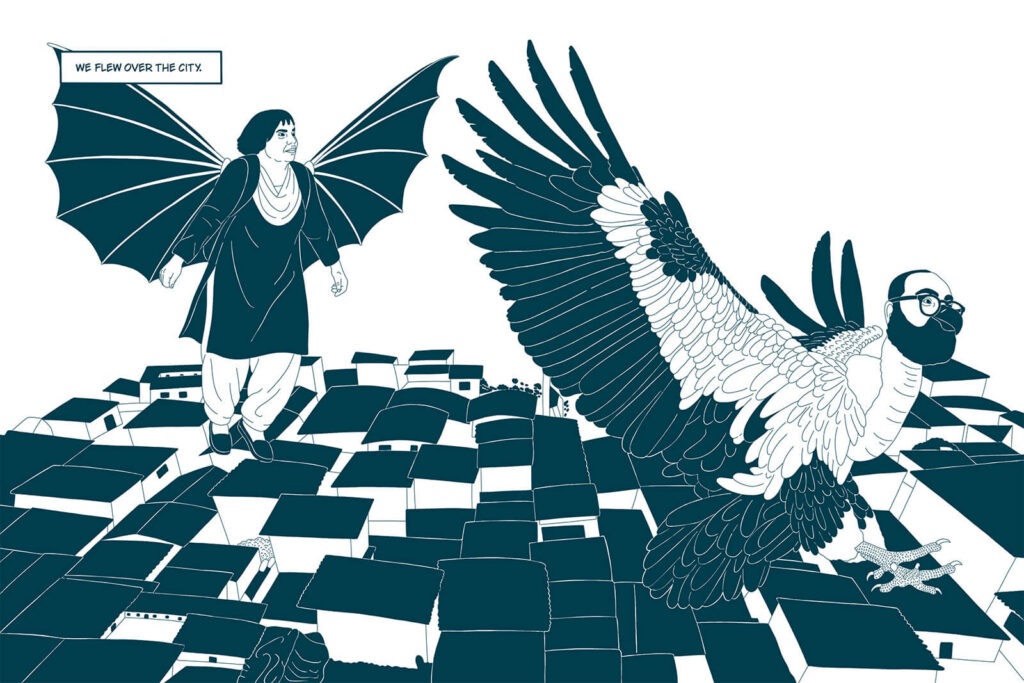
This quiet moment segues into the next dream, which constitutes the sixth chapter. As Siddhesh goes to sleep following a regular working day, he meets Dr. Gail Omvedt. They find themselves in Nagina, Siddhesh’s hometown. As they explore the town together, they pay a visit to the shoe workshop owned by Siddhesh’s uncle. Refusing to reduce his uncle’s quiet labour to a mere occupation, Omvedt insists that it is in fact history; every stitch is an act of documentation, and every sole is a page. Flying over the market, they observe Dalit stalls, which are always on the edges of the market. Omvedt tells Siddhesh that caste is an economy of erasure, it decides not only what one sells, but what their labour is worth. Back at his uncle’s workshop, Siddhesh sees a pair of freshly stitched shoes, and realises that silence is not empty, it is heavy with memory.
The Dreams We Share: A Roadmap For The Future
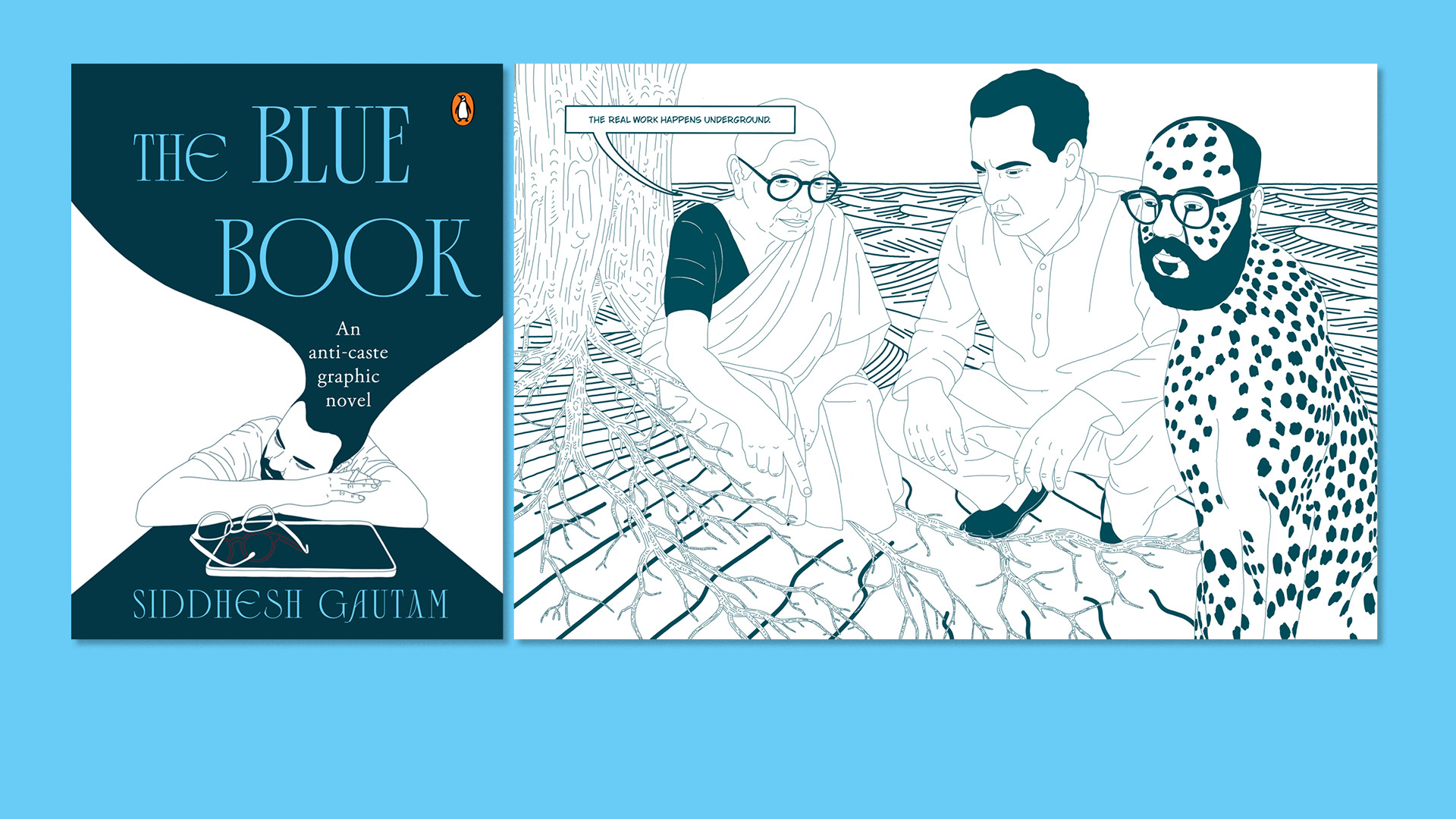
In chapter 7, Siddhesh comes across two more of his heroes, i.e. Kausalya Baisantri and Annabhau Sathe. Sitting under a lone tree in a desert, Baisantri and Sathe tell him that movements don’t grow from slogans, or without art, songs, poems and stories. Siddhesh then asks them: What does the anti-caste movement need today, structure or fire? We need both, Baisantri and Sathe answer, for fire without structure is lost in smoke, and structure without fire is just paperwork. They identify what the movement must work towards: towards songs not self-censored, towards classrooms we haven’t imagined yet, and towards people who don’t yet know that they deserve to dream. Through Kausalya Tai and Annabhau Sathe, Siddhesh delineates his own vision for the future of the anti-caste movement, not enlightenment as escape, but endurance as resistance.
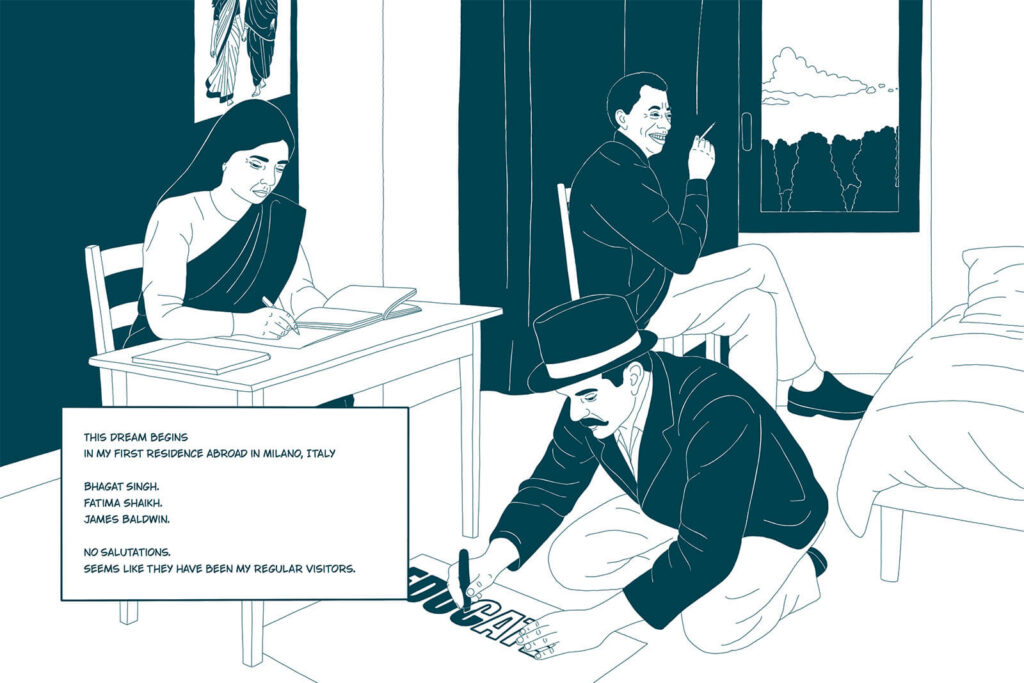
The final chapter unfolds in Siddhesh’s first residence abroad, in Italy. Here, we meet three more of Siddhesh’s friends: Bhagat Singh, Fatima Sheikh and James Baldwin. As he makes a poster with Babasaheb’s famous slogan Educate, Agitate, Organise written on it, Bhagat Singh observes that while we may call ourselves ‘Vishwaguru’, Indian people are still weighed down by caste and birth. Echoing his words, Fatima cautions that we must be careful of narratives that teach division, and emphasises that no child should grow up believing that they are “inferior than others by caste, smaller by gender, darker by colour or foreign by language.” Next, we are introduced to Baldwin, who tells us that creativity is not decoration – it is how we find what the world hides. Dreams, Baldwin says, are not an escape, but a rehearsal of truth. With these words, the three great reformers hand Siddhesh a card with nothing on it – just the colour of the oppressed; a colour shared by millions, a colour called blue. We don’t always need alphabets or digits, they tell Siddhesh. Sometimes, a colour is enough.
Siddhesh’s dreams are not his alone. They are shared by the hundreds of thousands of us who are with him in the fight for a future where one’s caste does not determine their life chances. Through his touching words, minimalist blue-and-white colour palette and surreal page-wide illustrations, Siddhesh enlivens those from history who showed us the path we today walk upon, and forces us to confront our own privileges. In doing so, he imbues with life the thoughts and feelings so many of us fail to express. When I was requested by Feminism in India to review this book, I had no idea of the journey that it would take me on. The Blue Book, then, is one of those rare works that challenges not just how we think about the world, but also how we see it.
All images are via The Blue Book by Siddhesh Gautam, published by Penguin India
About the author(s)

Abhijay Rambabu (he/him) is a sociologist with a keen focus on digital, urban and cultural sociology. He researches and writes upon these topics, in addition his writings on ecology, inequality and critical caste studies.