An intriguing case of a photographic anomaly in colonial India is the Illustrated Historical Album of the Rajas and Taluqdars of Oudh, compiled and illustrated by Darogah Haji Abbas Ali in 1880 under the patronage of Sir George Couper. The album was an account of more than three hundred Awadh taluqdars, about thirty-seven of whom were women.
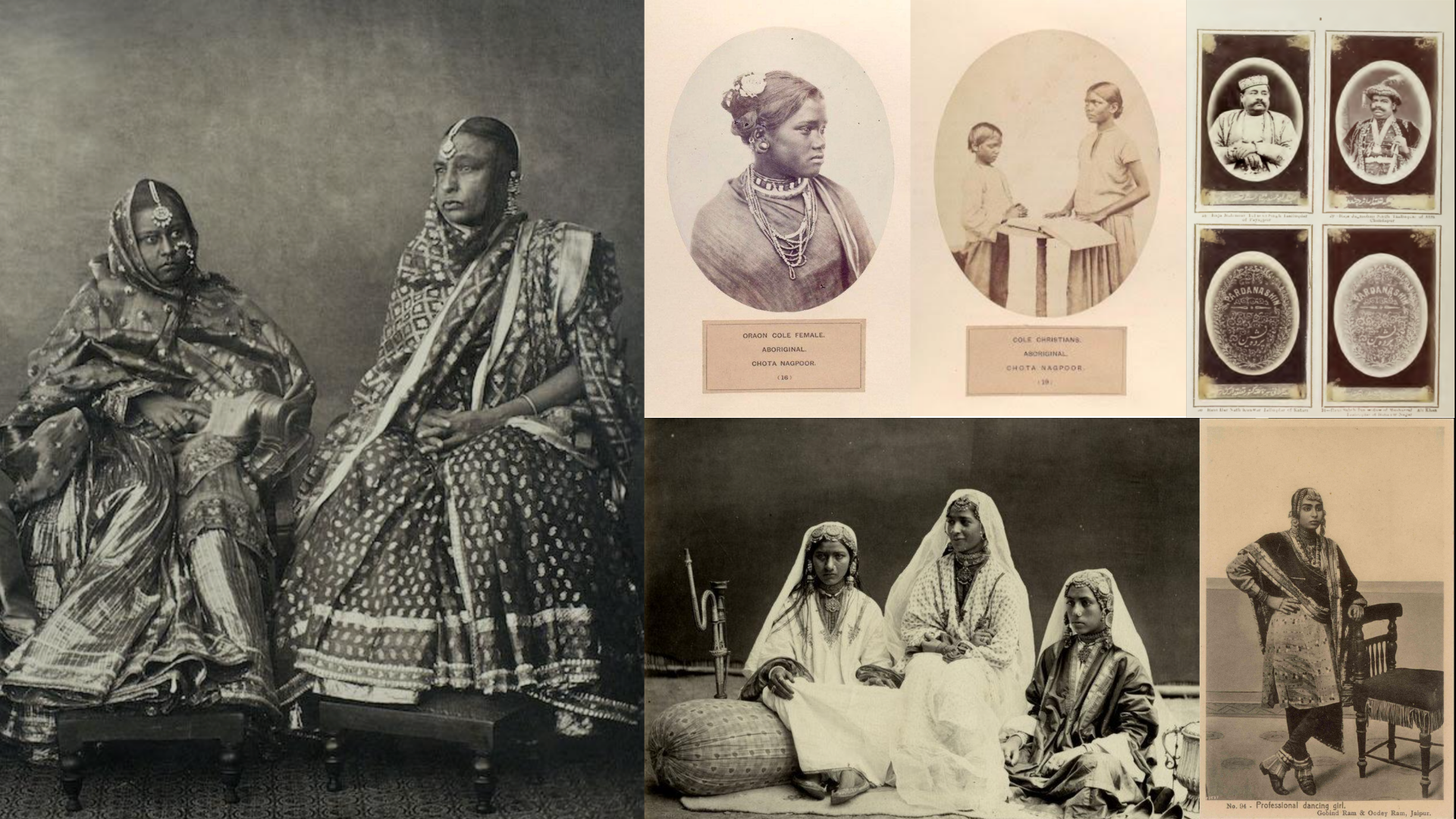
The oddity of the featured women, both Hindu and Muslim, lies in the fact that those oval frames were empty. Instead, the medallions that should have carried their photographs were engraved with the words ‘pardanashin‘, meaning hidden behind the veil. In a sense, their invisibility is visible in the frames; their identity not erased, but represented only behind the limitations of cultural thresholds and gendered boundaries of ‘honour’ and ‘privacy’.
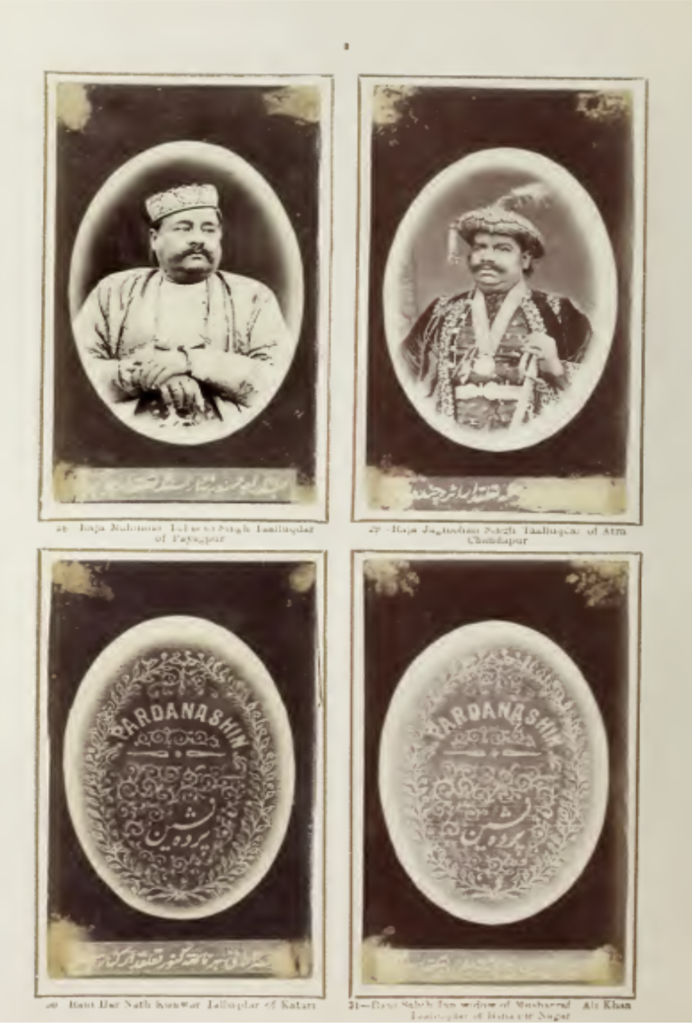
While promoted as an objective documentation tool, early colonial photography was a construction of Indianhood as an ethnographic specimen of a backward civilisation, thereby justifying the civilising mission of the colony. In this context, the women under the lens of the colonial camera became a projection of colonial tropes — they became classified, categorised, and labelled depictions of the performance of Indian womanhood. Occurring sporadically amidst an overwhelming male representation, they essentially became ‘the other within the other’.
While promoted as an objective documentation tool, early colonial photography was a construction of Indianhood as an ethnographic specimen of a backward civilisation, thereby justifying the civilising mission of the colony.
Ranging from the carefully preserved absence of elite women to instances of negotiated self-representation, to categorised racial and social ‘types’, to the hyper-representation of nautch girls, photography became a site where imperial power shaped how women were made visible, or kept invisible.
Women as ethnographic ‘types’
The categorised depictions of women as embodiments of colonial notions regarding native Indian people can be seen in The People of India (1868-75). An 8-volume official ethnographic project, it was originally conceived by Lord Canning who wanted to possess photographs of the ‘natives’. Women (and men) here are ‘types’ — showcased not as individuals but as representatives of a category. Most images show standardised poses — both front and side profiles — and largely neutral expressions, making it convenient to classify and compare groups as ethnographic types.
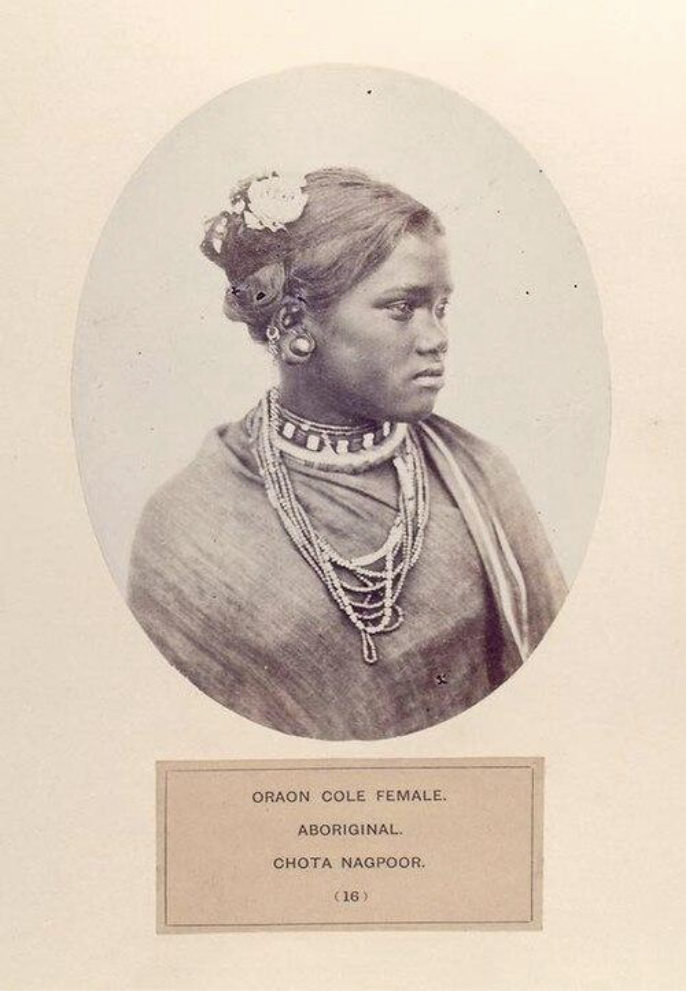
Photographs were captioned ‘Limboo female’, ‘Oraon female’, ‘Munipooree female’, and so on. The purpose here was to emphasise the characteristics of the women from the documented tribes, particularly their visual markers like dress, hairstyles, and ornamentation, and the ‘kind of femininity’ they were thought to exhibit.
For instance, one description of Santhal women says, ‘The Sonthal women are fat and short, and though not pretty according to the European idea of beauty, have a very pleasing expression of countenance’. Another description states that Santhal women were free from the prudery that secludes Hindu and Muslim women but are nevertheless modest and feminine. One can see that photographs were a tool to construct and compare different kinds of femininity in India while using women’s bodies and perceived behaviour to define entire communities.
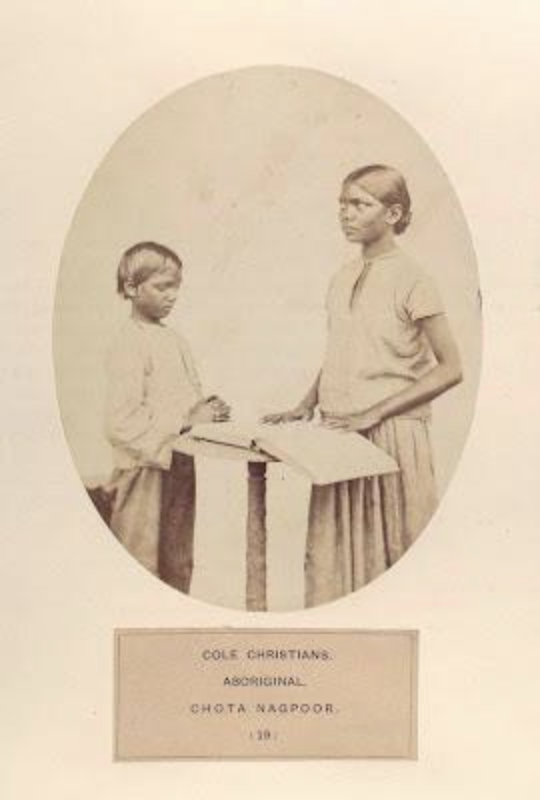
If tribal women could be photographed as specimens of a ‘backward community’, they could also be staged as images of successful moral reform through conversion and education. One image captioned ‘Cole (Kol) Christians’ shows a girl wearing a simple dress, unadorned, standing in front of an open book — none of which is incidental.
If tribal women could be photographed as specimens of a ‘backward community’, they could also be staged as images of successful moral reform through conversion and education.
While still classifying them, the picturisation shifts from a primitive ethnic type to a Christian convert type, constructing a visual form of propaganda of a ‘Christian pupil’ who now prioritises her books over any archaic adornments. The accompanying description claims that the new simplicity in appearance was part of a requirement to be ‘tidy and clean’, and a compulsion to cast away all vanities such as ornaments.
The negotiated representation of royal women
Unlike ethnic photographs, the portraits of royal women display the intersection of colonial documentation and elite women’s concerns of respectability and performances of power. Elite women, particularly in the North, observed purdah, making photography incompatible with the norms of seclusion. However, archives show that rather than an outright prohibition, photography was incorporated as a negotiated activity exercised under controlled circumstances in royal households.
However, archives show that rather than an outright prohibition, photography was incorporated as a negotiated activity exercised under controlled circumstances in royal households.
But distinct from the empty frames of the pardanashin women, an exceptional documentation emerges from the state of Bhopal in the 1860s. The portraits of the Begums of Bhopal, first photographed by Lt. James Waterhouse in 1862, contested colonial fantasies of Indian womanhood in many ways. The tenures of the four begums between 1819 and 1926 were exceptional on many counts — they were truly legitimised female rulers who withstood the pressure of powerful male claimants to the throne and established their rule by force of personality rather than by the right of succession. Added to this was their refusal to observe strict purdah, particularly by Nawab Sikandar Begum who saw it as an ‘absurd and ridiculous custom’.
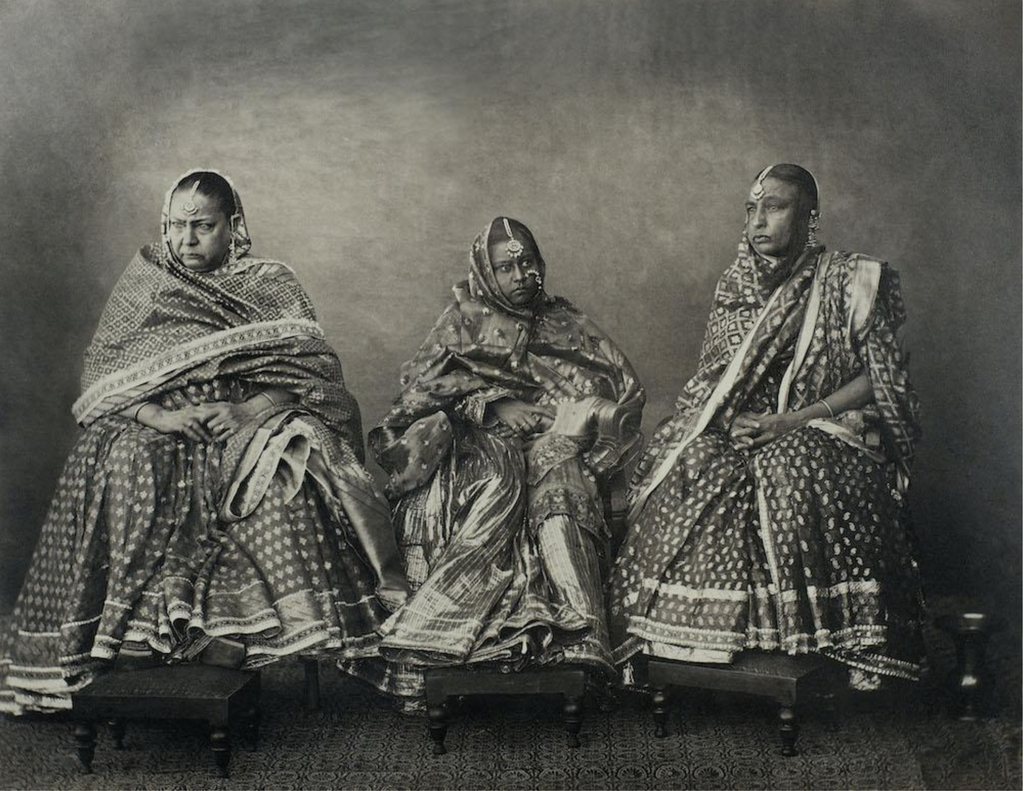
Waterhouse recounts how Sikandar Begum was enthusiastic to be photographed, dressing herself for the occasion. He remarked that ‘I had no time to take the picture twice as the Begum changed her dress immediately‘.
The Begums of Bhopal, therefore, added an element of self-representation to the colonial endeavour of ethnographic documentation. According to Sophie Barfour Lynn — who wrote a paper titled The Photographic Portrait in The British Raj: A Study of the Representation of the Begums of Bhopal — by picturing the begums with their women relatives rather than with their husbands, the photographs place agency with the women, positioning the begums as part of a powerful matrilineal line of succession rather than as their husbands’ possessions.
The hyper-visible ‘nautch girl’
The ‘nautch girls’ (a blanket colonial term that encompassed classical ceremonial performers, courtesans, and temple dancers across several regional traditions) were among the most hyper-visible women in 19th century colonial photography.
Following the tradition of relegating individuals to ‘types’, nautch girls were also rendered as one. They were the women who stood for the ‘exotic East’ — sensual and theatrical images that became popular in exhibitions, albums, and postcards, especially for a ready European market. According to Professor Kathryn Hansen, ‘The eager adoption of the new technology by courtesan sitters altered photographic practices toward the close of the nineteenth century.‘
Their public performances and accessibility to photographers coincided with the expanding commercial production and reproduction of photography, as well as new global networks of circulation. Together, these factors resulted in a wider proliferation of nautch girl imagery.
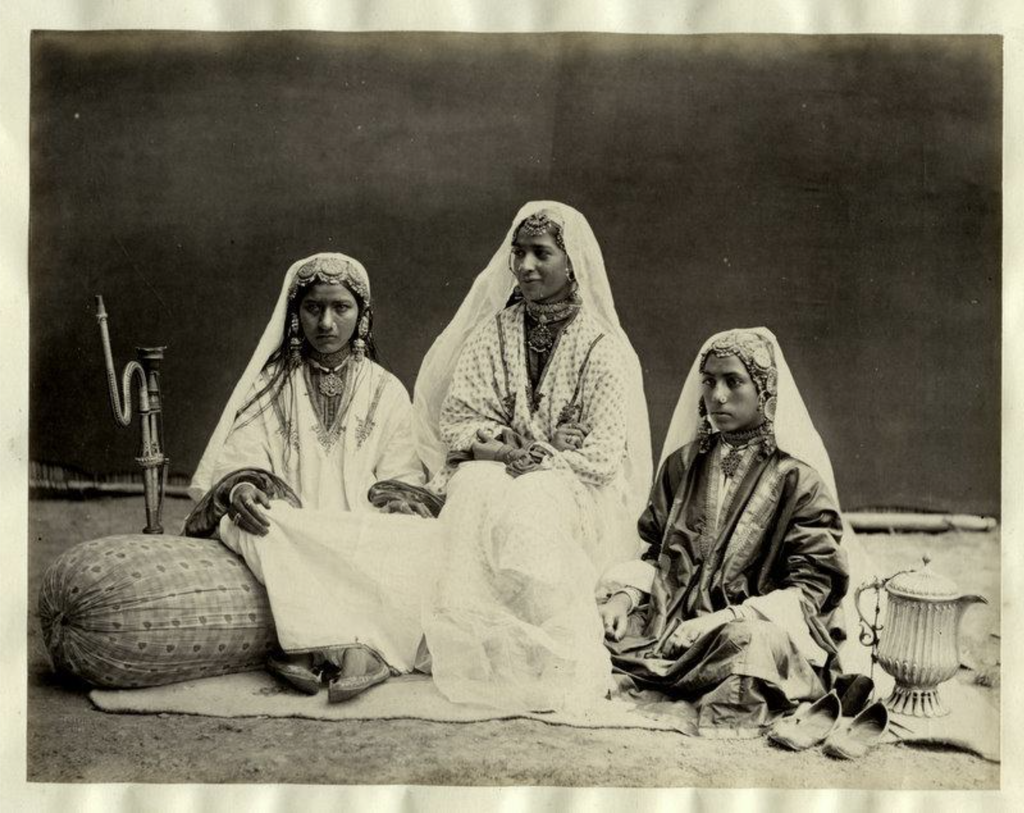
Some of the earliest photographs of women dancers come from Samuel Bourne’s work in the 1860s, recording nautch women as a desirable subject for the European eye. In Samuel Bourne’s own description of the pictures of Kashmiri nautch women, they were gathered on the orders of the English resident in Srinagar to bring the best-looking nautch girls.
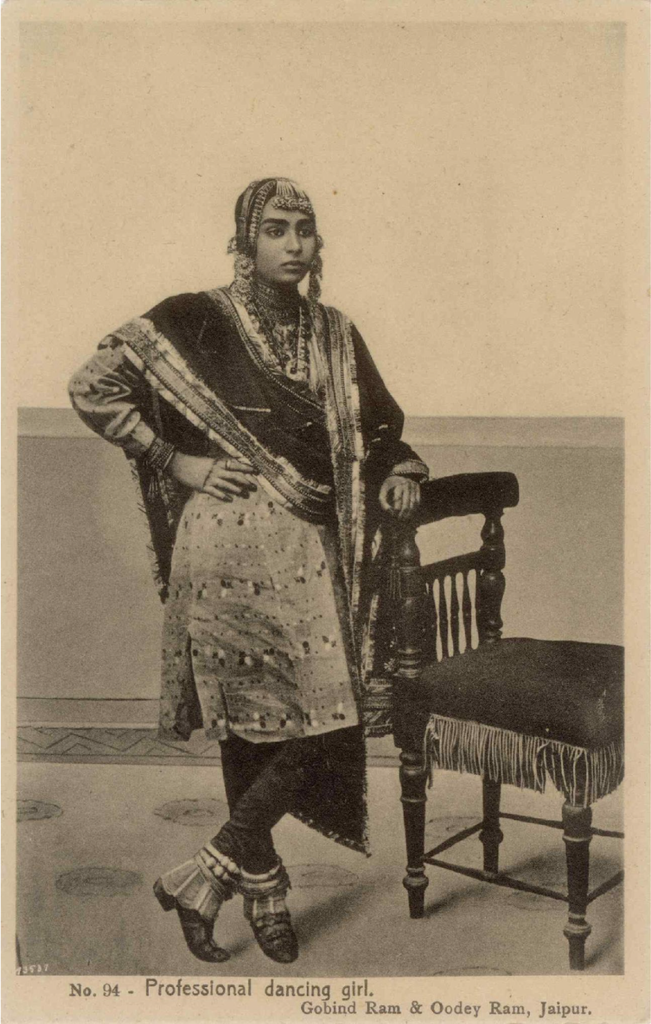
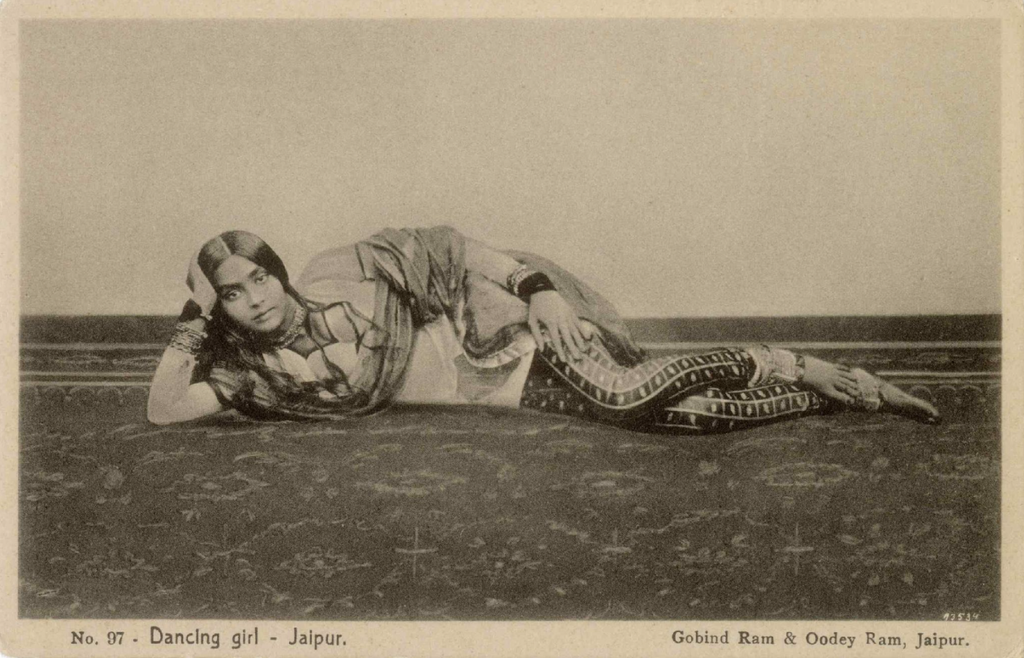
The mass-produced nautch girl postcards created by Indian studios like the Gobind Ram and Oodey Ram Studio was wilfully catered to colonial tastes. This included the ‘Professional Dancing Girl’ photograph with carefully posed costumes, jewellery. and body language. Another one titled ‘Dancing Girl — Jaipur’ shows a woman in a reclining posture, holding an uninhibited sensual gaze directly at the viewer. In rendering them a commercially reproduced colonial visual type, nautch girls became an actively and selectively shaped figure, vilified in both the colonial and nationalist perspective as the decadence of eastern womanhood.
Women behind the lens
Interestingly, the patriarchal constraints placed on women to perform respectability led to the emergence of exclusive studios for women in the late 19th century, run by European women. The Journal of the Photographic Society of India describes studios that existed to photograph ‘native ladies only’. As per the publication, these studios were surrounded by high walls and European women photographers were assisted by native women.
According to Siddhartha Ghosh, the first of these professional women photographers was Ms E Mayers with a zenana studio in Waterloo Street, Calcutta. Apart from her, women such as Ms Imp, Ms D Garrick, and most importantly, Ms Wince are mentioned because of their early photographic endeavours.
In an advertisement dated 1885 in the Bamabodhini Patrika, Ms Wince offered lessons to women in the art of photography in their houses, following the popularity of such ventures in England. The magazine, in fact, notes: ‘In this country, women are unable to learn photography because there is no means to do so. Those women who have the time, the money, and above all the inclination to be a photographer should never waste this chance. We hope you will seize this opportunity.‘
It didn’t take long for Indian women to become their own image makers, with Sarojini Ghosh becoming the first Indian woman to open a commercial studio in 1899 in Bengal.
While the direct results of her venture remain unclear, it didn’t take long for Indian women to become their own image makers, with Sarojini Ghosh becoming the first Indian woman to open a commercial studio in 1899 in Bengal.
As an agent of cultural domination, photography enabled the Victorian gaze to objectify the lives of its Indian subjects. And as we saw, the gendered pattern of this gaze was never a straight binary of public men vs private women. Instead, women’s visibility under the lens was structured by class, caste, geography, and norms of respectability. Between the purdah-observing taluqdari women and the hyper-visible image of the nautch performer lies the spectrum of colonial visual politics — a system that decided who would be seen, how, and how much, and what those images would come to mean for generations of historical memory.
References
- The People of India: Photographic Illustrations with Descriptive Letterpress (Vol 1), edited by J. Forbes Watson & John William Kaye
https://archive.org/details/dli.pahar.0652/mode/2up%20 - India Through the Lens: Photography 1840-1911, by Vidya Dehejia https://archive.org/details/indiathroughlens0000unse/page/n7/mode/2up
- The Photographic Portrait in the British Raj: A Study of the Representation of the Begums of Bhopal, by Sophie Balfour-Lynn https://www.academia.edu/8968538/The_Photographic_Portrait_in_The_British_Raj_A_Study_of_the_Representation_of_the_Begums_of_Bhopal
- Chobi Tola: Bangalir Photography-Chorcha (Taking Pictures: The Practice of Photography by Bengalis) by Siddhartha Ghosh, translated by Debjani Sengupta
https://read.dukeupress.edu/trans-asia-photography/article/doi/10.1215/215820251_4-2-202/312671/Zenana-Studio-Early-Women-Photographers-of-Bengal - How the Colonial Imagination of the ‘Nautch Girl’ was Read Back into Indian History by Omar Khan https://scroll.in/article/1090349/how-the-colonial-imagination-of-the-nautch-girl-was-read-back-into-indian-history
- Beyond the Frame: Exploring Dimensions of Colonial Photography in India by Martin Tom & Balaji Ranganathan https://www.researchgate.net/publication/378230259_Beyond_the_Frame_Exploring_Dimensions_of_Colonial_Photography_in_India
- An Illustrated Historical Album of The Rajahs and Taluqdars of Oudh by Darogah Haji Abbas Ali https://archive.org/details/illustratedhisto00alid