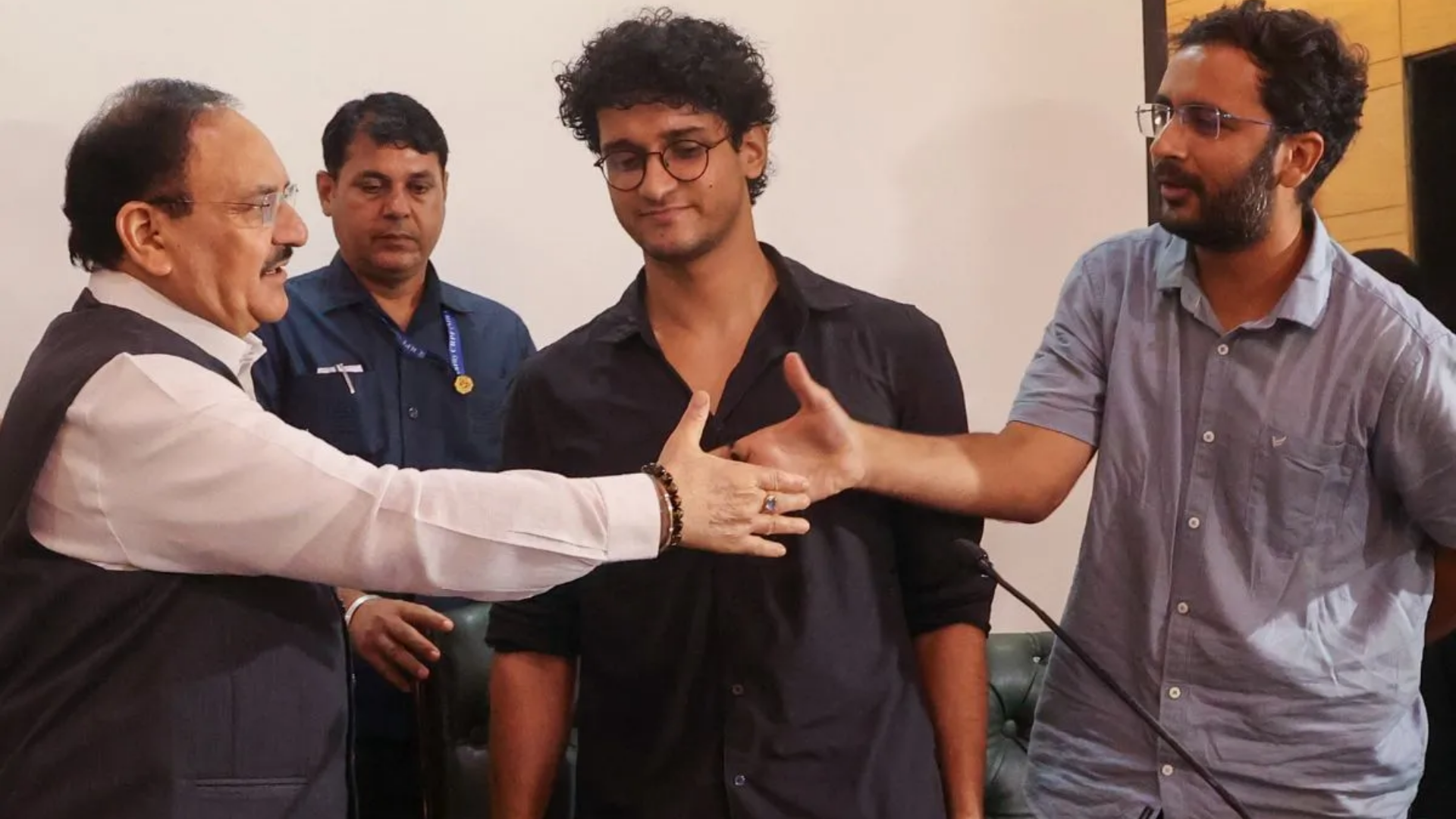
The spontaneous rise of the Cockroach Janta Party has come to represent a new political moment in India. On the ground and on digital platforms, its fierce — and now successful — demand for Dharmendra Pradhan’s resignation and its call for a nationwide youth mobilisation have resonated deeply with millions of Indian youth plagued by repeated systemic failures.
Behind this swell of public anger lies not only a paper leak but also a fundamental question about the nature of political transformation: does simply replacing leaders solve our deepest crises, or does it merely scratch the surface?
However, behind this swell of public anger lies not only a paper leak but also a fundamental question about the nature of political transformation: does simply replacing leaders solve our deepest crises, or does it merely scratch the surface?
The CJP and the savarna liberal fantasy
The CJP’s call for Pradhan’s resignation may be a legitimate response to his administrative failures. But the demand also reflects a familiar Savarna liberal belief — that changing who occupies positions of power is sufficient to change the structures through which power operates. Removing a minister from his position does not alter the structural conditions that determine who has access to power, whose interests are represented, and whose voices are heard. The problem is not that the CJP demands change. It is that its political imagination stops at institutional reform, without questioning whether the underlying administrative systems themselves require transformation. In doing so, it almost perfectly exemplifies the Savarna liberal fetish: reform without structural change.
Removing a minister from his position does not alter the structural conditions that determine who has access to power, whose interests are represented, and whose voices are heard.
The same limitation applies to its attempt to build a nationwide movement. India is not a homogeneous nation waiting to be mobilised around a common grievance. It is a society deeply stratified by the intersecting inequalities of caste, class, and gender. Tens of thousands of working-class and Dalit youth join these rallies. Even so, their radical potential is subsumed into a caste-blind Savarna liberal agenda. A nationwide movement claiming to represent the people must ask who the people actually include. Refusing to confront inequalities in the name of unity risks making privilege appear universal.
The savarna liberal and the politics of indifference
Savarna liberals might be willing to call for change. However, they remain reluctant to take sides in the inevitable conflicts by way of which change actually happens. The government may be criticised, and institutional failures may be condemned. Yet their willingness to speak against injustice rarely translates into political solidarity with those organising against it. When one is quick to oppose the government but reluctant to raise their voice for structural change, all they do is condemn oppression without aligning with the oppressed. In demanding change but refusing to confront the relations of power that produce social inequalities, both Savarna liberals and their politics remain far removed from reality.
For instance, why did the Ken-Betwa protests receive no mention in the CJP’s demands? Why was there no mention of any of the other protests happening simultaneously with that of the CJP’s? Why was the protest withdrawn as soon as the demand for Pradhan’s resignation was accepted, without any calls for changing the underlying structures of oppression?
Savarna liberals often consider their apolitical stance to be neutrality. But in a society where even the power to dissent is governed by caste, neutrality itself is not neutral. In a profoundly unequal society, the refusal to take sides is simply taking the side of the oppressors.
Savarna liberals often consider their apolitical stance to be neutrality. But in a society where even the power to dissent is governed by caste, neutrality itself is not neutral. In a society like ours, taking the ‘neutral’ stand is an implicit acceptance of the hierarchical social structure. Savarna liberals are willing to demand change, provided change does not require confronting their privilege or taking a side. However, in a profoundly unequal society, the refusal to take sides is simply taking the side of the oppressors.
Political democracy without social democracy?
The real problem with Savarna liberalism is the separation of political democracy from social democracy. When Savarna liberals associate democracy with only elections, they fail to recognise that political democracy doesn’t exist in isolation; it is not independent of the social and economic conditions that surround it.
When Savarna liberals associate democracy with only elections, they fail to recognise that political democracy doesn’t exist in isolation; it is not independent of the social and economic conditions that surround it.
This reductive understanding does not pay any heed to Dr B.R. Ambedkar’s warning: mere political equality without its social and economic counterparts puts democracy itself in peril. A society can be politically democratic while remaining socially unequal. Institutions can be reformed, and ministers may come and go, but the structures of privilege that unequally arrange everyday life remain untouched.
This is the core contradiction of Savarna liberalism, namely that political democracy is defended, but the demand for social democracy is hardly as forceful. Importantly, political inequality cannot be separated from the call to simultaneously democratise social relations. If some groups enter political life with generations of accumulated privilege while others inherit nothing but exclusion, any promise of equality remains inadequate. The question, then, is not merely whether institutions function properly, but who they function for and who they leave out, and whether they reproduce the same inequalities that exist around them.
NEET and the myth of merit
The debate around NEET illustrates this contradiction perfectly. The immediate focus of the CJP was on Pradhan’s resignation. However, Pradhan’s resignation doesn’t resolve the deeper structural crisis: the fact that we have accepted a system in which the futures of millions of young people are determined by a single ‘meritocratic’ examination. The CJP’s demand is to make the examination fairer on paper, and is tinted with Savarna liberal undertones. But this demand stops short of questioning the social inequalities that determine who can actually compete in this examination.
What never crosses the Savarna mind is that the idea of merit itself is based on historical amnesia. As the A.K. Rajan Committee’s report pointed out, the CJP’s demand should have been to abolish an examination that is exclusionary at its core. In any case, S. Anitha did that first.
Opposition to reservations in higher education and now the rise of the Reservation Hatao Andolan (RHA) reflect this logic, where access to elite institutions such as IITs and IIMs is imagined as the exclusive product of merit, thus obscuring the unequal social and educational conditions through which merit itself is produced
Meritocracy presents success as a natural outcome of talent and individual excellence. In doing so, it reduces advantages accumulated over the course of history into seemingly deserved rewards. Through this narrative, privileges accorded by caste are detached from their historical origins and are instead recast as solely personal accomplishments. Opposition to reservations in higher education and now the rise of the Reservation Hatao Andolan (RHA) reflect this logic, where access to elite institutions such as IITs and IIMs is imagined as the exclusive product of merit, thus obscuring the unequal social and educational conditions through which merit itself is produced. Crucially, the inequalities of caste, class, and gender don’t end when an examination begins.
Who does the system work for?
The question of who the system works for must not go unanswered. A student who has benefitted from years of high-quality schooling doesn’t go into an examination hall under the same conditions as one who did not have access to a comparable standard of education.
Furthermore, Savarna liberal calls for reform are removed from the exploitation of workers whose labour is extracted by the economy. The demand for a meritocratic system ignores centuries of exclusion from education and employment. For instance, domestic work and financial dependence are disproportionately forced upon women. These inequalities dictate who can participate in political life in the first place. A nationwide movement asking people to come together, all while refusing to acknowledge these differences, risks reproducing the very hierarchies it claims to oppose.
The Savarna liberal fantasy is therefore not simply an attachment for surface-level reform. It is the hypocritical desire for change without confrontation, political transformation without social transformation, democracy without redistribution, and equality without challenging privilege.
The Savarna liberal fantasy is therefore not simply an attachment for surface-level reform. It is the hypocritical desire for change without confrontation, political transformation without social transformation, democracy without redistribution, and equality without challenging privilege. It directly reflects the quintessential Savarna liberal attitude: ‘It’s fine, as long as it doesn’t affect me’. The CJP is but one expression of this wider political sensibility; the real problem extends far beyond it. Any movement that seeks to transform India must be willing to confront the structures of privilege that determine the quality of our lives.
About the author(s)

Abhijay Rambabu (he/him) is a sociologist with a keen focus on digital, urban and cultural sociology. He researches and writes upon these topics, in addition his writings on ecology, inequality and critical caste studies.

Good post! We will be linking to this particularly great post on our site. Keep up the great writing
I would like to further add by concretizing some of my own beliefs about education and what it should mean, even in a country with vast unemployment.
First is the idea of education as a means of economic mobility. This idea took off with the GI Bill post WWII in the US. In around 30 years since that bill when higher education got really accessible, corporate America tightened it’s screws and the demand from educational institutions was to produce people capable of working in high paying, white collar jobs. Before this period, higher education was very elitist but also did not seek to be a pipeline of wage slaves.
In India, I believe, this was to be expected. In an impoverished nation, even without corporate demands, the goal of people is naturally to move up the economic ladder. In my view, this is an expression of the idea of finding private solutions to public problems.
We seriously need to ask that whether the goal of useful employment for all is even desirable, let alone attainable. How many doctors, nurses, sanitation workers, civil engineers, electronics and computer engineers, architects, urban planners, etc. does this country really need? With improvements in technology, I have a hunch that this number is far lower than the number of unemployed. If the effort required to meet the needs of society can be handled by fewer people, why are we in a race to create pointless jobs, slog away for many hours a week, compete with each other in highly toxic examinations? why not unleash the creative energies of the nation in arts and sciences?
I hope the reader of this comment can see that my view is aimed at exploring the possibility of short-circuiting a lot of steps we seek for social justice. If it is not possible, it would be very sad to see us be in a system where we are still slogging away at exams and jobs; even if a bit more equitably.