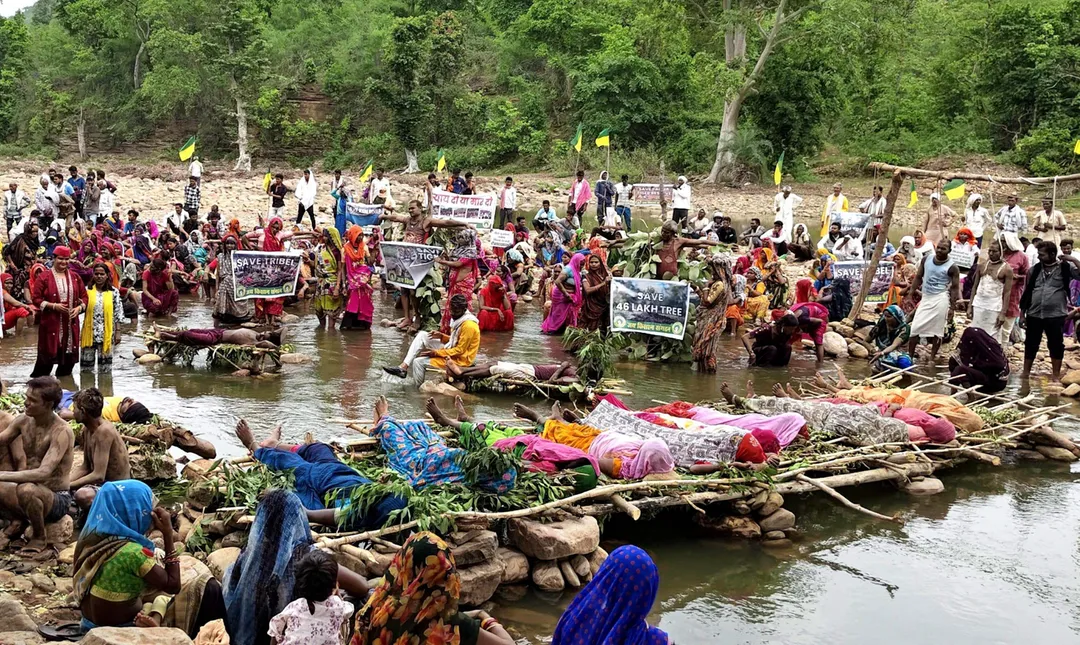
While the nation holds its breath watching the anti-National Eligibility cum Entrance Test (NEET) protests unfold at Jantar Mantar in the capital, the geographical heart of the nation is witnessing another act of dissent. In Madhya Pradesh’s Chhattarpur, women lie on a symbolic funeral pyre, and a few meters away, villagers stand waist-deep in the Barana river protesting against the Ken-Betwa river linking project. The “Nyay do ya mrutyu” was a resolve to preserve one’s livelihood and stay rooted to the land they have tilled for years.
On December 25, 2024, the Indian Prime Minister laid the foundation for the 44,605-crore Ken-Betwa river-linking project, which seeks to transfer water from the Ken basin to the Betwa basin through a 221-km-long canal. It is the first project of the ambitious river-linking agenda of the National Democratic Alliance led by the Bharatiya Janata Party. It aims to address water scarcity across parts of Madhya Pradesh and Uttar Pradesh, with a commitment to irrigate 10.62 lakh hectares, provide drinking water to 62 lakh people, and generate 130 MW of electricity. However, agitation by the villagers is not limited to this infrastructural project but also the Mahjgaon and Runjh irrigation projects.
The grievances arose from inadequate compensation, land loss, displacement, illegal evictions, and allegedly false police cases against villagers. The local population is mainly Adivasi, belonging to the Gond and Kol Tribes. Their lives are anchored to the Ken river and the forest produce, and this project is a signal of doom for these tribal communities demanding rehabilitation while the mainstream media overlooks their struggle.
Overlooked and Underplayed
Sonam Wangchuk’s indefinite hunger strike is painful to watch, but Jai Kisan Sangathan’s leader Amit Bhatnagar’s indefinite hunger strike is not even receiving mainstream media coverage. Spearheading the Chita Andolan in Bundelkhand and Chhattarpur regions, Bhatnagar, who is also the local Aam Aadmi Party leader, demands fair compensation and rehabilitation for families affected by the three initiatives. Bhatnagar alleged that the gram sabhas’ consent was fabricated and administrative mishandling had occurred. Villagers claim that the project has taken away their land without fair and full compensation. However, on the 14th day of the hunger strike, the state police forcibly intervened, dismantled the pyres and shifted Bhatnagar to a hospital.
In February 2026, the protests turned violent as villagers pelted local officials with stones. They gheraoed the Bijawar Tehsil office, demanding the release of Bhatnagar, who was taken into custody and released four days later, on February 12. Similarly, in April, tempers ran high as villagers clashed with local police and administrative officials who tried to approach them but then retreated. Finally, on April 16, the villagers suspended their second round of protests following assurances of dialogue. A fresh survey was announced to ensure no eligible villager will be left out of the rehabilitation package.
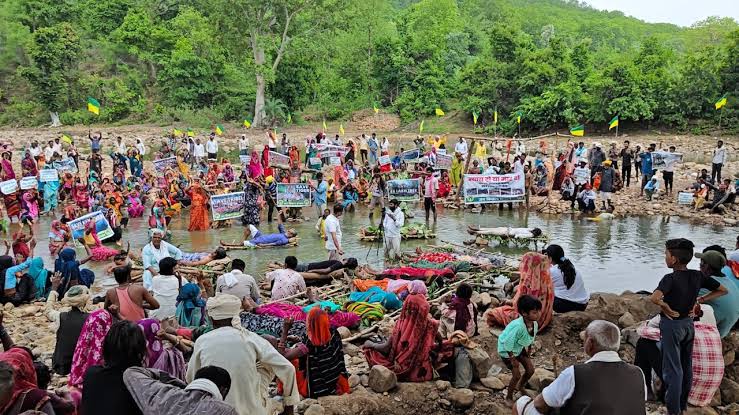
This time, in July, the visuals were moving. Villagers were lying on funeral pyres floating on the Ken River. This Phansi Satyagraha and Jal Andolan with women standing knee deep in the river holding infants with nooses tied around their necks was to say that death is better than a life without justice. Soil was smeared on their bodies, symbolic of Mitti Andolan, and they collectively fasted as part of the Akash Andolan. The villagers claimed that the Daudhan Dam project submerged 22 ancestral villages, forcibly displaced 7000 tribal families, and that massive corruption had taken place. The total area that will be submerged is 9000 ha, including over 4141 ha of the core area of Panna Tiger Reserve and 1314 ha of the buffer zone.
Bundelkhand comprises 13 districts in Uttar Pradesh and Madhya Pradesh. The idea of this project dates back to 1980, when the government formulated a National Perspective Plan to transfer water from surplus areas to water-deficit regions. 30 link projects were identified, and the Ken-Betwa link is the only project under the plan that has started implementation. However, irrigation projects that come at the cost of the livelihoods of the very villagers they serve are unacceptable. According to government estimates, around 17,101 trees were identified for felling, of which 12,404 trees have been felled within the Panna Tiger Reserve. Ecologists say that the reserve is under threat, and so are the wildlife habitats of Gharials and vultures. A central empowered committee constituted by the Supreme Court to examine the wildlife clearance submitted a 2019 report. The report questioned the clearance, highlighted large-scale felling of trees, raised concerns about the impact on wildlife, and expressed doubts about the viability of the project.
Rightful claim for rehabilitation
The government maintains that the villagers have been adequately compensated, but in this third round of protests, the tribal communities have again raised concerns over inadequate compensation, claiming that the assurances given then were false. The villagers also claim a violation of essential tribal-related forest rights. The Panchayats Extension to Scheduled Areas Act, 1996, empowers the gram sabhas with self-governance rights over local land, minor forest produce, and water bodies. Similarly, the Forest Rights Act, 2006, legally recognises the rights of forest-dwelling Scheduled Tribes and Other Traditional Forest Dwellers to correct historical injustice. Provisions include mandatory consultation prior to acquiring land. Protesters alleged that mandatory consent from the gram sabha was not obtained before displacement. Regional alliances, such as the National Alliance for Climate and Environmental Justice, have condemned the administration for deploying illegal evictions, demolitions, and false police cases to force relocation.
The announced rehabilitation package provides compensation for private land as per the land acquisition law, or Rs 12.5 lakh, whichever is higher, along with compensation for trees and orchards. The villagers have demanded village-for-village and land-for-land resettlement within the same habitat, and that the compensation amount be raised to Rs 25 lakhs. They also seek greater transparency in the survey of land and houses. Bhatnagar alleges that the provisions of the 2013 land acquisition law have not been followed. Officials contend that many demands cannot be met because they go against the law. For example, the 2013 law recognises a family as a single unit and does not permit benefits to be extended to individual voters. On the demand to change the cut-off date to January 1, 2026, officials say altering it would violate established norms. The local administration is currently abiding by the February 16, 2024 cut-off date to determine eligibility.
An official told Frontline Magazine that more than Rs 700 crore in compensation has been disbursed, accounting for 90% of the award value. They added that supplementary awards were being prepared for those who have expressed dissatisfaction over exclusion, accounting for roughly 10% of the families.
No less, no more
It is not to dismiss the fire that is burning at Jantar Mantar, but to bring to attention another important movement against arbitrary government action. Lives, livelihoods and generations of networks are at stake for the supposed ‘development’, that is as the government says, ‘for the betterment’ of the tribal communities. What good is development if it snatches the very means of survival and imposes an idea of cement and concrete without replenishment?
Under a net of false promises, these three developmental projects: Ken-Betwa, Runjh and Majhgaon, are masking social, economic and ecological disasters. Bhatnagar’s hunger strike is joined by the people of Bundelkhand and Chhattarpur who lie flat on funeral pyres, tied to wood and starving not for food, but the Right to Life and Livelihood. This right is inherent in Article 21 of the Indian Constitution as a fundamental right.
The age of social media has come to us, with independent journalists going on the ground to provide due coverage, but will mainstream news channels move beyond the narrative devised by the government? Both the anti-NEET paper leak and the Ken-Betwa protests demand accountability, consideration and transparency. Both protests have taken the Gandhian route of hunger strike. Both protests are receiving little to no coverage. Both protests were intervened in by the state police. Both Wangchuk and Bhatnagar were forcibly admitted to a hospital. It is saddening that the largest democracy in the world is compelling its citizens to choose death over living in the unjust state of affairs that it has created. True democracy demands that mainstream media move past filtering out dissent and reclaim its foundational duty: holding power accountable through critical, unyielding advocacy.
About the author(s)

Second year student of Media Studies at CHRIST (Deemed to be University), BRC, Bangalore. A trained Kathak dancer, theatre artist and political nerd.

There is definately a lot to find out about this subject. I like all the points you made