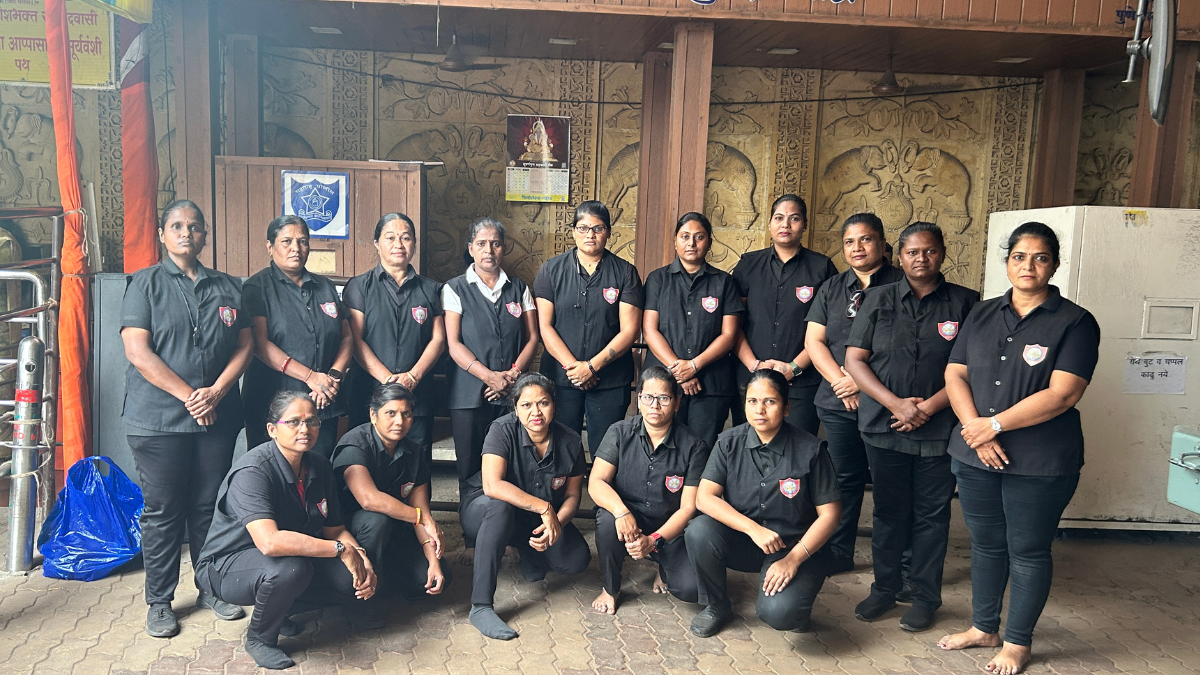
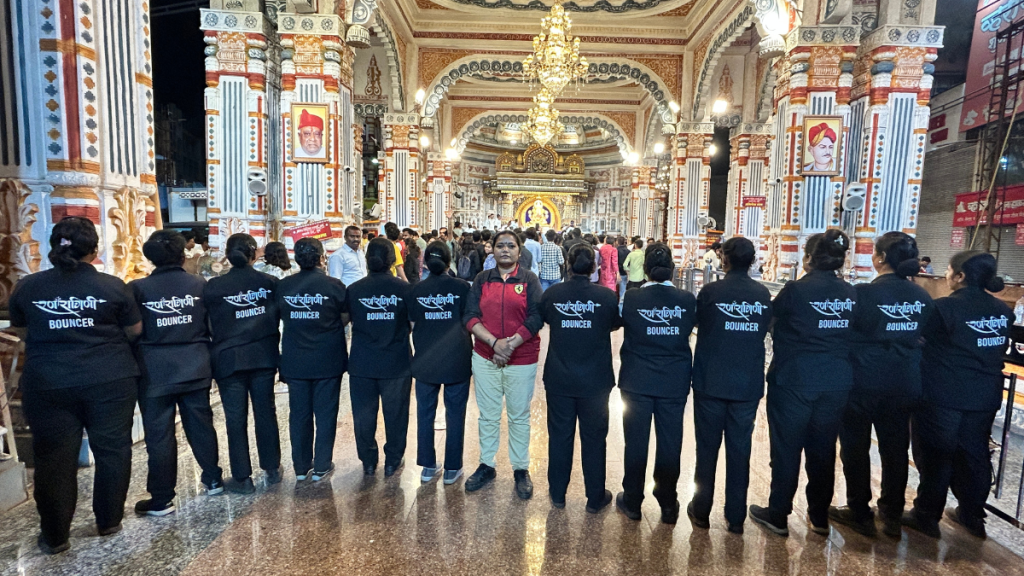
On a humid afternoon in Pune, Deepa Deepak Parab, founder of Ranragini Lady Bouncer Group, is posted outside a crowded political rally where her black ‘Security’ T-shirt hints at the force she commands: over 700 women bouncers across the city. Parab, once a makeup artist and film extra in Bombay, had her life flipped when she decided to become a lady bouncer in the year 2016 after being forced to quit police training by her parents, choosing a similar path that allowed her to use her skills and assert her independence. “Many questioned my choices and said that this job is not meant for women. But I made up my mind. It started with just five women in sarees showing up to unpaid gigs”, said Parab.
The feminist urban theory often refers to the right to the city and not only to reside in a city but to shape and inhabit its public spaces freely. For many Indian women, nightlife has long been a contested terrain through layers of surveillance, fear and self-censorship.
Deepa Parab’s long journey: dreams cut short
For as long as she can remember, Parab wanted to wear a uniform. “I wanted to become a police officer”, she says. “I had enrolled in the force and was undergoing training without the knowledge of my parents. When they found out, they tore my books. My family’s mindset was very conservative and they felt a girl’s place is indoors”, said Parab.
The disappointment stays even now. “My studies were less but my dreams were not”, she says with a small laugh. Having been forced to abandon her training, Parab turned to whatever work came her way. She later married at the age of 27 and shelved her own ambitions. It was only after her in-laws passed away in 2015 that she decided to reclaim a piece of her old self. “I told my husband, I’ve fulfilled all my duties. Now I want to try my hand at something new.”
This desire took her to Mumbai and unexpectedly into the film industry. Parab worked as a makeup artist and an extra in Marathi films. “Once, I got to play a policewoman; I was so happy that day”, she says. It was on the film sets that she first noticed men in black T-shirts: tall, stoic men controlling the crowd with a word or gesture. “They would protect the celebrities just like the police and people would listen to them”, she recalls. “I thought it is too late to become a cop but I can still become a bouncer,” She was initially dismissed by people. “Even today, people think ladies are weak but strength is not only in the body, it is in the mind”, she said. Returning to Pune, she began training herself and other women too. “If you want to be a bouncer, you need strong arms and legs. Only then can you hold your ground in a crowd or protect someone else”, said Parab.
What began with five women in sarees would eventually grow into a 700+ strong Ranragini Lady Security Services providing a disciplined and determined all-women crew to occupy public spaces traditionally controlled by men. The demand for female bouncers has grown steadily especially in weddings, VIP security and private parties.
Parab’s journey started with five women in sarees showing up for unpaid gigs and learning the job on the ground. “When I started, there were just two female bouncers in Pune. The rest were called ‘security guards’: women who lacked physique, height and command to provide real security”, she says. The major hurdle she faced while training was convincing women to step into a male-dominated space. “There were so many questions: if we wear this, what will our families say? After the events, there is no time, no buses, I don’t know how to drive a car, etc.”, said Parab. She suggested cream coloured sarees as a pragmatic and symbolic solution. “Gradually, I made the team wear sarees.”
The first events were religious gatherings where Parab’s team could observe male bouncers in action. That is where she and her team learnt crowd control, coordination, and authority. Earning credibility has been a separate battle altogether. Payment remained inconsistent and unequal with women earning less than men for similar work. “One of our first assignments was during the Ganesha festival when we had to take charge of women and the elderly”, said Parab. These humble beginnings gave Parab an opportunity to nurture a team that could handle the most complicated events: political rallies, religious ceremonies, and private functions.
Female bouncers: a new dream
What began with five women in sarees would eventually grow into a 700+ strong Ranragini Lady Security Services providing a disciplined and determined all-women crew to occupy public spaces traditionally controlled by men. The demand for female bouncers has grown steadily especially in weddings, VIP security and private parties.
The recruitment of women into the training stage is overseen by Parab herself who ensures that their height, weight and physical structure align with the requirements. Once selected, they are trained for free at the Pandit Nehru Stadium in Pune. “I do not charge them anything for the training“, says Parab. “And of the fees that they receive, I just keep 100 Rs. Sometimes, celebrities or event managers give us big amounts as a gift. We don’t keep that money either. I have funded the education of two girls with that money. I like to think of my work as a social activity and not as a business”, added Parab.
Each woman is asked to attend a couple of events where her capabilities are tested. “If all goes well, she continues to work with Ranragini as a bouncer or bodyguard or a security official. On average, they earn between 700-900 Rs. per event, with 100 Rs. reserved for Parab’s fund.
Her training is grounded in empathy. “For instance, if there is an intoxicated girl at any club or any event, our job is to ensure she’s safe, escort her to a cab, and make sure she reaches home without harm”, said Parab. The job is also deeply personal for her. Once while protecting a domestic violence survivor, she realised she was not just providing security but standing up for someone in need. “That day I understood what it really means to protect“, said Parab.
The emergence of female bouncers like Parab’s team is a part of a subtle shift in how women inhabit India’s public spaces. In feminist urban theory, scholars like Shilpa Phadke, co-author of Why Loiter?, describe the right to the city as not merely the right to live or work in urban spaces but to move through them freely with agency, visibility and without fear. For decades in India, women’s access to public life has been mediated by ideas of safety. The presence of women bouncers turns that logic on its head.
About the author(s)

Aditya Ansh is a freelance media writer based in South Asia. His works have been featured in Mongabay, The Hindu, Indiaspend, etc.


Wow! This real story has several glass-ceiling-break points; home, society, self… Salute to Deepa Parab and her team.