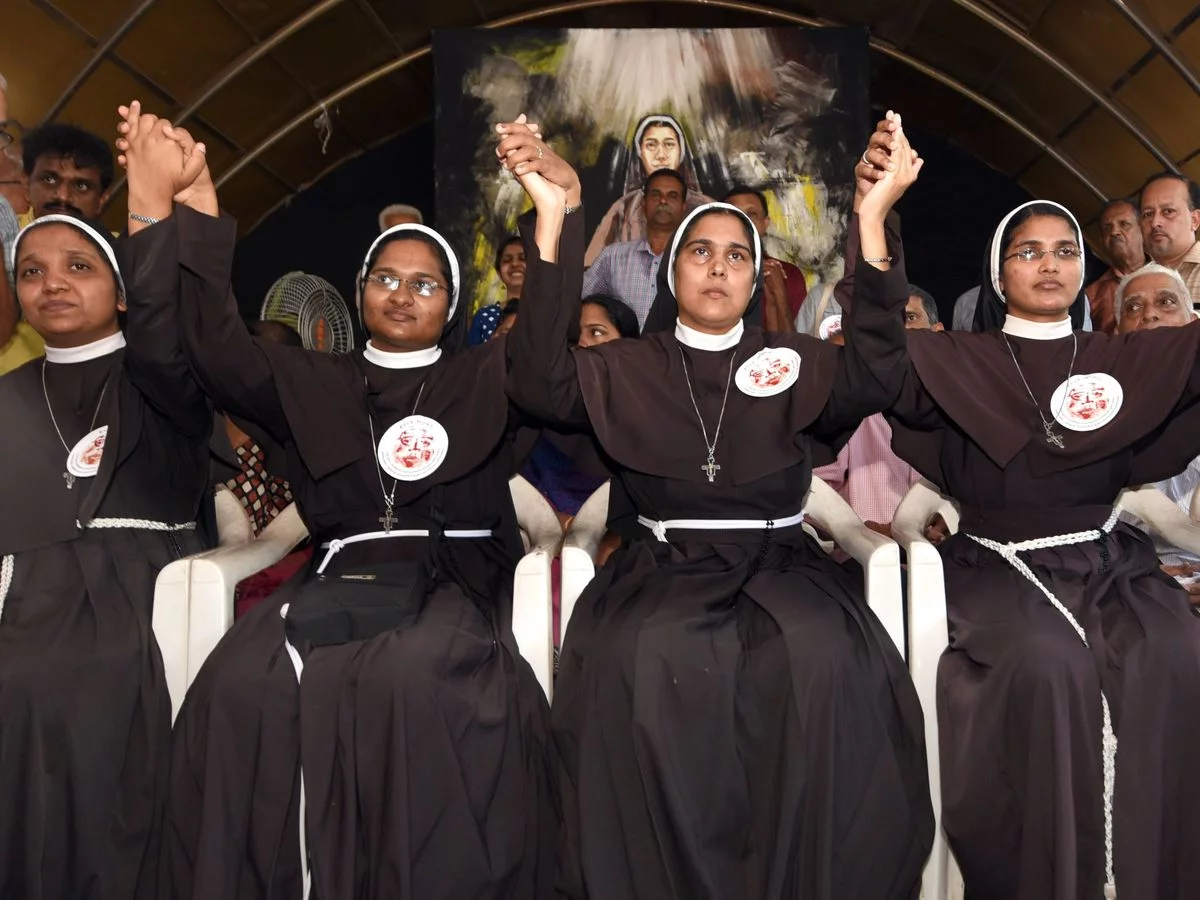
At the age when an individual considers retiring, Lucy Kalpura joined a student hostel and started her law school journey. This story is not about coming of age empowerment but about a nun who was expelled from her convent in 2018 for having protested against a powerful bishop’s sexual abuse of a fellow sister. She was rejected from her community. When her lawyer withdrew from her case, she argued her case in the High Court. Last week, she became Advocate Lucy Kalapura. Indeed, a reassuring end to a beginning.
However, the head of Kerala’s Syro-Malabar Catholic Church, Jalandhar Diocese, Bishop Franco Mulakkal remains free, untouched and acquitted in 2022 by a trial court in Kerala. Just a few miles away at the Saint Francis Mission Home, the survivor has decided to break out of isolation to say, “Many people think the case is finished, that I have left this place. But the fight is not over. I don’t want to hide anymore. I want to be seen and heard”.
The state of Kerala is much in the news due to a series of sexual assault cases. Member of Legislative Assembly (MLA) Rahul Mamkootathil has been indicted by the police on three charges of rape with a troubling pattern of serial sexual misconduct, stalking and predation. He has been expelled by the Indian National Congress (INC) but continues to remain an MLA even while in jail under judicial remand. Last month the state also witnessed the acquittal of actor Dileep in the 2017 actor sexual assault case and this verdict has moved the complainant against Bishop Franco to break her silence. Her case is another instance where acquiescence to acquittals is expected from the survivor and the relationship of power between the accused and the complainant complicates the prosecution’s claim of lack of consent.
Survivor’s trial by the society
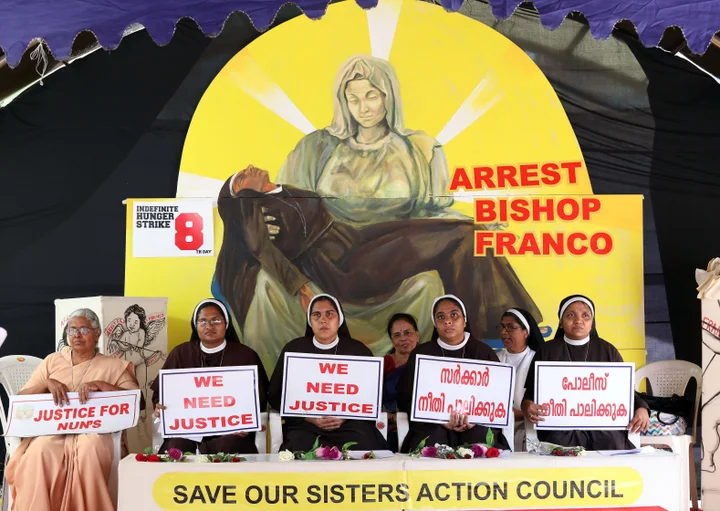
A sexual harassment case against a bishop was not the scandal India anticipated when, on June 29, 2018, a complaint of rape was registered against Bishop Franco Mulakkal of Jalandhar diocese. Before a formal complaint was filed, it was Bishop Franco who filed a complaint against the survivor and her family members alleging that they were blackmailing him and threatening to kill him. After this the survivor filed a complaint accusing the bishop of having sexually abused her on thirteen occasions between 2014 and 2016. No immediate action was taken despite a formal complaint leading to protests by a fellow group of nuns.
In India, the erstwhile criminal code, Indian Penal Code 1860 defined the crime of rape under Section 375. Explanation 2 of this section defines consent as an unambiguous, voluntary agreement conveyed through words or gestures to participate in a sexual act. This is an unequivocal expression of willingness for a specific act and not limited to a mere lack of physical resistance. The proof of lack of consent is generally on the prosecution but by Section 114A of the Indian Evidence Act, 1872 the burden shifts to the defendant if the accused is in an authoritative capacity.
On request by the Special Investigation Team (SIT), the register of the accused was seized and the statements matched the timings of his visits to the convents. Through July 2018, Pala Bishops and Bishop Mar Sebastian Vadakkel confirmed receiving grievances from the survivor while her family alleged being pressured to drop the case in exchange for money. The case gathered international attention when women-led organisations submitted a memorandum to the Vatican’s ambassador in Delhi.
A sexual harassment case against a bishop was not the scandal India anticipated when, on June 29, 2018, a complaint of rape was registered against Bishop Franco Mulakkal of Jalandhar diocese. The case gathered international attention when women-led organisations submitted a memorandum to the Vatican’s ambassador in Delhi.
Similar to the arrest of Dera Sacha Sauda (DSS) Chief, Baba Gurmeet Singh Ram Rahim, at the arrest of the bishop, the supporters and private security guards of the bishop created a ruckus by manhandling media persons and destroying their equipment. Yet, this did not break the resolve as the Joint Christian Council went on a hunger strike in Kochi demanding the bishop’s arrest. When the survivor sought the ambassador’s intervention, Bishop Mulakkal alleged anti-church sponsorship and the Missionaries of Jesus launched a probe against not only her but also other nuns supporting the case. Bishop Mulakkal was finally arrested on 22 September 2018 and remanded in judicial custody after which he got bail twice. But his bail was cancelled in August 2020; he was not arrested again. The trial began in September in the Additional Sessions Court of Kottayam and in January 2022, he was acquitted of all sexual assault charges. Bishop Mulakkal sent his resignation to Pope Francis in 2023 and yet he holds the honorary title of Bishop Emeritus while staying in a retreat centre in Kottayam. He is active in church-related activities, holds private prayers and seems to be living an unaffected, normal life.
In contrast, the survivor has suffered isolation, allegations of faking the charges, and moral indignation. The five nuns who vowed to continue their advocacy against the acquittal were ostracised by the Church and are no longer called the Brides of Christ. Three of them renounced nunhood, left the congregation and struggled to support their families. Only two continue to live with her in the St Francis Mission Home, which has 28 rooms. Sister Lucy was a key figure who has spoken a lot about their institutional marginalisation and a forcible exile into obscurity.
Eleven years of exile
The survivor, Sister Ranit, has decided to reveal her identity in a series of interviews with Asianet News, Mathrubhumi and others. With a resolution to fight the case till the end, she said, “Till now, it was my allies who spoke for me. But now there’s no point in me keeping quiet. I must come out and speak for myself”. It was the December 2025 verdict in the infamous Kerala actress assault case, which acquitted actor Dileep, accused of masterminding the crime of abduction and gang rape, that triggered Sister Ranit.
After the 2022 verdict, the senior nun had appealed to the High Court of Kerala but no hearing has taken place to date. Not even a public prosecutor was appointed by the state and Sister Ranit continued to live in that part of the Missionaries of Jesus congregation, which is presided over by the Jalandhar Diocese. Last November she met Chief Minister (CM) Pinarayi Vijayan after writing more than thirty-five letters to officials within the Catholic Church who refused to acknowledge it. She has demanded the appointment of senior advocate B.G. Harindranath, in the Kerala High Court, as Special Public Prosecutor.
The survivor, Sister Ranit, has decided to reveal her identity in a series of interviews with Asianet News, Mathrubhumi and others. With a resolution to fight the case till the end, she said, “Till now, it was my allies who spoke for me. But now there’s no point in me keeping quiet. I must come out and speak for myself”.
There are some commonalities between the two survivors. Coincidentally, advocate B Raman Pillai is the common defense lawyer in both the cases. Talking to The News Minute (TNM) she recalled her experiences with Advocate Pillai, who is known to be ruthless in his questioning and shared how the judge had to intervene, reminding him of his limits. She told TNM, “There were some questions which entirely broke me”, recalling how he would repeat the same questions until she cried in distress.
Even the actress-survivor met the CM after he extended an invitation to her for lunch on Christmas and she also identified herself in public by sharing a post on social media. The actress-survivor spoke about how her sexual assault was an open secret in the industry even though the law forbade its disclosure and she was shamed with impunity. She wrote, “Though I am not the one who had committed the crime, there have been many attempts to humiliate, silence and isolate me”. Boldly she asserted how she did not have faith in the judge or his court, as she had expressed during the trial as well. Sister Ranit issued a statement calling this acquittal a painful realisation and a surreal reminder of the multiple cross-examinations she faced in courts, like the actress.
Both have been accused of falsely accusing the alleged perpetrators. Sister Ranit has been called a “pawn” by Bishop Franco who was used to disrupt his rapid rise to power. Unflinchingly, he told TNM that the women from Punjab who defended him told the media that, “Now let us take for granted that our bishop has such (sexual) needs. For that, he doesn’t need to go to Kerala. We are here”.
Bishop Franco’s interview with TNM is outrageous. He falsifies all allegations of rape in India, denies that it even occurs, questions why women should even be allowed to exist and gives his own unscientific “finger position test” to determine a woman’s virginity. It is this man who was let free by the courts.
Nothing left to lose
Hardened by the society’s and system’s trials, Sister Ranit is committed to bringing justice to her own cause. We live in an India where survivors of sexual assault have to take redressal into their own hands. Last month, the survivor of the 2017 Unnao Rape Case was dismissed and forcefully detained by personnel after she protested against the suspension of the sentence of the convicted ex-MLA Kuldeep Singh Sengar. The world saw the survivor being manhandled by security personnel and detained in a bus with no female officers, and her mother was forced to jump off the moving bus as it drove away with her daughter.
Be it Baba Ram Rahim, Sengar, Dileep or Bishop Franco (whether convicted, as in the first two cases or acquitted), all shared a relationship with their complainants that was primarily defined by power. This brings up the question of consent and lack of consent. In the judgement that acquitted Bishop Franco, nearly thirteen pages talk about the fiduciary relationship shared between Bishop Franco and Sister Ranit, yet that deliberation played no part in deciding about his acquittal. How does a person with lesser power in the dynamic of the relationship then complain?
Judicial intent in a subjective system based on the principles of procedure established by law is then a major deciding factor for such cases. Imagine Sister Ranit’s plight as a nun who, having spoken about multiple accounts of rape by the Bishop, took the risk of declaring that her vow of chastity had been violated. The supporters of the accused in such cases argue about how rape can take place multiple times, questioning the integrity of the complainant.
Firstly, consent is not manufactured. It is a product of circumstance and power. Max Weber’s classification of legitimate authority fits well here as:
- Rational-legal (political) authority in cases of Sengar and Mamkootathil,
- Traditional (discipleship) authority, as in Bishop Franco and Baba Ram Rahim, and
- Charismatic authority (influence) of Dileep.
Adding to this classical understanding, the intersectional power structure shaped by gender, caste, class and religion further complicates the exercise of consent. Further complicating this dynamic are the societal expectations for a woman to forgive and forget abuse. Survivors have to overcome this pyramid of disincentives to voice their grievances and when they do, public scrutiny, character assassination, system-inflicted re-traumatising and loss of livelihood follow.
Society’s search for the ‘perfect victim’ is against the accepted legal practice of presumption of guilt in sexual assault cases. The cost-benefit analysis of this equation is tragic and yet, survivors choose to take the risk. The battle only begins here, as many cannot sustain to make it to the finish line and may have to settle, leading to more pushback. Agony is aggravated when, after conviction, bail or release is ordered by the administration, citing procedural deficiencies.
The actress-survivor’s overdrawn battle resulted in the sentencing of six accused. The Unnao survivor’s determination led to a stay on the suspension of Sengar. The unbending spirit of Baba Ram Rahim’s survivors has sentenced him for life, and another complainant has spoken out. Mamkootathil has been arrested and suspended from the Congress Party. Sister Ranit has made a decision: “I will go till the Supreme Court. I will not rest until I have got justice.” Now they await the judiciary to take the blindfold off to accept that power rewrites consent and reality should shape its interpretation in each case.
About the author(s)

Second year student of Media Studies at CHRIST (Deemed to be University), BRC, Bangalore. A trained Kathak dancer, theatre artist and political nerd.