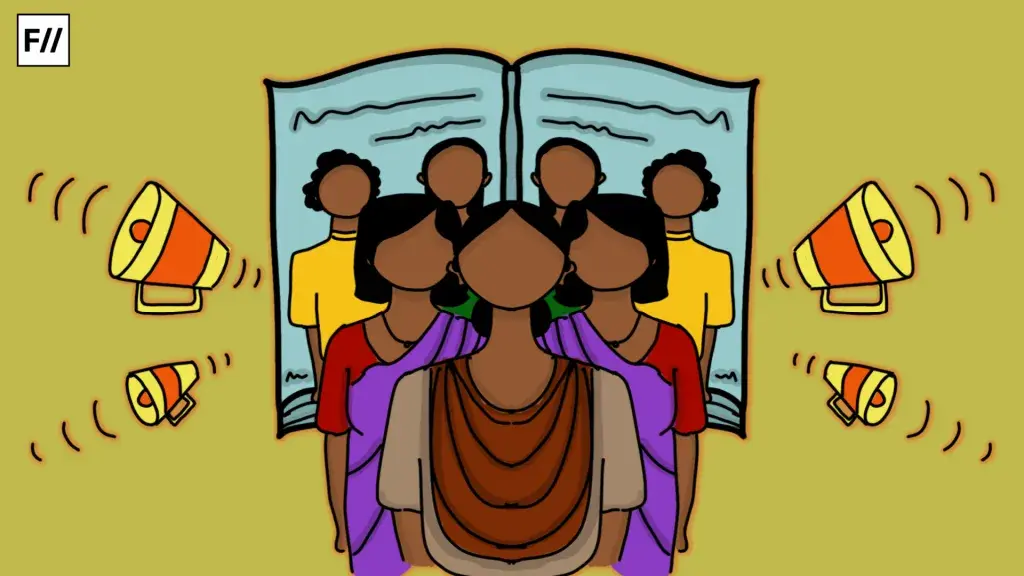
“I did not feel victorious. I felt only tired.” ….. “The Weave of my life” ends with a radical gesture where the author boldly made the choice of fatigue instead of victory. She declares one awkward truth rather loudly: that neither endurance offers any moral consolation, nor does merely surviving bring emotional dividends. This phrase clings to the reader like a bitter aftertaste, refusing to recast suffering into something meaningful. Since the 2010s, these refusals have surfaced more in feminist literature and they have met with severe moral censure. Women whose narrative remains unresolved or furious on those pages are persistently called upon to offer explanations.
Psychological research by Victoria Brescoll and Eric Luis Uhlmann (2008) finds that angry women are perceived as less competent and credible than men expressing the same emotion. Funnily enough, the same criterion boosts men’s standing and devalues women’s. As the logic infiltrates literary culture, it alters the reception of stories. When a female author resists closure, her work simply becomes bleak or emotionally draining as it declines to bandage the bleeding wound.
Bleak endings in global feminist fiction
The “happily ever after” never arrives in Kandasamy’s “When I Hit You” where the narrator’s escape from an abusive marriage yields no healing or emotional repair. Critics celebrated the book’s urgency but repeatedly returned to its “relentlessness” as if the anger offended the essence of the narrative. Studies in Frontiers in Psychology (2020) clarify this discomfort: regardless of justification, anger in women magnifies flaws in their personality. Inheriting the demand, the literature wants women’s pain to arrive adorned with elegance or redemption. When the author in “Burnt Sugar” does not forgive her mother and never reaches emotional clarity, it provokes similar responses among critics who call her voice cruel.
Studies in organisational behaviour trace the erosion of authority of women to their refusal of emotional accommodation. What unsettles is not the absence of love but deliberately declining to perform it. Across borders and languages, the same emotional bias governs our judgement of conclusions. Dangarembga’s heroine in This Mournable Body tries to combat precarity and self-doubt, but her efforts never crystallize into victory making her existence vulnerable and fragile till the end of the book. The expectation of the readers to find the light of hope at the end of the tunnel results in disappointment with some calling the novel “frustrating”. Yeong Hye’s withdrawal from the social norms is left unexplained in “The Vegetarian” which becomes disorienting through brutal imagery used by the author Hang Kang.
Dalit women’s writing in India has consistently denied the soothing closure demanded of narrative. The expectation that women must redeem pain comes from using happiness as a disciplinary regime that pushes women towards acceptable endings.
Besides admiring the power of the narrative, reviewers find it to be “strange”. Ferrante leaves us hurt through fractured friendships and mounting betrayals where the ache lingers even after closing the book. These are endings that do not promise empty fairy tales but force readers to face the reality as it is – with anger and knots of identity. Media studies reveal that women’s rage is more likely to be pathologised, while men’s despair is read as carrying philosophical depth. In literature, McCarthy’s The Road embodies the way male bleakness is valorised. The novel’s post-apocalyptic desolation and survival are celebrated as emotionally powerful, accompanied by a hauntingly strong father-son bond. Nobody searches for faultlines in its ending but rather discusses the greatness of dwelling on love even amid the collapse of humanity.
Reddit threads on this book provide glimpses into the interpretations of the readers, suggesting that even bleak endings like this are also open to meaning rather than dismissed as flawed.
Dalit Narratives and the Refusal of Redemption
Dalit women’s writing in India has consistently denied the soothing closure demanded of narrative. Pawar’s memoir withholds repair for endurance even when male-authored caste narratives are praised for their stark honesty. The expectation that women must redeem pain comes from using happiness as a disciplinary regime that pushes women towards acceptable endings. Such endings honour these narratives since the lives they depict were never destined for healing. Feminist writing circles back to women who leave, endure, resist or withdraw but do not find peace. In When I Hit You, intellectual intimacy collapses into a marriage of violence, and the wife takes the readers with her on her journey of departure, leaving questions of emotion unanswered.
The language carries anger under the weight of what has been endured. Sometimes the anger comes in the form of the unreadable silence of Yeong-hye when her decision of not eating meat sparks surveillance and confinement in her family. “The Vegetarian” crafts her unhappiness into a deeper withdrawal from the burden of self-explanation. But sometimes the urge to silently rebel seems to lose its moral upper hand when faced with the tricky question of “responsibility”. Doshi’s story traces this outline starting from maternal neglect shaping childhood trauma to eventual adulthood, where the daughter cares for the same mother as dementia sets in. These contradictory emotions of love and resentment coexist, reminding us of the harsh truth that forgetting does not absolve cruelty. A similar refusal shapes The Weave of My Life when caste violence remains unredeemed till the very end of the book. The author survives through education, marriage, motherhood and politics only to resist its translation into victory. To offer transformation here would be to restore faith in a system that has already betrayed her.
When Tambuzdai started her journey, her biggest capital was faith in self-improvement. But reality hit her harder than imagined – failed jobs, predatory relationships and the slow corrosion of dignity. Tsitsi Dangarembga ends her This Mournable Body makes oneself angrier, tougher and painfully aware of its own constraints. Collapsing under the structural weight, stagnation of the developmental arc becomes the most honest conclusion. The elderly woman in Geetanjali Shree’s book navigates through the process of converting stagnation into movement. Someone like her who is weighed down by grief and inertia after her husband’s death finds motion in life after crossing borders and exploring desires. Gesturing towards freedom, the author finishes her storytelling while highlighting how partition remains unhealed and memory resists reconciliation. When the woman moves without emotional settlement, history shadows her steps.
These authors turn away from neoliberal feminism’s call for endless self-repair, hope amid systemic injustice and emotional labour even in storytelling. Not all pain leads to progress, and not every story consoles.
What ties them together is their defiance of emotional obedience. Angry, unresolved endings are framed as alienating even when they are no less profound than the stories of reconciliation. The endings feel abrupt because they refuse the illusion that telling the story is itself a cure. They remain faithful to bodies scarred by violence and relationships that persist without repair.
The post-2010s terrain defined by shrinking care structures, unrelenting gender violence and the rise of authoritarianism intensified the hunger for hopeful endings. Women are told to heal alone, though the architecture of injustice stands firm. In this climate unhappy endings stand as political statements. These authors turn away from neoliberal feminism’s call for endless self-repair, hope amid systemic injustice and emotional labour even in storytelling. Not all pain leads to progress, and not every story consoles.
To write about unhappy endings, then, is also to practise them. This article does not conclude with the assurance that things will eventually get better because such gestures risk reproducing the affective order it resists. Feminist scholarly writings call for attention to the durability of harm and the exhaustion resulting from being asked again and again to justify pain. To acknowledge pessimism is political recognition, not creative deficiency – the structure of injury endures even when the book ends. By ending without repair, the article stands with the story it defends – refusing to heal the reader and insisting that unresolved endings are demands for reckoning that have not yet been met.

awesome ?