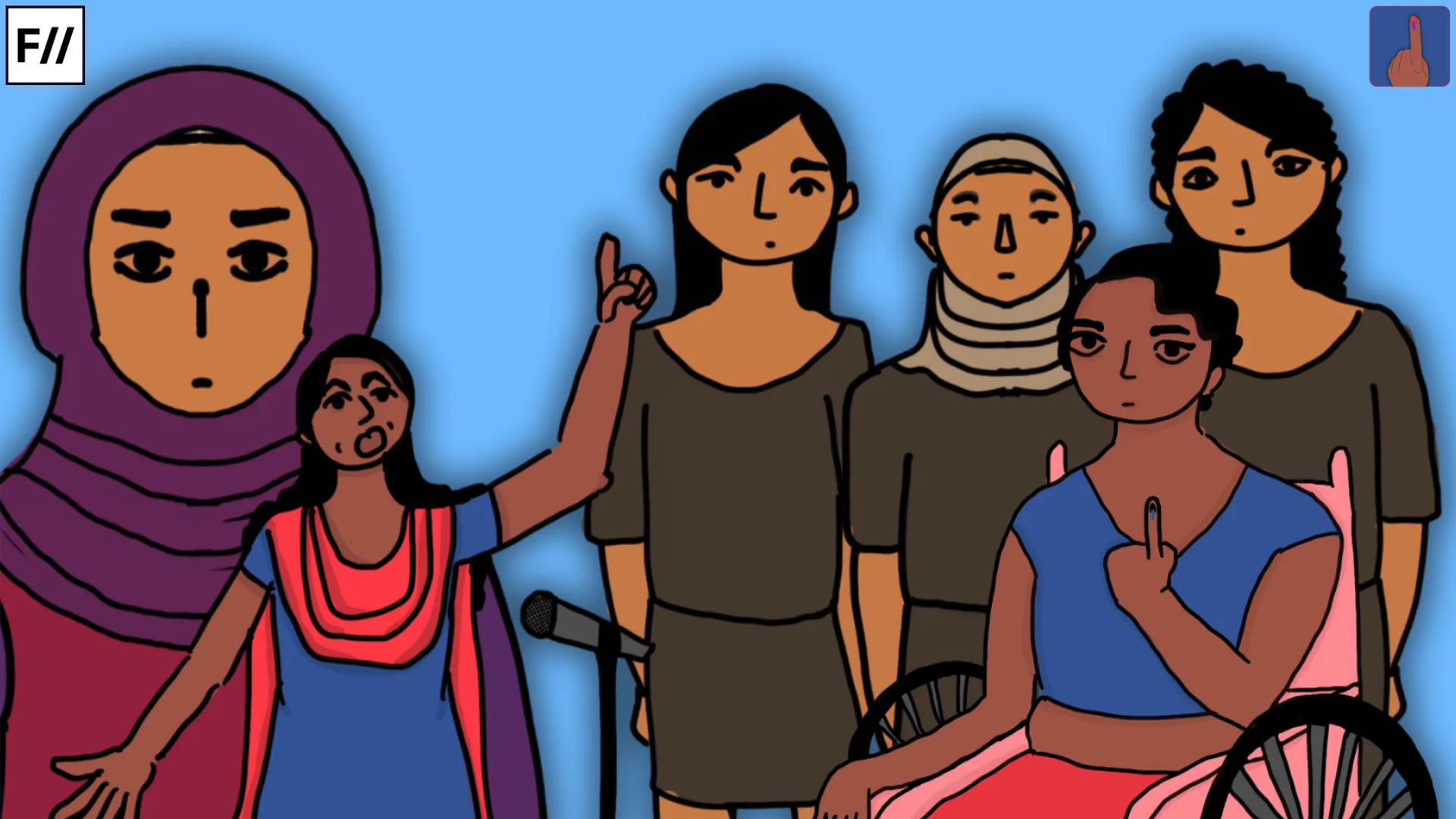
Citizenship is often framed in legal and constitutional discourse as a neutral, universal status granted by the state. Yet feminist scholars have long challenged this universalised narrative, arguing that citizenship has never been neutral nor uniform. Iris Mariam Young (1990) conceptualises citizenship as a set of practices embedded within social structures that decide inclusion and exclusion: Nira Yuval Davis (1999) places citizenship in an intersection of gender, ethnicity, and cultural belonging, and Seyla Benhabib (2002) highlights the importance of recognising plural identities within democracies. Drawing upon these frameworks, the case of Mostari Banu v. The Election Commission of India emerges as a critical moment in redefining citizenship in India, asserting that citizenship is not a legal-static status but gendered and culturally mediated. This is to analyse how feminism in India starts not from the upper ranks of elites or bourgeoisie, but from the periphery – asserting legal and moral authority over bureaucratic and state practices.
Mostari Banu’s Challenge: A Rural Muslim Woman’s Stand
Mostari Banu, a 44-year-old history postgraduate and a housewife from a small village in Bhagwangola in the Murshidabad district of West Bengal, approached the Supreme Court in November 2025, challenging the ECI’s Special Intensive Revision (SIR) of electoral rolls. Long before the interventions of high-profile political figures such as Mamata Banerjee, Banu’s petition foregrounded the everyday concerns of marginalised voters. Her legal challenge ruptured the assumption that democratic resistance flows from political elites, illustrating how feminist agency can originate at the peripheries, with an ordinary Muslim woman setting the moral and legal agenda that political elites later follow.
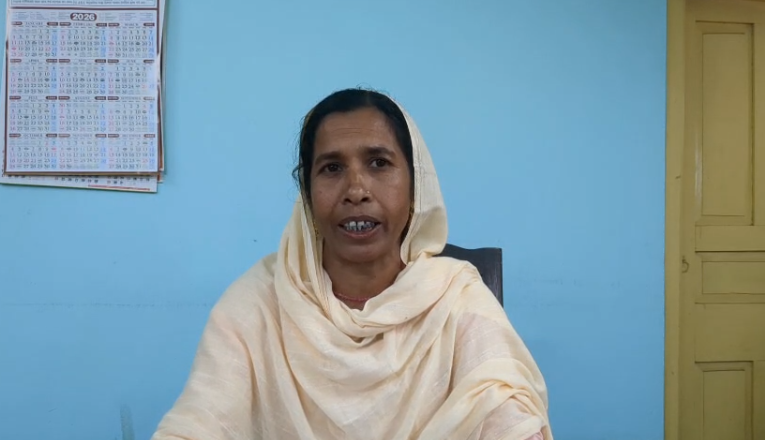
Banu’s petition centred on the ECI’s requirement that voters attach passport-sized photographs to their SIR forms. For many Muslim women, such directives collided with cultural norms of modesty and parda, creating a direct tension between democratic participation and cultural practices. As Banu herself argued, compulsory photographs placed the Muslim women in a position where they had to choose between civil rights and personal dignity, highlighting how bureaucratic procedures, even when framed as neutral, can produce a system based on exclusion and form a broader part of administrative and bureaucratic violence.
Drawing upon these frameworks, the case of Mostari Banu v. The Election Commission of India emerges as a critical moment in redefining citizenship in India, asserting that citizenship is not a legal-static status but gendered and culturally mediated.
This legal intervention resonates with the earlier landmark cases involving the Muslim women, most notably Shah Bano v. Union of India(1985), which challenged patriarchal norms within Islam to secure maintenance rights. While Shah Bano confronted constraints within religious norms, Mostari Banu’s case interrogates the homogenising tendencies and impulses of the modern Indian state. While the two cases are very contradictory in their nature, the former asserting legal rights and the latter cultural rights, in both cases, the Muslim women establish the fact that their social and political agency is not of passivity but of active challenge to the power dynamics of both religion and politics that subordinate them. The Muslim women, thus, actively negotiate power to ensure recognition, privacy, and justice.
Banu’s case also highlights the structural dimensions of administrative exclusion. SIR procedures categorised voters based on documentation, such as age verification and proof of citizenship through birth certificates, and required repeated appearances for alleged discrepancies. Banu herself, despite being a registered voter since 2002, received summons questioning age discrepancies with respect to her father. Rural voters, migrant labourers, and the marginalised women faced significant challenges in complying with bureaucratic requirements. Young (1990) highlighted that democratic participation required the removal of barriers that inhibit the marginalised from exercising their rights. Banu’s intervention highlighted the disproportionate burdens these procedures impose on the marginalized sectors, highlighting how formalistic approaches to democracy can inadvertently disenfranchise the very groups they purport to include. This same logic applies to the Matua community in West Bengal, who have been mass disenfranchised due to lack of required documentation.
Caste and religion based discrimination
Forefront on highlighting the intersection of gender, religion, and rural marginality as “multi-layered citizenship” was Yuval-Davis (1999). Banu’s case wasn’t just simply a Muslim woman but an educated rural Muslim woman who is constrained by modesty norms, social expectations, and bureaucratic invisibility. Her exclusion wasn’t simply bureaucratic or religious but a product of multiple intersecting social hierarchies. For Benhabib (2002), SIR would stand as an assimilist norm which disregards community autonomy and dignity. Banu’s petition echoes the ethical argument that Benhabib presents, that democratic states must succumb to homogenising tendencies and uphold cultural rights to ensure that the marginalised are not pushed to the periphery. From a post-colonial lens, the grandeur claims of feminism being a monolithic global movement stand naked, as Banu’s activism also stands central in rationalising the arguments of the post-colonial feminists: that oppression is layered and intersecting, and a feminist praxis must not only engage with gender but also other marginalized identities too. This is necessary in the Indian context, as gender discrimination runs parallel with caste and religious based discrimination, particularly against Dalits and Muslims.
Banu’s intervention had a wider impact, as the Supreme Court in January 2026 allowed Class 10 Admit Cards as valid proof of age and permitted their submission through authorised representatives. This also exacerbates another central critique of the post-colonial feminists: bureaucratic measures must be reconciled with cultural realities. While high-profile political leaders amplified criticisms against the SIR, what makes Banu’s activism distinct is its grounding in everyday experiences of marginalization and precarity of the Muslim women. At times when the post-colonial states, as Mohanty argues, have entered a phase of forced homogenisation post-1990s, Banu’s praxis centred on the lived realities of the marginalized women rather than political rhetoric.
Banu’s intervention had a wider impact, as the Supreme Court in January 2026 allowed Class 10 Admit Cards as valid proof of age and permitted their submission through authorised representatives.
Her legal challenge redefined citizenship as a process of active negotiation with the state: the capacity to assert cultural rights, confront arbitrary procedures and insist dignity is inalienable to democratic participation. By foregrounding the Muslim women, Banu’s intervention is a praxis of post-colonial feminism: insistence on encompassing the cultural and ethical dimensions of inclusion and a strong reminder that democracy isn’t just a spreadsheet of laws and elections but also the lived realities of those who are often silenced. In asserting her rights, Banu not only challenges SIR but also loosely carries the flame of the anti-CAA-NRC protests, where Muslim women played a dominant role in agitations against the discriminatory act. This argument stands stronger for another two reasons: (i) critics have labelled the current SIR process as “back-door NRC”, and (ii) the representation of Muslim women in Lok Sabha stands at the precarity, as only 18 of them have been elected since 1952. Through her activism, Mostari Banu brings the Muslim women forward to the contemporary democratic process in India.