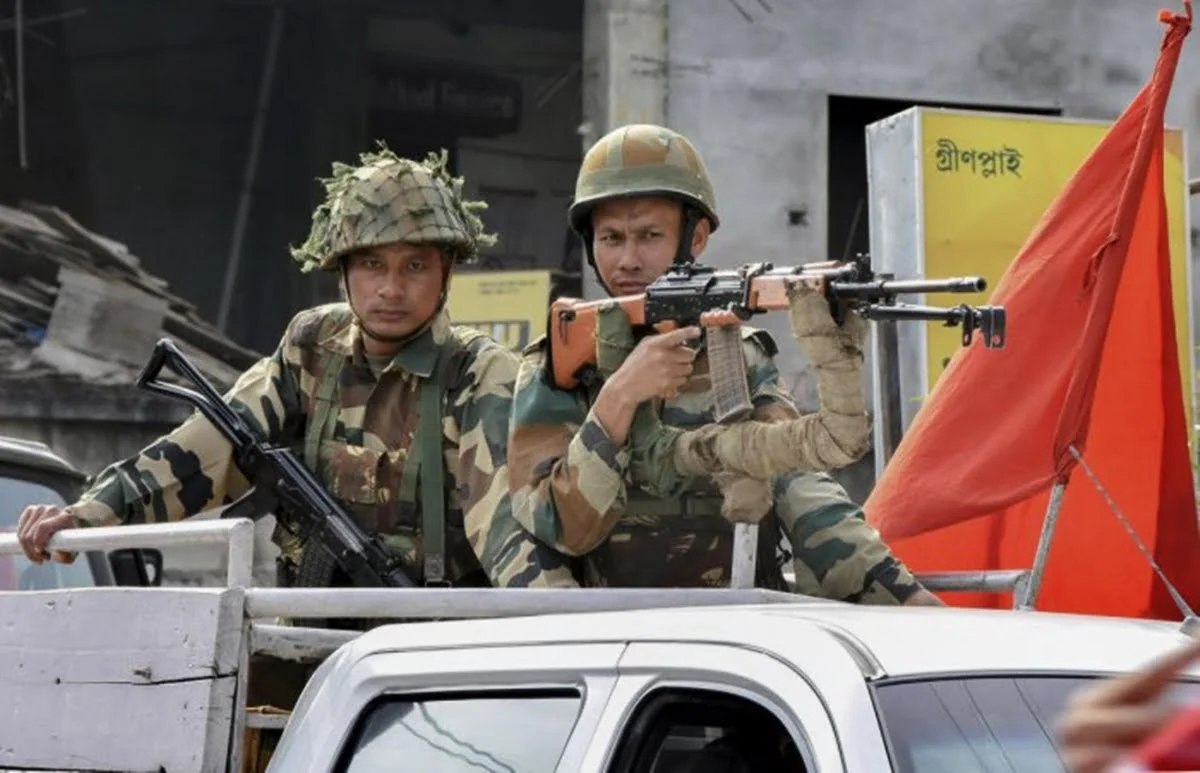
In November of 2000, Irom Sharmila, a civil rights activist from Manipur, later recognised as a prisoner of conscience by Amnesty International, started a hunger strike, demanding the repeal of the draconian Armed Forces (Special Powers) Act (AFSPA), which has been criticised by several national and international bodies. Her struggle for repealing AFSPA started after the killing of ten civilians in Manipur by the Assam Rifles (a paramilitary force) in Malom, an incident known as the ‘Malom Massacre’.
The beginning of a protest: Irom Sharmila and Malom
‘A hunger strike is not an attempt at suicide. Irom Sharmila is being detained by the government solely for her inconvenient activism,’ states Aakar Patel, Executive Director of Amnesty International, India. ‘She is a prisoner of conscience, using her freedom of expression to protest against an unjust law. And her shameful detention leaves a stain on India’s commitment to human rights that grows harder to remove with every passing year.’
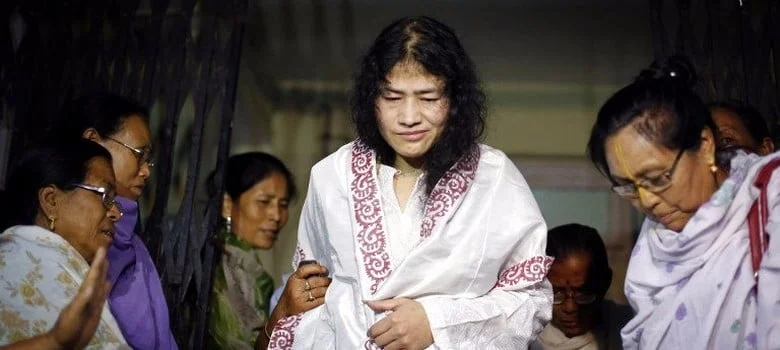
November 2025 marks the unparalleled struggle of Irom Sharmila, completing 25 years after her arrest under Section 309 of the Indian Penal Code. Insurgency in Northeast India is regarded to be a huge internal security threat by the Indian state. Too often, without examining the region’s historical and cultural context, the machineries of the state have exploited and violated people’s rights in the name of securing peace and integrity of the nation.
AFSPA, Militarisation and systematic abuse
AFSPA has been used for criminalising dissent, facilitating human rights violations, and extrajudicial killings for a long time in the region. Militarisation under AFSPA has created conditions for systematic abuses, such as custodial rape, killings, and harassment at checkpoints.
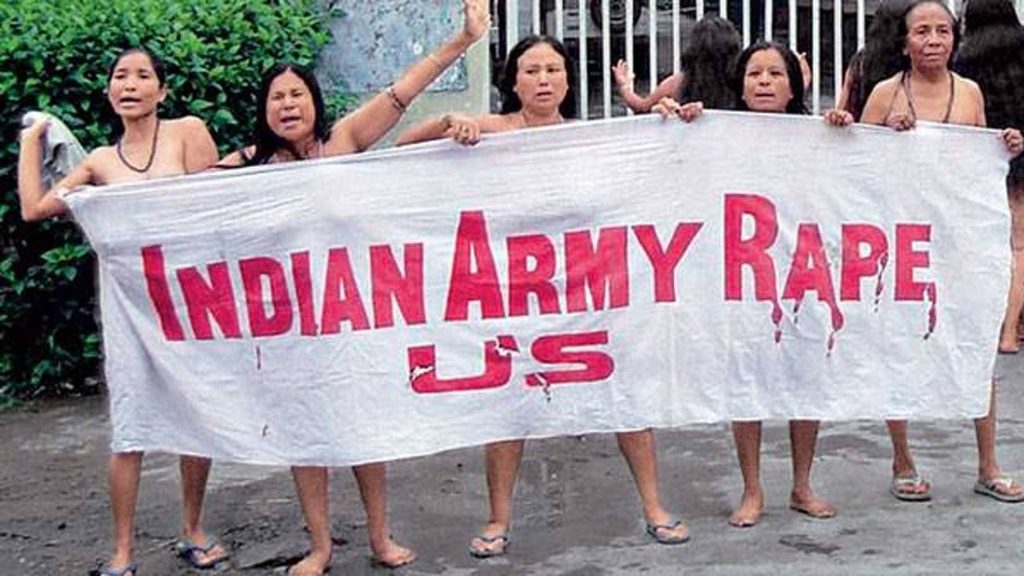
The Ima Mothers’ nude protest is one of the most powerful and shocking demonstrations against the Indian state, which took place in July 2004 in the capital of Manipur, Imphal. The demonstration represented the voices of marginalized northeastern women which are often suppressed by the state and its machinery. It took place after the rape, torture, and custodial killing of Thangjam Manorama, a 32-year-old woman, by personnel of the Assam Rifles. Manorama was taken from her home on July 10, 2004, on suspicion of links with insurgents. Hours later, her body was found dumped by the roadside, riddled with bullets and showing signs of brutal sexual assault. In response to this, twelve elderly women activists gathered in front of the Assam Rifles headquarters, stripped naked, and held the banner which read, “Indian Army rape us.”
The Armed Forces Special Powers Act has been used for criminalising dissent, facilitating human rights violations, and extrajudicial killings for a long time in the region. Militarisation under AFSPA has created conditions for systematic abuses, such as custodial rape, killings, and harassment at checkpoints.
The Frontier Manipur cites public’s ongoing concern and the relevance of the same brutal incident in 2021: “On July 15, 2004, 12 mothers of Manipur took the decisive step of disrobing themselves in front of the Kangla Fort, Imphal, the then Assam Rifles Headquarters, in protest against the custodial rape and murder of Thangjam Manorama. Manorama was arrested by 17 Assam Rifles on the intervening night of July 10 and 11, 2004, from her own house and her lifeless corpse was found lying at Ngariyan foothills the next morning. The defiant act of the Meira Paibi leaders triggered a massive public protest in Manipur against the draconian Armed Forces Special Powers Act, 1958 (AFSPA). Months of sustained civil disobedience movement were calmed down only when the then Prime Minister of India promised “to replace AFSPA with a more humane act.”
Historical patterns of sexual violence (1980s and 1990s)
This incident was not the only one. The brutal subordination faced by people, especially women of this turbulent region made the question of nationalist struggle rigid. The decades of the 1980s and 1990s witnessed this sexual and physical war, which led to the violation of basic human rights on a huge scale. The women of that time, of the Northeast region, were even afraid of stepping out of their homes.
Another such inhuman and brutal gang rape and murder case took place in the Lakhimpur district of Assam:
“On October 16, 1991, a 14-year-old girl, Bhanimai Dutta became the victim. On that day, a group of Army personnel suddenly cordoned off the residence of Mr Mukuta Dutta, father of Bhanimai, and picked up his son Babul Dutta and carried him to their vehicle while beating him mercilessly. When Mukuta Dutta and his wife rushed to the gate of their compound to bar the Army personnel from taking Babul away, three Army personnel entered the house and raped the 14-year-old Bhanimai. When Mr Mukuta and his wife returned from the army vehicle where Babul was being detained, they saw the army personnel leave their house in a hurry. On entering the house, they discovered the nude body of Bhanimai on the bed wet with blood. She died soon thereafter. The army men blocked the post-mortem of Miss Bhanimai Dutta for up to three days. They forced the doctor who performed the post-mortem to sign on a blank piece of paper before the procedure.” One can find the detailed coverage on this massive violence against women on the Assam Portal and here.
Such an incident of rape and killing also took place in the early part of the same month, on October 6, 1991, at a village near Gohpur in Sonitpur District.
“On that day, around 1:00-1:30 A.M., seven Army personnel entered the nearby house of Mr. Moniram Barua. The group of seven army men dragged her to a nearby jungle at gunpoint and raped her one after another. After repeatedly raping her, the army men threw her senseless body near a pond. Villagers who came to the spot pulled her out from the pond and took her to a hospital, where she was declared dead.” The same report by Manab Adhikar Sangram Samiti provides details on 28 other brutal rape cases committed by security personnel.
AFSPA’s continued impunity and global context
Even after all these rape cases that happened during the implementation of the draconian act like the AFSPA, which is still being implemented even now in many districts of the Northeast region, the issue of human rights violation and measures through which it can be protected has a long history of its own in the international arena.
The sexual, physical, and psychological war against women aligning with patriarchal norms in the region in the militarised settings makes them vulnerable. There have been demands for repealing the AFSPA for the same.
Some of the instruments, like the Convention on the Elimination of All Forms of Discrimination against Women (CEDAW), clarify that every woman should have the right against exploitation of her body. This got recognition in the form of commitments under Article 4 of the Universal Declaration of Human Rights, Principle 9 of the Declaration of the Rights of the Child, Articles 7 and 8 of the International Convention on Civil and Political Rights, and Article 8 of the Declaration of the Elimination of Discrimination against Women. The declaration of 1974 goes to the extent of extending protection to women and children even during emergencies and armed conflicts.
India, which claims to be a significant supporter of the protection of women’s rights, itself fails to protect them in many turbulent regions, which include not only the Northeast but also regions like Kashmir, Bastar and many others. Violence against women has been carried out by personnels of the armed forces and security enforcement agencies of India operating in the State. These perpetrators from security forces are immune to prosecution under the legal procedures as well.
The sexual, physical, and psychological war against women aligning with patriarchal norms in the region in the militarised settings makes them vulnerable. There have been demands for repealing the AFSPA for the same. According to the last official data available, the Armed Forces Special Power Act was in force in 194 police stations in 37 districts across four states—Assam, Arunachal Pradesh, Manipur, and Nagaland. Even after decades of violence, marginalisation, and exploitation towards the civilians of the Northeast Region by the state machineries, this draconian act is still being implemented in the region. Despite repeated calls to withdraw the AFSPA from UN experts as well as from national and international groups, the Act continues to be enforced and continues to cause human rights violations in the region.
About the author(s)

Dristy Baishya is a 2nd year student from Miranda House, pursuing BA Sociology Honours. Her interests lie in proletarian feminism, northeastern regionalism and culture,Human rights, Insurgency, state policies and its adverse effect on indigenous people. She identifies herself as a communist.