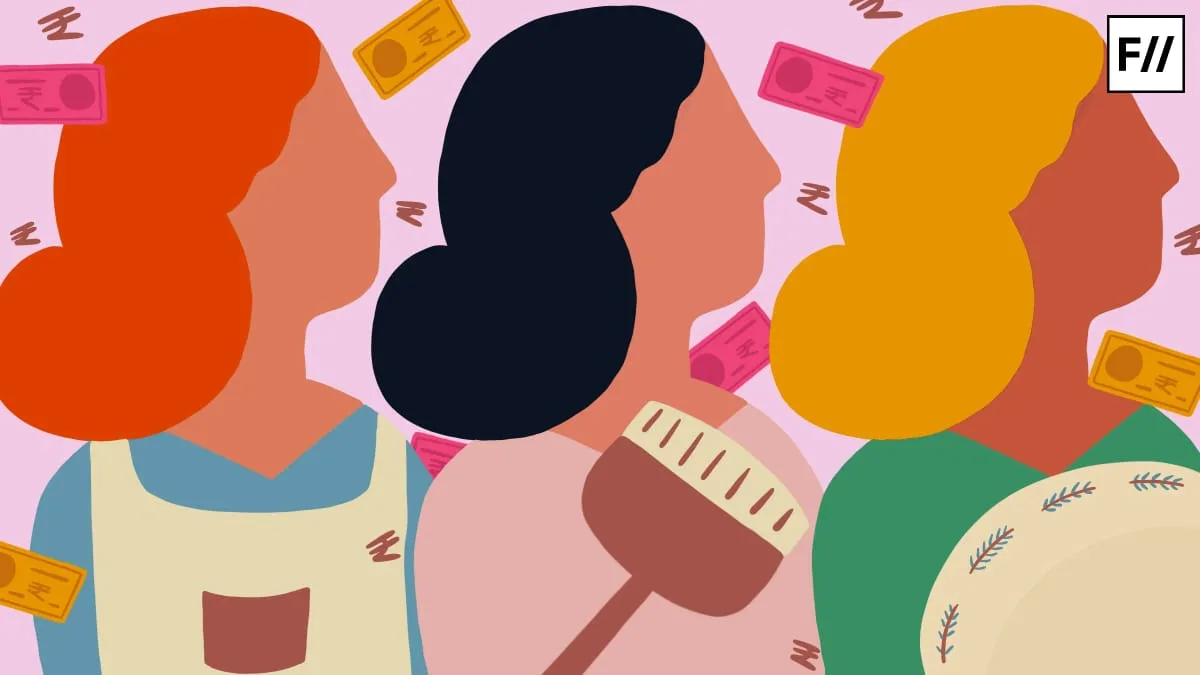
As capitalist logic colonises every dimension of our lives, commodifying our work, our relationships, and even our political resistance, the feminist movement has not been spared. Capitalism relies on individuality, and as its tendrils wrap around the heart of feminism, it produces a far more heinous form of feminism—choice feminism.
The rise of choice feminism
Choice feminism draws upon the triumphs of the second wave of feminism, building on the ontological edifice that equal rights have been achieved and gender discrimination eradicated, asserting that female empowerment is driven by personal agency in the absence of systemic barriers.

Debate on the historical and structural conditions of individual choice, the evaluation of women’s choices and the analysis of their consequences has been subject to much criticism within the choice feminist paradigm, which valorises autonomy and freedom. This doctrine brings about a political stasis, as critically analysing individual choices within the structural framework demarcates the ‘bad feminists’.
The #girlboss phenomenon
Girl-boss feminism emerged in the 2010s as a cultural phenomenon that promised to reconcile feminist politics with corporate ambition. This term gained popularity through the New York Times bestseller #Girlboss, written by Sophia Amoruso, the founder of the clothing brand Nasty Gal, which eventually claimed bankruptcy in 2016. In 2014, when this book was written, women were dramatically underrepresented in the business sphere, and valorised Amoruso’s rise to success as a feat of female empowerment and emblem of feminism.
However impressive her corporate eminence proved to be, her empire was based on white privilege, choice politics, and neoliberal capitalism, not feminism, which advocates for social, economic, and political equality of all. By championing individual advancement within existing hierarchies, girl-boss feminism ignores how systems of oppression operate intersectionally: a Black woman faces both racism and sexism, a disabled woman confronts ableism alongside gender discrimination, and working-class women of colour navigate compounded barriers that no personal development book can dismantle.
In fact, an investigation by The Sunday Times discovered that Amoruso’s company was paying their garment workers an hourly wage of £3.50 at a factory in Leicester-much lower than the minimum wage of £8.72 for those over 25—thus exposing the foundational hypocrisy of girl-boss feminism: empowerment for some women necessarily relies on the exploitation of other, more marginalised women lower down the supply chain.
Girl-boss feminism emerged in the 2010s as a cultural phenomenon that promised to reconcile feminist politics with corporate ambition.
Amoruso’s case exemplifies a broader pattern within girl-boss feminism, which operates within a capitalist neoliberal framework. Originally created to uplift women newly inducted into the workplace—free from the misogynistic biases and gender stereotypes faced by earlier generations—and to celebrate their accomplishments, it has quickly warped into a vehicle of toxic productivity and a means of trapping women within capitalistic structures.

This ‘pop feminism’ began by extolling women for their professional and career accomplishments, and ended up using the attainment of such accomplishments as a means of assessing self-worth. Boiled down, it is simply another way to dehumanise women as tools of the capitalistic empire. It states that if you, as a woman, are unable to secure that coveted corner office job or chase that promotion, you’re just not productive enough, not pushing yourself hard enough, or not hustling enough. You’re letting the patriarchy win.
This philosophy is more or less espoused in the playbook written by the COO of Meta, Sheryl Sandberg, titled Lean In. As a personal development book, it does delineate how women tend to subconsciously hold themselves back from professional advancement, and encourages working women to negotiate better salaries and working conditions, to break the so-called ‘glass ceiling‘, acknowledge bouts of imposter syndrome, and to revel in their own accomplishments while simultaneously continuing to push for more.
However, as a doctrine of feminism, it falls dangerously short of the mark. It leads women towards internalising their own discrimination, towards the belief that any failures to attain job interviews or pay raises are faults of their work ethic or mindset alone, completely disregarding the presence of gender discrimination within the organisation and individualising structural and institutional barriers.
The toll of hustle culture on women
Additionally, this indoctrination into the ‘hustle culture’ that pervades society has negative repercussions for women, such as work-life burnout and exhaustion. Within this patriarchal arena, one is expected to grind 24/7 and view exhaustion as ambition. Numerous studies have shown that women tend to avoid entering and performing in competitive spaces, depicting that the metrics used to define success in a zero-sum, winner-take-all, male-typical system may leave women unsatisfied, stressed, and exhausted.
Numerous studies have shown that women tend to avoid entering and performing in competitive spaces, depicting that the metrics used to define success in a zero-sum, winner-take-all, male-typical system may leave women unsatisfied, stressed, and exhausted.
In fact, the mere thought of competing with another woman can trigger elevated stress responses and unhappiness. Research shows that even simulated competitive settings can raise cortisol, the body’s stress hormone, signalling strain rather than motivation. These findings depict that rigid hierarchies alloyed by relentless competition were not built with women in mind, who value collaboration and connection vis-à-vis contention and conflict.

This phenomenon may be particularly insidious when assessing women’s performance, as the systemic factors that lead to gender discrimination are still ubiquitous, which manifest in gender pay gaps, unequal opportunities, slow promotion rates, and microaggressions. These often result from deeply entrenched gender stereotypes, such as the motherhood penalty (in which a woman faces lower pay after becoming a mother, due to loss of job experience, reduced productivity, or discrimination) and the ‘maybe baby‘ risk (in which managers’ expectations that a child-free, child-bearing-aged woman will become a mother in the near future affects their risk perceptions of employing that woman).
A woman unconsciously affected by these kinds of biases, who laments her wage stagnancy, her lack of success in securing a promotion, or her resentment at being sidelined in the workforce, will tend to interpret the problem as a personal one, believing her failures stem from her incapability, which may lead to her sacrificing other aspects of her life in favour of improving her labour productivity in the hopes of gaining equal footing with her male colleagues.
The girl-boss narrative, for all its promises of empowerment, ultimately serves as a smokescreen for capitalism’s co-option of feminist ideals.
The girl-boss narrative, for all its promises of empowerment, ultimately serves as a smokescreen for capitalism’s co-option of feminist ideals. By reframing systemic oppression as individual shortcomings and exhaustion as ambition, it traps women in a cycle of self-blame and overwork while leaving patriarchal structures unchallenged. Until we reject the false promise of individual advancement through endless productivity and reclaim feminism as a movement for structural transformation, the girl-boss phenomenon will continue to burn women out in service of the very capitalism that perpetuates their oppression.
References:
https://web.stanford.edu/~niederle/Niederle.Vesterlund.QJE.2007.pdf
https://thesciencesurvey.com/editorial/2022/12/31/the-downfall-of-the-girlboss/
https://wearerestless.org/2021/09/30/girlboss-feminism
https://19thnews.org/2023/04/workplace-discrimination-mothers-open-secret
https://onlinelibrary.wiley.com/doi/10.1111/jasp.12799
https://harvardpolitics.com/girlboss-gaslight-gatekeep
About the author(s)