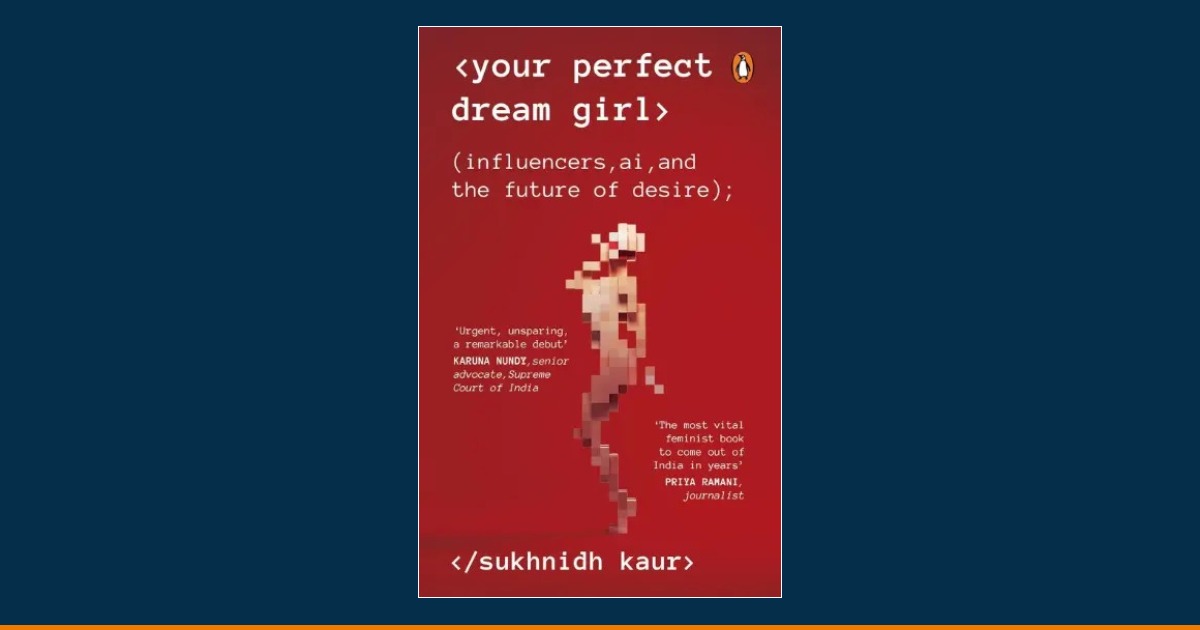
The Internet loves discourse. Especially around women, their bodies, their presence on the internet, the authenticity of female influencers, whether beauty creators are promoting unrealistic standards, and how AI-generated girlfriends will impact real-time relationships among other things. Sukhnidh Kaur’s Your Perfect Dream Girl: Influencers, AI, and the Future of Desire asks readers to step away from this discourse, and try considering a different question: “who benefits from the versions of ourselves we are encouraged to perform?”
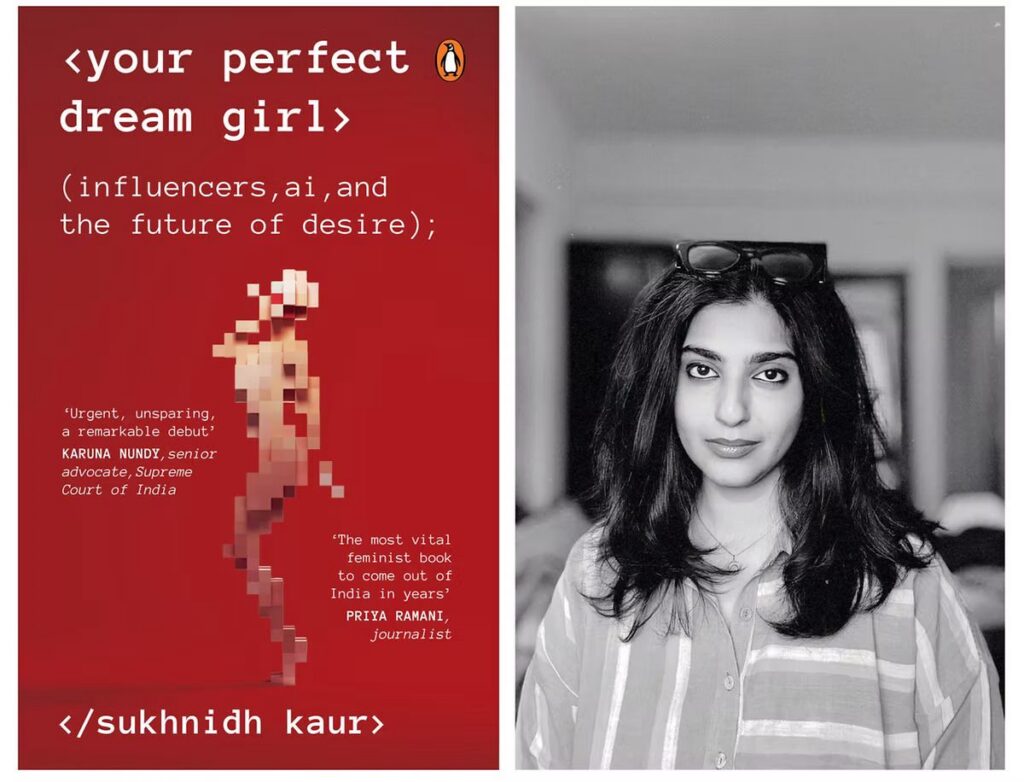
The 27 year old researcher studying human-tech interactions spent nearly 15 years of her life as an influencer. Kaur’s debut is a part-memoir, part cultural critique, part-feminist narrative and yet none of these in a conventional sense. Written in epistolary style, consisting of 25 letters written to a faceless man, Kaur starts the conversation by calling herself and other female influencers, “a spectacle” on the internet. The image becomes a recurring theme for the rest of the book.
From Makeup Industry to AI Companies
In one of her letters, Kaur asks, “Do you think we become who we are or discover it?”, then she returns to the image of “a little palette of concealer” standing between herself and “the girl inside me”. Here the concealer becomes a metaphor for the industries that promise drastic transformations while the women learn to move further away from their bodies.
Kaur clearly connects how the beauty industry always operated on a promise of drastic transformations, almost to the point that makeup had become synonymous with “putting a filter on”, to the social media feeds that favours the edited/filtered pictures, rewarding with amplified visibility prompting in performance of a curated online self. The AI then learns from those performances, reproducing them as datasets and synthetic personalities.
Kaur resists treating AI as a neutral tech. Instead she presents arguments how these systems inherit biases, desires, and gendered assumptions embedded within the data they are trained on.
Referring to the AI research scholar, Emily M Bender’s theory of AI systems as stochastic parrots where AI systems generate a combination of the datasets that were used in AI training as outputs, Kaur resists treating AI as a neutral tech. Instead she presents arguments how these systems inherit biases, desires, and gendered assumptions embedded within the data they are trained on. Kaur brings in subjects like beauty standards, influencer culture, recommendation algorithms, deepfakes, AI companions to the conversation in her letters as different stages of the same process: Patriarchal technocapitalism.
She argues that AI is not a new addition for digital surveillance or scrutiny directed towards female bodies, but the latest stage in a much older thought of turning femininity into a commodity, allowing continuity for her earlier claim on calling herself and female influencers “a spectacle”.
While scholarly references add great value to Kaur’s arguments, it occasionally assumes that readers are already a part of these conversations around AI ethics, platform capitalism, and influencer culture. Readers approaching these for the first time may find themselves pausing to catch up before the narrative carries them to the next idea.
When Women Become The Discourse
In one of her letters, she recalls an experience of internet backlash triggered by another influencer’s accusation on Kaur for plagiarism, calling Kaur’s career and identity, a “cheap second copies of her ideas”. Though this influencer was later outed as a fraud, the initial engagement and backlash did not care about the facts once the spectacle came to an end. This experience of initial accusation, fierce internet backlash, and lukewarm response cycle Kaur had written about is not an isolated account limited to Kaur alone.
One of the viral controversies of 2026 illustrates this pattern, The backlash and scrutiny against lifestyle Instagram content creator Lifeofpujaa quickly became a referendum on her personality and authenticity, with social media users presenting arguments over whether she is authentic enough or not, whether she deserved the scrutiny she received. However, there was little to no attention paid towards the platform algorithms which were rewarding the engagement brought by moral policing, backlash, and endless scrutiny.
This book’s strongest ideas is its insistence on redirecting attention away from individuals and towards systems. She writes, “I want us to ask who benefits from the version of ourselves we perform. Then I want us all to stop mistaking proxy battles for resistance”. The observation feels relevant to contemporary internet culture where conversations frequently revolve around whether a woman is “cringe”, “fake”, “problematic”, or “corrupting culture”.
Beyond The Influencer
One of the most honest reflections in this book emerges through its engagement with Virginia Woolf. Referring to Woolf’s A Room of One’s Own, “the truly radical luxury is not the room but what happens inside it,” she writes. Later, she reflects that she had to “claim my identity as a great man writing a theory of the world” before believing she could think beyond the roles society was expecting of her.
The book further reveals Kaur’s ambition is beyond the idea of documenting an influencer’s perspective. She is using her lived experience, and the multiple accounts of various women who were also impacted by the visibility on the internet, to theorise the relationship between tech, gender, labour, and identity. Such perspective allows the author to write with candour that resists the binary of men vs women arguments. Instead it allows her to demonstrate how platform capitalism monetises different vulnerabilities, female insecurities, male loneliness, an unhinged interest for a spectacle online, and the reducing attention span in general.
Kaur is using her lived experience, and the multiple accounts of various women who were also impacted by the visibility on the internet, to theorise the relationship between tech, gender, labour, and identity.
Bringing in subject matter expertise, interviews from women whose lives have similarly been shaped by the virality on internet, along with her own lived experiences and layered first-hand research into internet’s darkest corners, from deepfake ecosystem to AI companion platforms, places where a female body is nothing but an object of desire makes this book a conversation starter about how platform capitalism works, who is being incentivised here, and who is bearing the cost of it.
Despite its subtitle, Your Perfect Dream Girl is not just about influencers or AI. It is at large about the commodification of a female body in the digital age and the systems that make this commodification appear normal. It asks the readers to look beyond virality and tech novelty towards the economic and political aspects that shape the narratives. Your Perfect Dream Girl comes with a suggestion “I want young women to wake up and realize that we are pawns benefitting the system through our own self-surveillance,” Kaur writes reiterating the need to identify where self-expression turns into self-surveillance.
About the author(s)