Despite promises of a brave new world, the climate crisis has only deepened in recent times. Perhaps the question is no longer whether more technology is required to save the Earth, but whether the Earth is really something we need to ‘conquer’.
Wildfires have engulfed forests across continents, rivers ran dry, and rising temperatures broke global records. The human tendency is to measure things in numbers, be it progress or catastrophes. Likewise, attempts were made to gauge rising sea levels, carbon emissions, and the disappearance of species. Renewable energy, carbon neutrality, and international climate agreements are frequently debated, given that these conversations are indispensable. Yet they often overlook the worldview that birthed the environmental crisis in the first place.
What if the gendering of nature as ‘Mother Nature’ has contributed to this? After all, in a patriarchal world, anything perceived as feminine is often subjected to an extractive logic and mistreatment.
Such phenomena and the human responses to them make one wonder whether environmental damage is not just an ecological failure but also a cultural one. What if the gendering of nature as ‘Mother Nature’ has contributed to this? After all, in a patriarchal world, anything perceived as feminine is often subjected to an extractive logic and mistreatment.
The above question is central to ecofeminism, and the green literature that emerged from it can offer a meaningful resolution.
A snapshot eco-feminism and green literature
Ecofeminism, also referred to as green feminism, is a concept that emerged in the 1970s through the work of the French feminist Françoise d’Eaubonne, who argued that patriarchy had both subverted women’s autonomy and facilitated the devastation of the environment.
Ecofeminism is understood as a movement that argues that the oppression of women and the exploitation of nature emerge from the same systems of hierarchy, extraction, abuse, exploitation, and control embedded in patriarchy.
Ecofeminism is understood as a movement that argues that the oppression of women and the exploitation of nature emerge from the same systems of hierarchy, extraction, abuse, exploitation, and control embedded in patriarchy, which traditional forms of feminism have long been fighting against. Many visionary women wrote about these issues through fiction, and they also prophesied the ecological crisis and its intensifying consequences in their books.
Green literature, a product of ecofeminism, is a form of writing that focuses on nature, the environment, ecological crises, and the relationship between humans and the natural world.
Ecofeminism and green literature represent a step towards the radicalisation of the feminist movement. These concepts focus heavily on the interplay between nature and nurture, examining how the environment and humans mutually influence and affect each other.
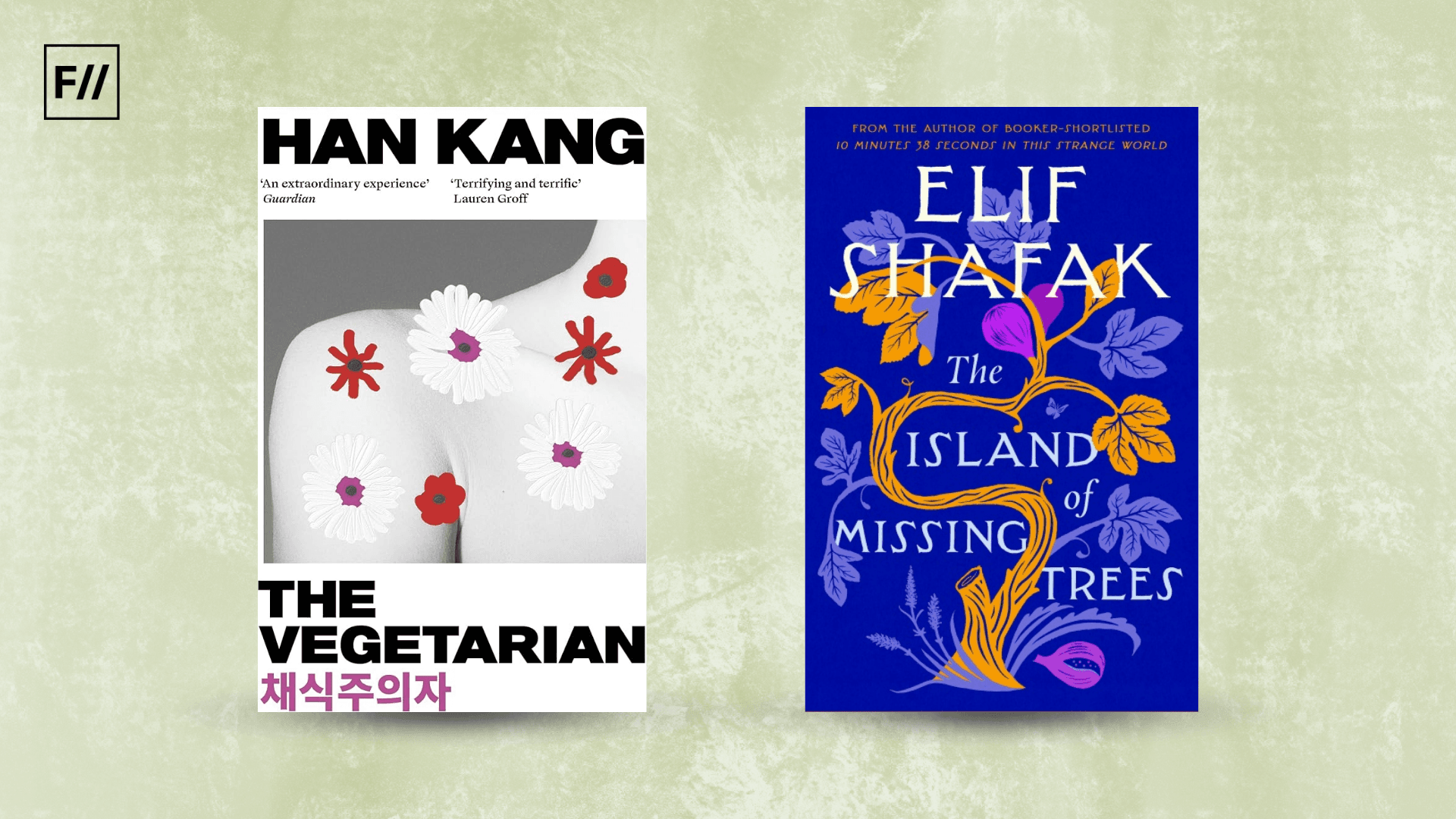
‘The Vegetarian’ by Han Kang
‘I wish I was a tree’ is the line that opens Han Kang’s The Vegetarian. The novel features a woman who quits consuming meat. Her decision to give up meat becomes an act of resistance and a rejection of familial and social violence. Her vegetarianism shocks her family to such an extent that her husband, along with her parents, attempts to force-feed her meat.
In the book, the act of quitting meat is seen as a stand-in for a woman making her own choices and resisting social and familial norms.
Doctors label her as psychologically unwell. The protagonist, on the other hand, imagines herself turning into a plant, as she has always felt herself to be in a vegetative state anyway. The people around her grow desperate to restore her conventional femininity, one that aligns with the expectations and conveniences of family life. In the book, the act of quitting meat is seen as a stand-in for a woman making her own choices and resisting social and familial norms.
Her wish to be a tree exposes us to the tragic reality that women possess virtually no control over their own bodies or life decisions in our patriarchal world. Just as a tree can be chopped down for the sake of convenience, women can be subjected to similar forms of violence and control.
‘The Island of Missing Trees’ by Elif Shafak
In The Island of Missing Trees by Shafak, the fig tree is also one of the protagonists, and most of the book is written from its point of view. The fig tree has stood through wars between the Turks and Greeks and survived fires by being chopped down and buried. Shafak reimagines trees and nature as living archives that remember what humans have chosen to forget and move on from.
Shafak reimagines trees and nature as living archives that remember what humans have chosen to forget and move on from.
Novels such as these are often marketed as environmental manifestos, whereas they are tales of something far more unsettling. They ask disturbing questions, such as whether the ecological catastrophe unfolding around us is deeply intertwined with the ways in which we have organised power.
Historically, wars and conflicts over power and colonialism have caused environmental destruction, yet we often fail to register this as a form of collective trauma. Shafak refuses this separation. The fig tree’s roots extend into the soil, which is presented as an extension of its mind. The soil absorbs and stores every event, both good and bad. Hence, even after the fig tree is uprooted, it remembers what humans forget. Perhaps the Earth has always been watching us and documenting our actions.
Gender and nature
Thinkers such as Vandana Shiva, Val Plumwood, Maria Mies, and Carolyn Merchant have expanded and challenged ecofeminist thought by affirming that environmental justice is deeply intertwined with questions of gender, caste, colonialism, and economic inequality. At the heart of this argument lies a deceptively simple observation.
Patriarchy not only thrives through spectacular acts of destruction alone but also sustains itself by metamorphosing living beings into resources and commodities. The intersection, thus, becomes visible: women’s labour dissolves into the shadows, indigenous lands become mining sites, forests turn into furniture, rivers turn into sites of extraction, and animals turn into luxury leather bags. Essentially, their value is measured by their usefulness.
Nature — much like women — is rarely perceived as a ‘real’ entity but as an inanimate object that is valuable only so far as it is useful. The Vegetarian and The Island of Missing Trees document this tragic crisis of women and nature, not as parallels but as intersections.
A phenomenon familiar in India
Ecofeminism is often subjected to harsh criticism for drawing parallels between women’s subjugation and nature’s exploitation. Many feminist scholars have even dismissed this notion. However, the intersection is very real and very political.
Historically, Dalit women, tribal women, women from fishing communities, and women from rural agricultural communities have often experienced environmental degradation first-hand, as their livelihoods depended directly on land, forests, and water. One glaring example of this is the Chipko Movement. The Chipko Movement of the 1970s witnessed village women hugging trees to prevent commercial logging. The movement was symbolic of how deforestation threatens not merely forests but also food security, access to fuel and water, and community survival. The movement became an enduring symbol of grassroots environmental resistance.
Similarly, contemporary environmental conflicts — from mining in tribal regions to struggles over rivers, forests, and coastal ecosystems — continue to demonstrate that ecological destruction disproportionately affects those that are the most marginalised. Climate justice is as much about inequality as much as it has been about carbon.
Beyond saving nature
Han Kang and Elif Shafak, through their stories, compel us to contemplate whether existence without domination is possible and whether healthy coexistence through interdependence can be practised.
If we continue telling ourselves that domination is inevitable, environmental collapse will remain inevitable too.
Literature cannot alter the torments inflicted on nature, but it can alter the collective psyche that perceives nature as a commodity to be conquered and monetised. If we continue telling ourselves that domination is inevitable, environmental collapse will remain inevitable too.
Ecofeminism and Green literature do not promise an easy solution to the climate crisis. They offer something unconventional and non-conformative: a different way of imagining power itself and shifting the paradigm thereafter. And perhaps every revolution begins there.
Ecofeminism and green literature do not promise an easy solution to the climate crisis. Instead, they offer something unconventional and non-conformist: a different way of imagining power itself and, thereafter, shifting the paradigm. And perhaps every revolution begins there.
About the author(s)