Where Yash Chopra is synonymous with melodramas, Karan Johar with rom-dramedies, and Anurag Kashyap with black comedies, Aditya Dhar has been creating his own brand of spy-espionage movies inspired by real-life events. His first, Uri: The Surgical Strike (2019), was inspired by the 2016 terrorist attack on Uri—a small town in Kashmir—by militants from Jaish-e-Mohammed who are active in Pakistan. His second, Dhurandhar, is seemingly inspired by all the attacks Pakistani terrorists have ever planned and executed in India. Though Dhar has graciously fictionalised the very real terrorist attacks and smartly inserted real life footage of the 2001 Parliament attack as well as phone recordings from the 26/11 Mumbai attack, make no mistake, this story is entirely fictional. Any resemblance to actual persons, living or dead, or actual events, is purely not coincidental.
R Madhavan opens the film as Indian National Security Advisor Ajay Sanyal, inspired by IPS officer Ajit Doval, negotiating the safe return of the Indian passengers aboard the hijacked plane in Kandahar (based on the IRL plane hijack event). Though many lives were saved during this operation, it was largely scoffed upon and considered a national security failure, as three dangerous terrorists were freed from Indian prisons. You can read more about the incident here.
This embarrassing feat is followed by the 2001 Parliament attack which Indian intelligence completely missed to prevent. What face would the veer sipahis of Bharat Maa show if they got beaten by their neighbours so easily? That’s when the long con of Dhurandhar begins!
Dhurandhar Review: The plot and characters
Dhurandhar is the name of that fictional but radical operation by the Indian government which placed agents in the many terrorist groups of Pakistan in 2002 to provide intel back to India. And one such agent is Ranveer Singh’s Hamza Ali Mazari whose abnormally large physique, long hair, light coloured eyes and constant brood are manicured to perfectly fit the bill of a beast aka India’s ultimate weapon against Pakistani terrorists aka deshbhakt. He is aptly introduced with the song ‘Ishq Jalakar – Karwaan’ which paints him as this man who is not looking for a karwaan or creed to belong to. He has burnt his ishq, which in this case could either be romantic or perhaps the love for his country? Want more detail on who he is, where he comes from, and what he was in India before he was recruited for this mission? All of that will be explained in Dhurandhar part 2. Yup, not only is this movie 3 hours and 32 minutes long (barring the interval), there’s also a second part which will release on Eid next year. So mark your calendars, or not.
Dhurandhar is the name of that fictional but radical operation by the Indian government which placed agents in the many terrorist groups of Pakistan in 2002 to provide intel back to India.
Part 1 is almost entirely based in Lyari, Karachi, and focuses on the gang war and its regional politics. Legend has it, whoever rules over Karachi rules over Pakistan. Here, we get introduced to the kingpins: Akshaye Khanna as Rehman Dakait—an IRL gang leader who created the Peoples’ Aman Committee party in Lyari, Rakesh Bedi as political leader Jameel Jamali—loosely based on Nabil Ahmed Gabol, Arjun Rampal as ISI officer Major Iqbal—modelled after Ilyas Kashmiri and Sanjay Dutt as SP Chaudhary Aslam—based on Chaudhary Aslam Khan Swati. The film is set between 2002 and 2009, charting the time Hamza arrives at Lyari and infiltrates Rehman Dakait’s gang till Rehman is killed in a police encounter in 2009—which again is based in truth.
What works: Performances and music
Dhar uses the same chapter-style narrative as Uri for this incredibly long movie. Each chapter feels a little longer than the previous one, strapping us right in our seats and tempting us to flip the pages to find out how everything connects in the end. All the chapters are chronologically told with the last one titled ‘Et tu Brute’ — the chapter where our brute Hamza finally betrays Rehman. Akshaye Khanna is incredible in this film. He brings both—the emotional and the greed for power—in his performance and looks devilishly handsome doing it.
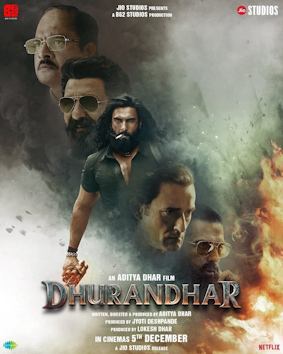
Though the media pushed Ranveer Singh to the forefront of the promotions, veteran actors Arjun Rampal and Rakesh Bedi easily outshine him in the scenes they are together. Another standout performer is Danish Pandor who plays Rehman Dakait’s cousin Uzair Baloch.
An additional driving force in the film—the music! The story may be a slowburn, but the score by Shashwat Sachdev is not. The film is laced with pumping, energetic beats. That being said, the only song worth listening to is ‘Ez-Ez’ by Diljit Dosanjh and Hanumankind. The rest of them are either remakes of already hit songs or forgettable. Parts of ‘Yeh Hai Ishq Ishq’ from the movie Barsaat Ki Raat have been used in two songs on the album, ‘Ishq Jalakar – Karwaan’ and ‘Move – Yeh Ishq Ishq’—both equally catchy. You also get a remixed version of ‘Rumba Ho’, amping up the only motorbike-car chase sequence. The ‘Dhurandhar title track’ is a rendition of Punjabi folk song ‘Na De Dil Pardesi Nu’—which translates to ‘don’t give your heart to a stranger’—setting the tone of caution for the characters and subtly nudging the viewers to not keep their sympathies with the strangers, even if they’re our neighbours.
What doesn’t work: the setting
As the characters are introduced one by one, Dhar recreates Pakistan’s political history but that’s where all the resemblance to reality falters and starts appearing gimmicky. The high speed action sequences shot from the top and the excessive use of slo-mo end up revealing just how much patchwork the post production team has had to do. And let’s be honest, shattering glass and gory deaths are overdone now. Somewhere along the line of adding stylistic shots, Dhar forgets to show actual spy work. It almost seems like the beast India sent to Lyari is just beauty and brawn, lacking the brain.
All this rhetoric borrowed from our aadarniya Pradhan Mantri ji’s speeches serves as a testament that the scriptwriter Dhar didn’t need much to cook up the story or the dialogues. The hate propaganda is subtly embedded into the story because all we see are the vile Pakistani terrorists.
The characters look like they’re straight out of a C-grade Indian movie, hurling ma behen ki gaalis at each other every other second. Funny that, since there are not that many female characters in the film.
Dhurandhar Review: where are the women?
In the gangwar infested fictionalized version of Karachi, there is no space for women, but only for Bharat Maa (which is an abstract concept) and two item song dancers with a sneaky Jasmine Sandlas singer cameo. For all the slow burn serious spy thriller it promises, Dhurandhar couldn’t escape the trope of an item song thrust in the middle.
As for the film’s heroine, Sara Arjun, the youngster plays Yaalina, Jameel Jamali’s daughter and Hamza’s love interest, and only enters the movie after the one-hour mark. The freshly 20, college-going, partying, father-hating spoilt brat finds her escape in the honest and good-hearted Hamza—who lucks out again. She becomes the perfect instrument for Hamza to keep an eye on the politician and his corrupt undertakings. She becomes an important aide in his plan to destroy the Lyari gangs from within. Perhaps she has a greater role to play in part 2.
Foreboding or foreshadowing
There is a lot of foreshadowing in the first 10 minutes of the film, which then makes its run time of 214 minutes not worth the investment. The most disappointing of all was the ultimate reveal that Ranveer Singh’s Hamza is an Indian agent, a scene that falls flat as the audience has known this for three and a half hours already. To make up for this lack of punch, Dhar has Ranveer Singh reciting these lines in his beastly voice, “Yeh naya Hindustan hai, yeh ghar me ghusega bhi aur maarega bhi” (This is the new India; it will barge in your house and will beat you up too).
All this rhetoric borrowed from our aadarniya Pradhan Mantri ji’s speeches serves as a testament that the scriptwriter Dhar didn’t need much to cook up the story or the dialogues. The hate propaganda is subtly embedded into the story because all we see are the vile Pakistani terrorists and the violence that Hamza has to perform in order to earn their trust, never mind that he may be cut from the same cloth.
As they say, truth is stranger than fiction, perhaps entertaining too. There’s an invisible line between truth and fiction and this film tiptoes that line. But it isn’t careful about it as it crosses the line, assuming no one is watching, but we are.
About the author(s)

Aarthi (she/they) is a young feminist, currently based out of Jodhpur, who enjoys writing on pop culture and art-related subjects. Through her writings, she attempts to position herself between self-reflection and social conversation leading to the exploration of unconventional ideas. In her free time, she travels, writes poetry, watches films and anime