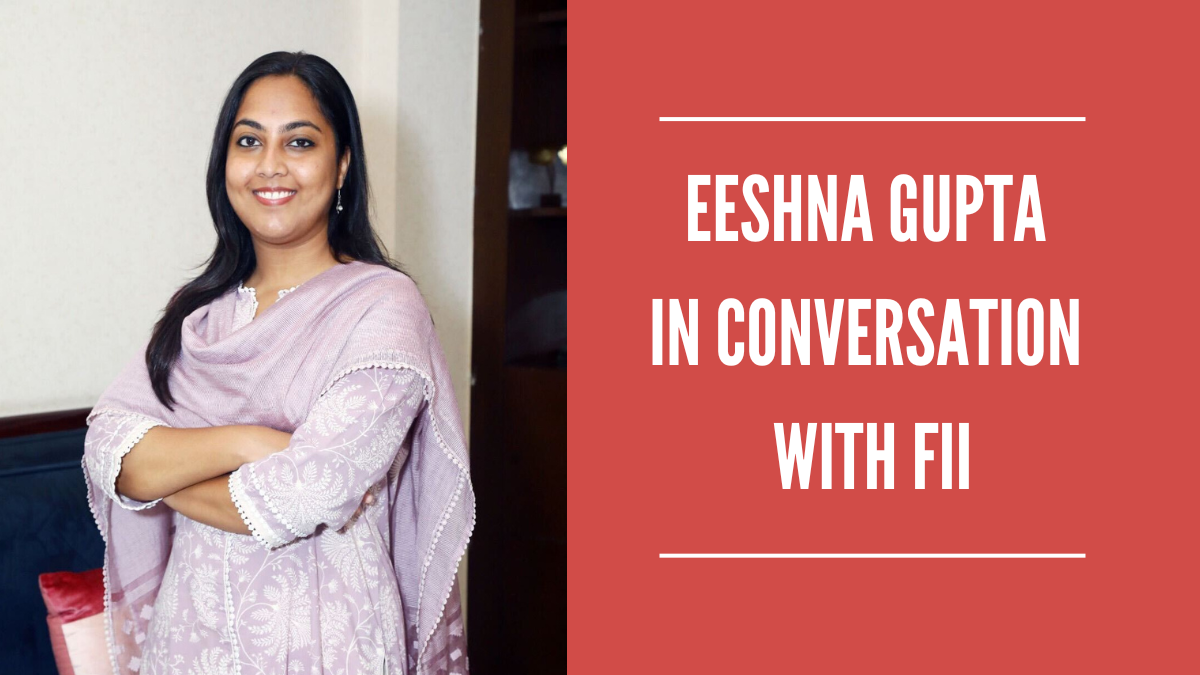
Eeshna Gupta is a 24-year-old young leader from Aam Aadmi Party (AAP), chosen as the party’s candidate for the Municipal Corporation of Delhi (MCD) by-elections from Ward 173, Greater Kailash (GK). Eeshna has been active in social and civic work for nearly eight years. She represents a new wave of Gen-Z entrants into politics, aiming to bring transparency, tech-enabled citizen services and grassroots accountability to local governance.
In a conversation with FII, Eeshna shares her journey in politics and what hopes she has of the future.
FII: You’re the youngest candidate to contest in MCD polls. What motivated you to enter electoral politics at 24? Was there a particular moment or series of experiences that convinced you to stand for public office?
Eeshna Gupta: Thank you for starting here because it takes me back to where my journey began. Stepping into electoral politics at 24 isn’t a dramatic leap but an actual progression. It is years of spending time doing social work, of organising on the ground and constantly confronting the everyday violence of inequality, which is the foundation of our country, unfortunately. Young women don’t just wake up one day and decide to contest the elections. For me, it has been a very slow accumulation of discomfort, of unease, with systemic injustices; because we are conditioned to accept, with how quickly our expectations as citizens has been lowered, even if we see politics at a macro level.
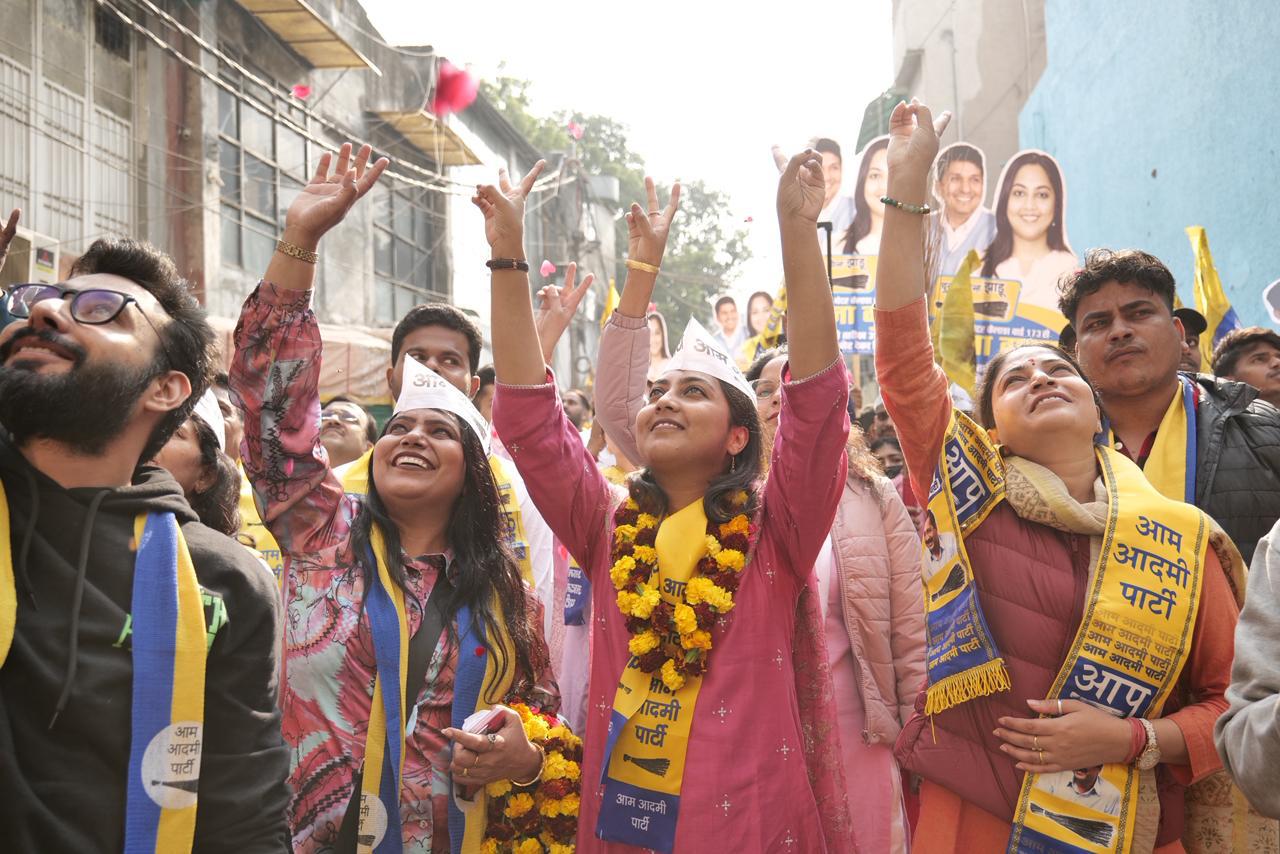
The question that has always haunted me has been very simple, which is that if not you, then who? And if not now, then when? Growing up in Delhi, I have been surrounded by stories of resistance, of resilience. I have seen activists building movements from scratch. I have seen the work of very good NGOs working on dignity. I have seen the work of writers, artists, academics and collectives, who have imagined new worlds. And of course, definitely the emergence of an alternative politics with the AAP that has challenged the very idea that governance must only remain in the hands of powerful and entitled people. Seeing that while growing up has been very inspirational for me.
So, entering politics at 24 is just my way of pushing against that entitlement. It’s my insistence that public office belongs to people who believe in accountability, who feel accountable, not just those who inherit power or believe that they’re owed it. My motivation is not for the sake of ambition. I genuinely believe that we are at a political moment where it’s an urgency now. And it’s the hunger to turn this energy, restlessness and frustration into something more constructive and transformative. So, politics for me is, to reiterate, not about claiming space but about genuinely creating it.
FII: You represent a party that came to power on anti-corruption activism and disruptive politics. Today, critics say AAP has become more like the establishment it once challenged. How do you in your personal capacity imagine renewing that original spirit?
Eeshna Gupta: All I can say is that good parties evolve and great parties keep evolving. And that evolution demands a new spirit without romanticising the past or getting cramped in that nostalgia. And I would say that my candidature itself reflects a progressive push from our senior leadership. My candidature is an acknowledgement that politics must constantly renew itself, and not just recycle the same faces and formulas.
My candidature is an acknowledgement that politics must constantly renew itself, and not just recycle the same faces and formulas.
So, if you look at history, the foundations of a political party matters. They set the moral tone, they set the ethical architecture and the boundaries of what is possible. So, parties that are built on movements, not monarchies, are positioned better to democratise power instead of holding it. So, for me the AAP isn’t just a past success story; it is a future facing political project. It is a party born out of protest, committed to governance, powered by ordinary people, and more importantly willing to reinvent themselves through them.
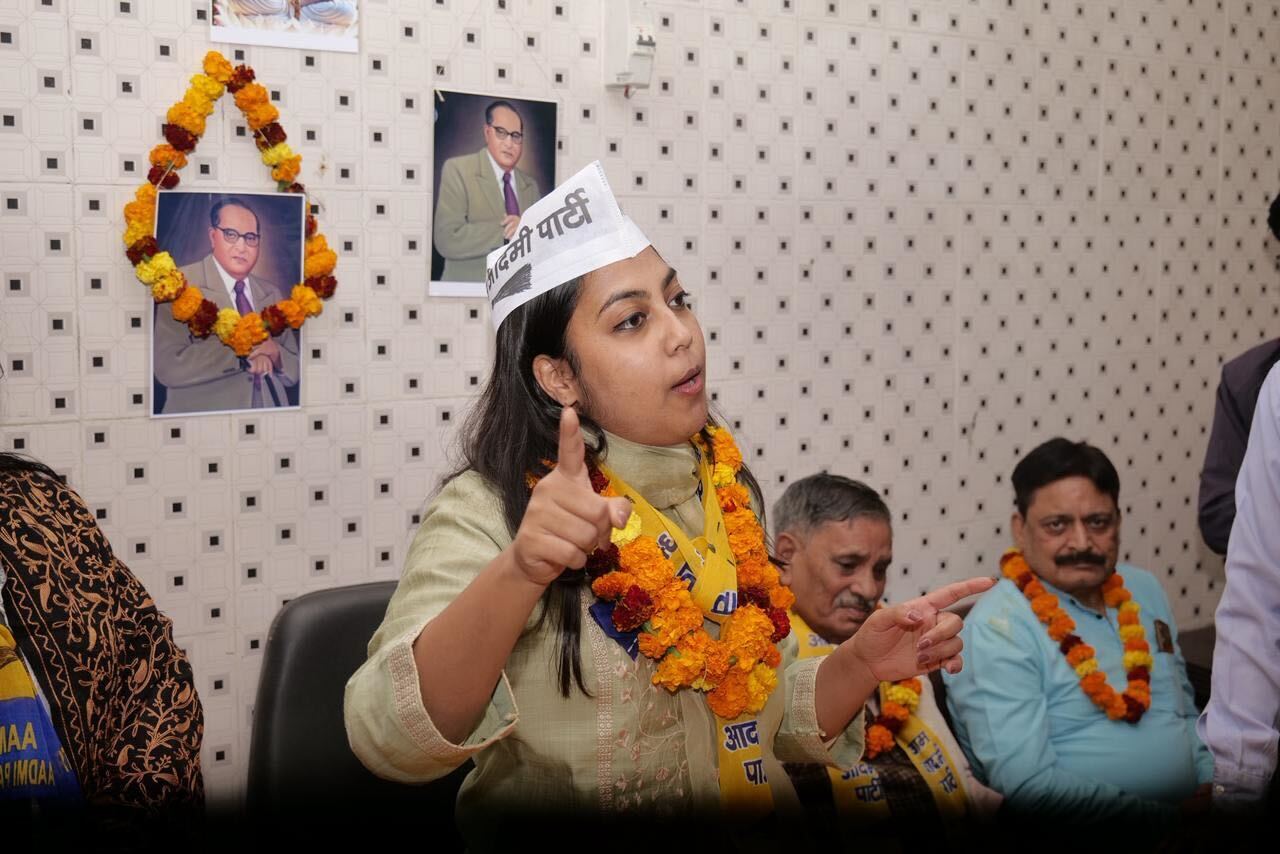
That is the politics India needs, one which is not inherited by power, but by evolving purpose and AAP, therefore, I believe, is the future of India; because it belongs to the young, it belongs to the restless, and it belongs to, most importantly, the hopeful.
FII: Given the increasing involvement of young people in politics globally, do you think your age (and generation) gives you a different lens on civic issues compared to “traditional” politicians and what does being a “Gen-Z candidate” mean to you, especially in the context of GK and Delhi’s civic politics?
Eeshna Gupta: Age is a question that all the reporters have spoken about and has time and again come. And the comparison that they draw is from traditional politicians. So, to begin with, I don’t mean to dismiss the experience that career politicians bring. Their years of political practice matters, and I’ve learned a great deal from them about systems, about rules, about processes.
But what my generation, and I would like to say our generation brings to the table, are fresh perspectives, and most importantly, an imagination of what is possible, and that is exactly what this moment demands. I have grown up in a digital world where information flows freely, where we are talking about climate change or sustainability, which aren’t theoretical issues but urgent inheritances, and I’m using the word “urgent” very deliberately. My generation has a heightened literacy around climate, digital transparency, around social justice. And we think in terms of interconnected systems, we are not looking at these things as isolated problems. Traditional politics often approaches civic issues through old frameworks, and my lens is intersectional. I look at waste management, not just as a municipal responsibility, but as an environmental justice issue that disproportionately impacts marginalised communities.
And with the speed at which our world is changing, politics has to be agile. It has to adapt to tech-driven tools for accountability. In my manifesto, which has been available in the public domain and was a very significant part of my campaign, I also proposed a GK Works app because technology isn’t ornamental but essential for faster reporting and meaningful grievance redressal.
In my manifesto, which has been available in the public domain and was a very significant part of my campaign, I also proposed a GK Works app because technology isn’t ornamental but essential for faster reporting and meaningful grievance redressal.
Regarding the generational shift, I think I was branded as a Gen-Z candidate, because it was a term a reporter pinned up, and then it was all across. It wasn’t intentional in any way. But this generational shift, I feel it’s very important because it pushes away from short term fixes; towards making governance more inclusive, transparent and innovative, because I feel our generation asks very simple and powerful questions, like, what is missing here and what would fairness look like if we started from scratch? Our campaign, my candidature and the young people I have worked with in the ideas that I’m talking about, I feel, are political, but more importantly, at its core, the outlook that we are bringing is positively disruptive, because it is refusing complacency. It is reimagining what governance can look like for ordinary people.
And to answer your second question, I would say that globally, Gen-Z’s are entering politics with a new vocabulary that is rooted in rights, inclusion, and environmental urgency. And with my candidature, I want to say that it is time for India to make that space, now, and for the future as well.
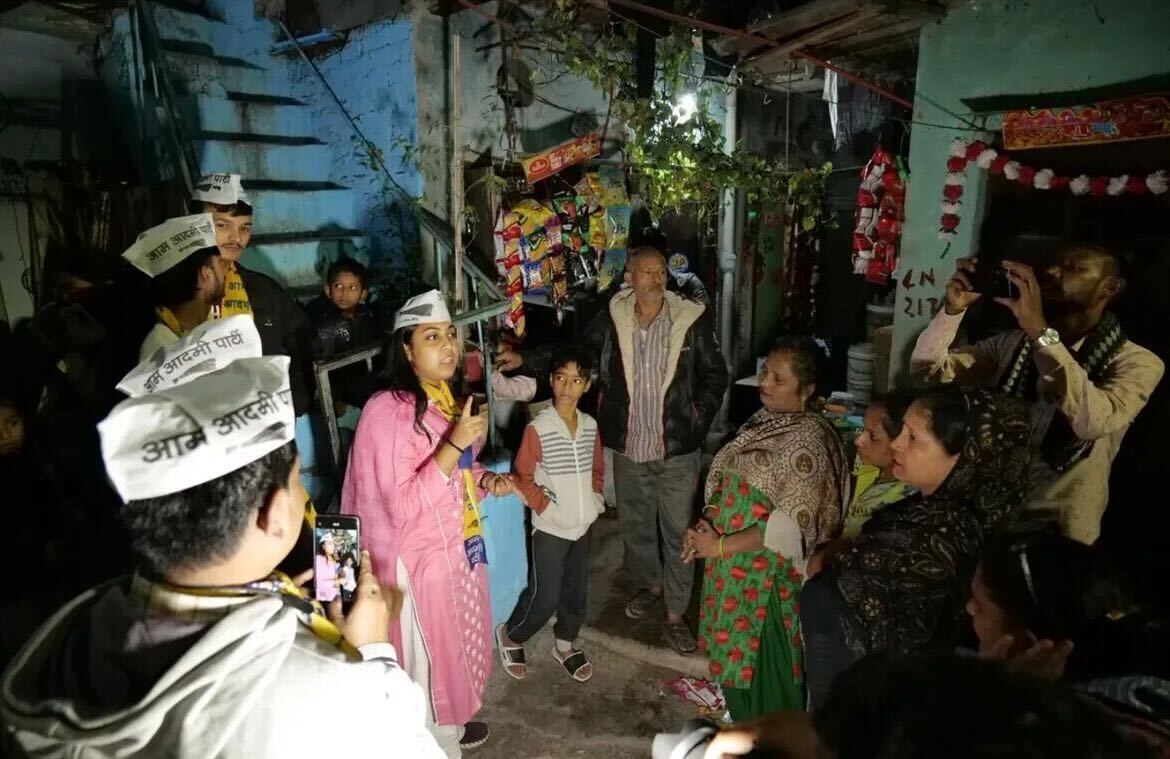
For me, being a Gen-Z candidate means refusing cynicism and insisting that democracy can work, especially at the hyper local level, where its absence was felt most directly in people’s lives. I also want to tell young people that it is “cool” to care, to show up, to organise, and strengthen our own neighbourhoods. Being apolitical is not rebellious; it’s being complacent. Participating in democracy doesn’t end with just voting. It begins there.
Our generation has to inject urgency into civic politics, that is too often slow down by legacy problems, and a cultural resignation. And talking about GK, as an example, although it’s perceived as an upscale neighbourhood, in reality, it’s a paradox. Beneath the facade are everyday frustrations, whether it’s piling garbage, traffic chaos, broken infrastructure, or most importantly, an unresponsive representative, if you consider the MLA, the MP and the central government. Being Gen-Z for me, means confronting these failures with smart, practical solutions. It means being tech savvy, it means being socially conscious, and unafraid to challenge what’s wrong. My politics is, therefore, a call to action for Delhi’s youth.
That is what I reiterate on all platforms because my politics is genuinely a call to action for Delhi’s youth. Politics isn’t a distant spectacle; it’s the ground beneath our feet. It’s the parks, it’s the waste, it’s the air we breathe, it’s the streets we walk on. It’s also our chance to imagine a cleaner, fairer city, and then build it block by block.
FII: There’s a critique that “youth in politics” often comes from privilege; elite education, networks, English-speaking backgrounds while working-class youth remain excluded. How do you acknowledge and bridge that divide in your politics?
Eeshna Gupta: I’m not someone who pretends I don’t have privilege; I acknowledge it fully. My education, my networks, the safety net I come from, these are not small things. They enable me to take risks. They enable me to speak up and to contest an election at 24. But I also believe that privilege should not be hoarded. It should be leveraged. I want to use whatever access I have to support people who don’t have the same proximity to resources, language, or platforms. Privilege is something to be deployed with responsibility.
I want to use whatever access I have to support people who don’t have the same proximity to resources, language, or platforms.
Where I disagree is with the cynical assumption that privilege is a pre-requisite for political participation. The AAP is a prime example. It has actively challenged that idea. It cracked open a political culture that once belonged to dynasties, big donors and entrenched lobbies.
Look at the stories within the AAP, many of our leaders entered politics with nothing but conviction. People who began as volunteers, auto drivers, teachers and activists, built their identity inside the movement, not outside it. They did not inherit space but rather created it. When they didn’t have financial means, they crowdfunded, which in itself is such a powerful tool in the space of traditional politics. They relied on community support, they turned ordinary people into political investors. That too, is a redistribution of power in a way.
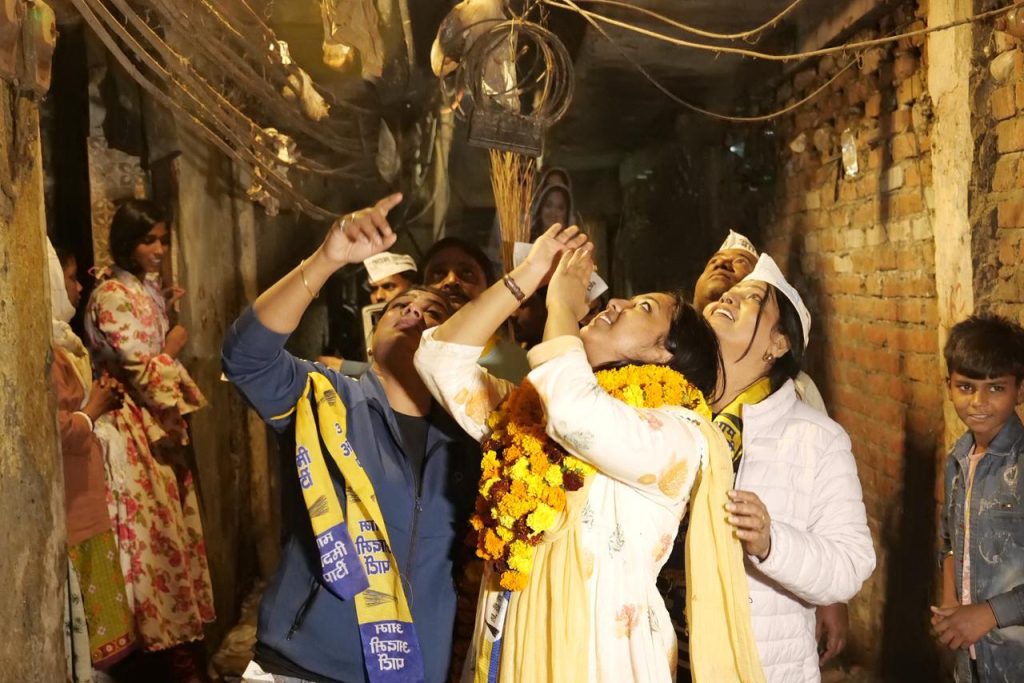
You do not need a surname. Whenever this conversation comes up, I just say, that you do not need a surname, a fortune, or permission to do politics. That is the legacy worth defending because it proves that politics does not have to be an exclusive club. It can be a public institution, which can be built brick by a brick by those who show up with courage. I believe that political courage is the only prerequisite.
FII: Even in neighbourhoods like GK which are considered to be relatively “upscale”, women’s safety, especially for younger women who are not local, remains a huge issue. As a woman in office, how do you plan to ensure women’s safety in public spaces in your constituency?
Eeshna Gupta: Safety and security come under the Delhi police, which is also under the central government. Although it is not the jurisdiction of MCD, but I have talked about it extensively in my manifesto, in terms of how we can identify dark spots, how we can work on women’s safety under the jurisdiction of the MCD, if we were to come to power.
I’ve said it previously as well that GK is perceived as an affluent neighbourhood, but that is the paradox of this area. Beneath its reputation as a privileged neighbourhood, there are also very serious civic issues that encouraged me to take part in this race. These issues have been ignored for far too long; residents have been taken for granted, and the everyday frustrations that they face are treated as invisible, simply because the area looks well off from outside. So, during my campaign, I put forward a detailed manifesto that laid out concrete, time bound solutions to all these issues, including women’s safety, and how I intended to implement them. It is available in the public domain for everyone to review it.
I’ve said it previously as well that GK is perceived as an affluent neighbourhood, but that is the paradox of this area. Beneath its reputation as a privileged neighbourhood, there are also very serious civic issues that encouraged me to take part in this race.
For me, in my practice, my point was never to just plainly talk about blanket issues. In my manifesto, as well as my conversations post-elections, I have always emphasised that every promise I made was backed with a plan; it was not just simply rhetoric. And as a part of this exercise, the point was never to critique the system; it was always to demonstrate that accountability and innovation are possible at the municipal level. And when we talk about young women, migrants and people from marginalised communities, I have built my politics on a simple foundation, from day one: access must belong to everyone. If I am an elected representative, irrespective of your background, identity, area in your own ward and in your jurisdiction; an elected representative has to be accessible for everyone, and accessibility to all and working for all is key. These have been my political foundations. Our leadership has always encouraged this and hopefully my practice in the future will also reflect that.
FII: A question which comes up with regards to GK being majorly an upscale and an affluent area is how will you ensure that your office remains accessible to ordinary residents (young, old, economically weak) and not only to those with influence, power or means?
Eeshna Gupta: With regards to the AAP, we have already bridged that gap. When we have been in power, there has been a very stark difference to the BJP. And it’s such a stark comparison that even if you go and survey on your own, you will see that. The AAP leaders have always been accessible to everyone, and have always been around during high and low times of their residents. AAP leaders have always worked their fullest and they’ve done honest politics in GK.
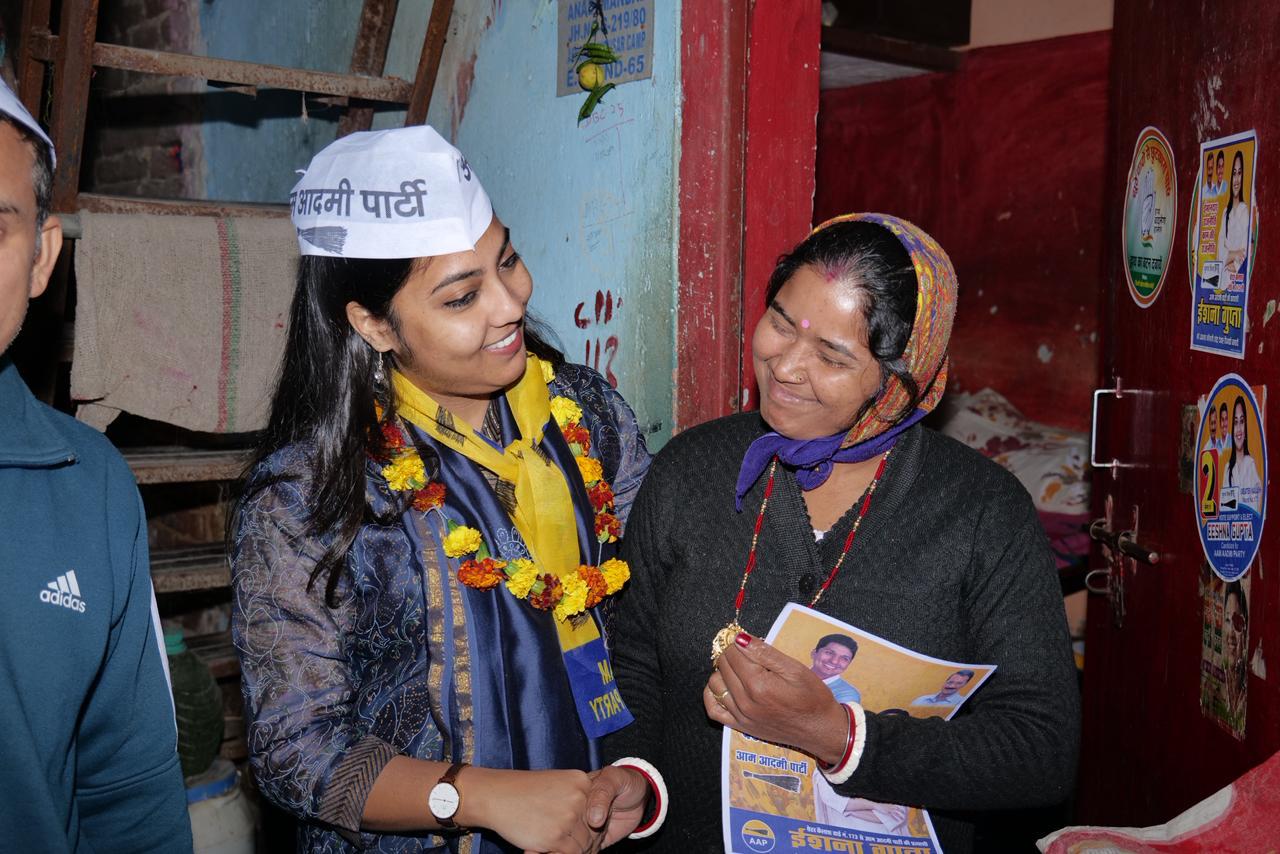
So, we are coming from a legacy of good work, approachability and availability to all.
And if we compare that with the BJP, we do not see that. Elected representatives are not available; only those with influence can access those spaces, go to the offices of electric representatives, and are reciprocated to.
FII: Women remain underrepresented in higher levels of Indian politics: even today, a fairly small share of state and national legislative seats are held by women. As a young woman candidate in a city ward election, do you see your candidature as part of a broader push for greater women’s representation in local governance? What message do you hope this sends to other young women?
Eeshna Gupta: In India, as of December 2025, women constitute only 13.6% of the Lok Sabha, with only 74 women out of 543 members. And when it comes to the Rajya Sabha, only 17.1%, which means 52 women out of the 245 members. Across state legislative assemblies, the national average of women MLAs stands at approximately 9%, which is very concerning. If you look at examples of states, Chhattisgarh has the highest representation at 18%, followed by West Bengal and Rajasthan, at around 13 to 15%. Several states remain below 10%, with Himachal Pradesh having less than 1%, and Mizoram having 0% women MLAs.
So, to add to your question, across the country, even in organisational roles, within political parties, which are very different from electoral contestation; we remain underrepresented. Only a handful of women are there.
Entering politics isn’t about replicating old power, t’s about reclaiming space with grace, with grit, with clarity.
In that context, young women choosing to contest elections, as well as taking part in party politics, is very important. It is an act of claiming space in a system that was never designed with us in mind. My candidature is a conscious nod to the larger struggle. To young women, my simple message is that you do not need a political surname to belong here. If a 24-year-old like me from a non-political family can navigate nominations, campaigns, organisational politics, and public scrutiny, so can you. Entering politics isn’t about replicating old power, t’s about reclaiming space with grace, with grit, with clarity. And I believe that Indian politics urgently needs our intellect, our empathy, and our unapologetic ambition. That will be my message to all young girls looking at politics for a sense of hope.
FII: At 24, coming from a non-political family; standing for office, you break the mould of traditional politics. Do you believe that more people like you who are young professionals, women, newcomers; should contest local elections? What structural changes does Indian politics need, to encourage that?
Eeshna Gupta: I think more people from non-political families and outside power lobbies must enter politics. It is not just to tick a diversity box, but to truly transform it. India urgently needs an influx of young professionals from intersectional identities – women and first generational entrants, to revitalise local governance and dismantle legacy power structures. I believe that when fresh voices break in, governance really changes, and decision making becomes more responsive and evidence based. It is also, then, deeply rooted in our real-life experiences.
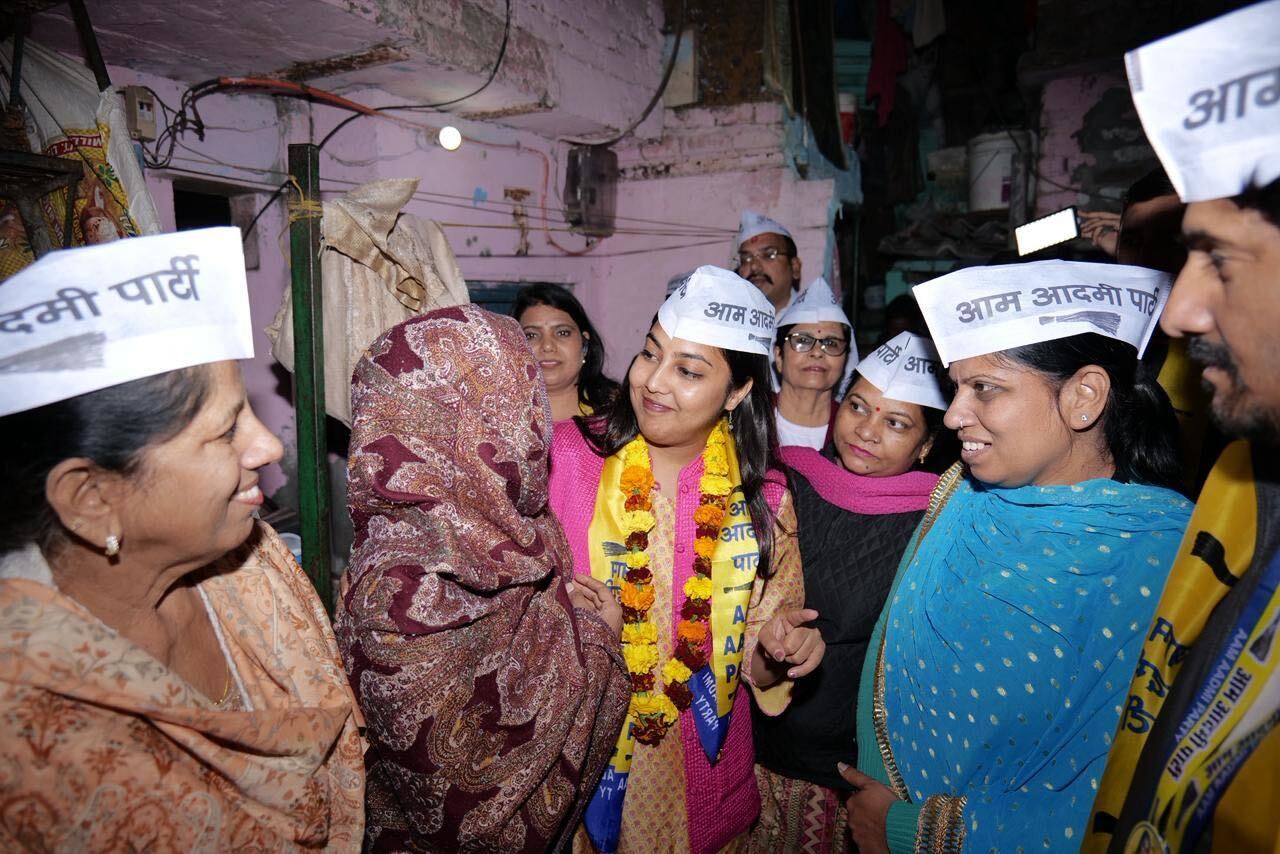
My own journey as a post graduate and social worker with no political lineage shows that expertise from outside traditional corridors can really bring in genuine innovation to public service. The AAP story proves that it is possible. Engineers, doctors, teachers, journalists, activists, and people various other professional backgrounds came together to show that governance can be people centric and effective, and that disruptive energy is needed again, now, more than ever. And in terms of solutions, tokenism won’t fix this, where we have one or two people who are just representing us. Real change will demand structural reforms, whether it’s through training and leadership, academies for political entrance, strong mentorship networks, gender responsive infrastructure, and merit-based ticket allocation systems.
If we want Indian politics to finally look, feel and function differently, we must redesign the gates and build real support systems for those who walk through them.
FII: What kind of legacy do you want to leave, as a young female political actor? What message would you like to send to young Indians who are disillusioned by politics?
Eeshna Gupta: As a young woman in politics, legacy for me is not measured in headlines, but in habits that outlast the individual. My broader legacy would be paving paths for others. It is up to us, the youth, to rewrite the narrative from cynicism to collective hope. I am doing my part and I want others to do theirs, not by being spectators, but by becoming participants.
To a disillusioned young Indian who feels only exhaustion and anger, I’ll say that your disillusionment is not a flaw, it is evidence of how deeply you care.
To a disillusioned young Indian who feels only exhaustion and anger, I’ll say that your disillusionment is not a flaw, it is evidence of how deeply you care. The system is not inherently broken, it is unfinished, and unfinished systems are the only ones worth stepping into, because they can still be shaped. So, start exactly where you are. Start on a residents’ WhatsApp group, start with a municipal complaint, start in a college election: student politics is also a very powerful medium.
Bring your idealism, your memes, your spreadsheets, your poetry, bring whatever you have, because it belongs in politics, and that is precisely what politics in India has been starving for: a new language, new tools, new imaginations, and new people willing to show up.
10. What would be your final message to anyone, young people included, who’d be reading your interview on FII’s platform?
As I said, the first step that you can take is to start with your own neighbourhood. And I want reiterate that I want young people to know that it is cool to care, to show up, to organise and strengthen our own neighbourhoods. And that being apolitical is definitely not cool. It’s being complacent. Participate in the democracy that we are gifted with, because not everyone has that. Participating in democracy does not end with voting, it begins there. Our generation has to inject urgency into civic politics and talk back to a culture of resignation.
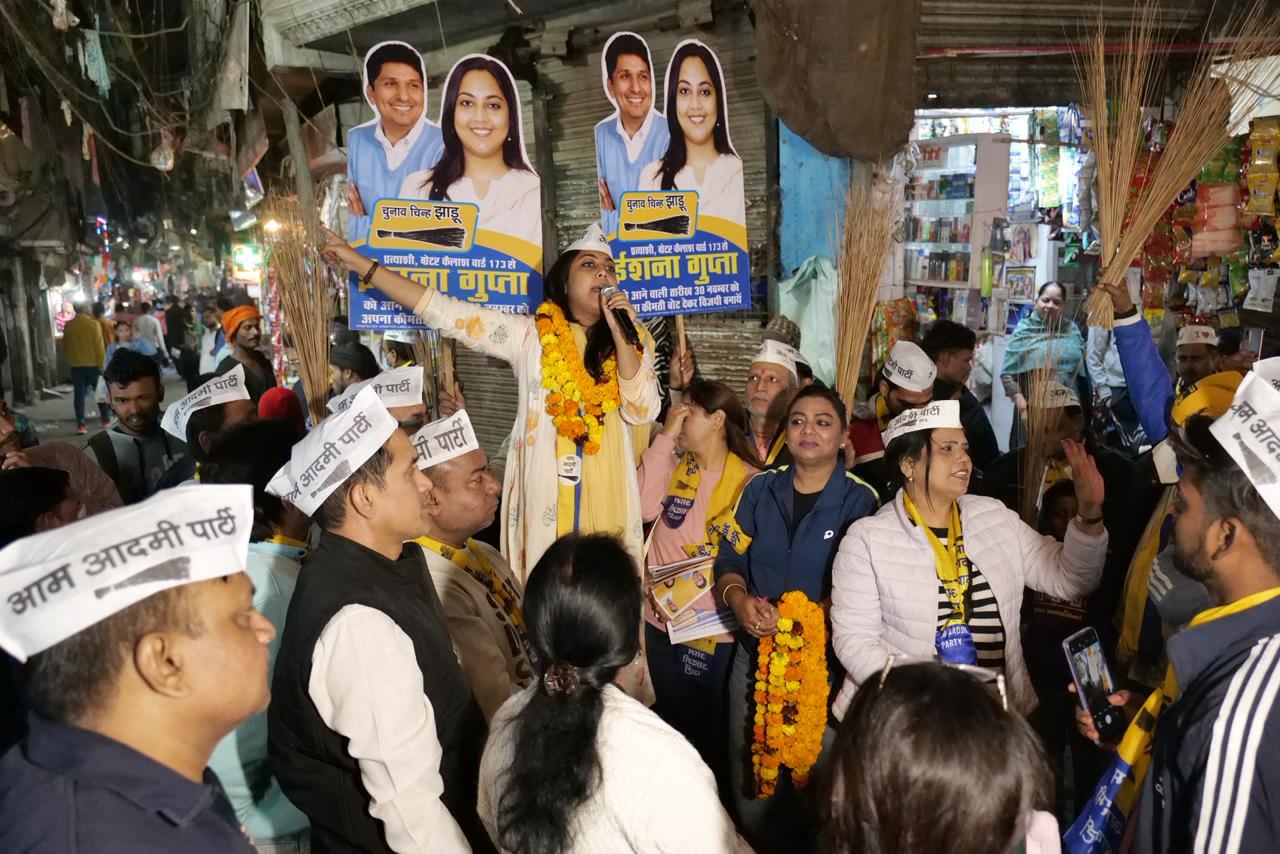
And for those who still feel that there are barriers to entering politics, I’d say, come volunteer with me, or join my team. Lastly, I feel that AAP is the future of Indian politics, because, again to reiterate, it belongs to the young, the restless, and the hopeful. We have to break through inherited power and be a part of an evolving purpose.
About the author(s)

Mema is currently a Master's student at South Asian University (SAU). Hailing from Manipur, her lived experiences there have shaped a deep commitment to the feminist cause. She cares deeply about women and their future, which she tries to convey with her writing. She finds joy in reading, writing and cooking.