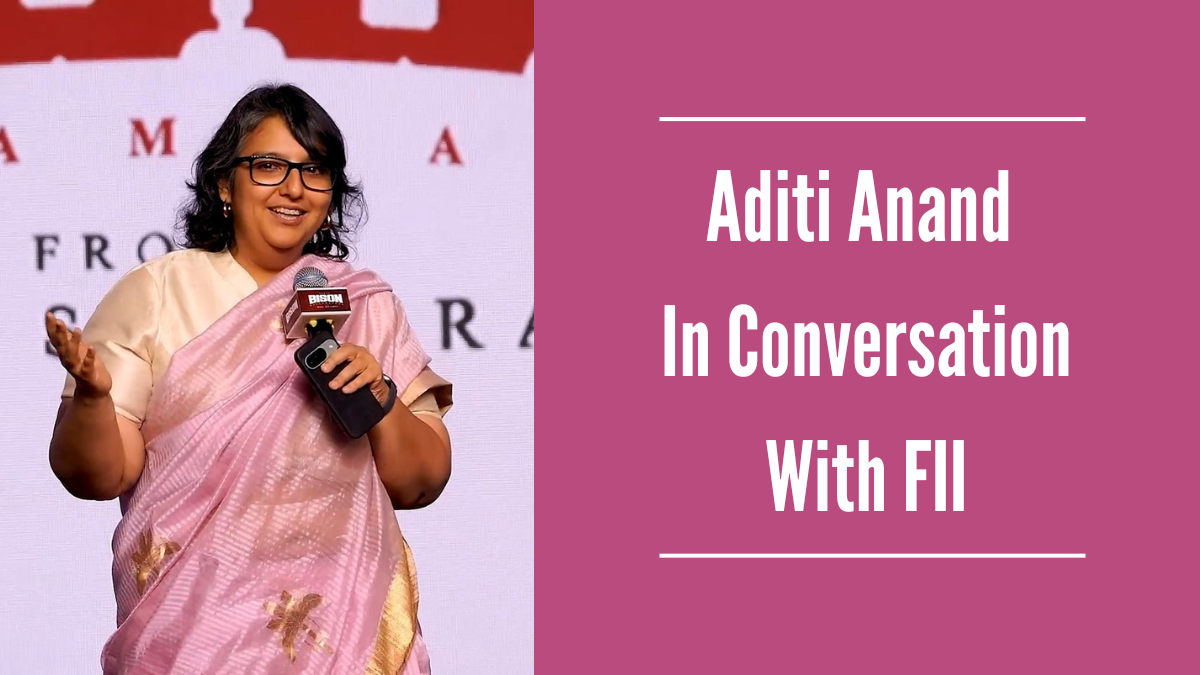
Aditi Anand is a renowned Indian filmmaker and producer. She has spent the better part of three decades asking hard questions through her storytelling: refusing to follow the norms and breaking the binaries that divide our daily world. For her, storytelling has never been separate from politics. With films like No One Killed Jessica, Paan Singh Tomar, and more recently Bison Kalaamadan, cinema has been as much an act of inquiry into power as it is of entertainment. The question that continues to drive her work: Who, ultimately, gets to tell the story?
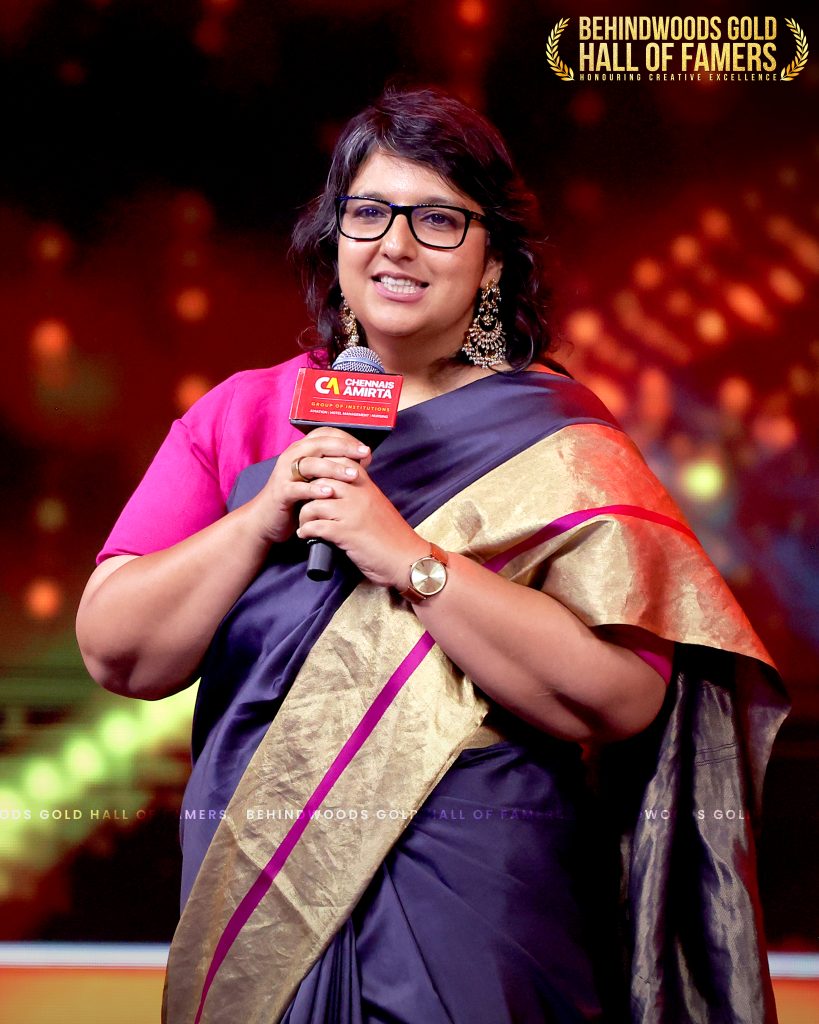
Aditi is an openly queer filmmaker and was one of the petitioners in Marriage Equality case in the Supreme Court. FII spoke with Aditi at a moment when the country is witnessing the rollback of Transgender rights and the parliament has just passed the Transgender Amendment Act. It is precisely the moment which needs a voice like hers — one that very well understands the implications of the decisions made by those in power, and the importance of inclusive storytelling as a form of people’s resistance.
When the country is facing a pivotal moment, producer and filmmaker Aditi Anand speaks to FII’s Assistant Editor Vishal Sharma on politics, the current state of Indian cinema, and queerness — and shares why she remains stubbornly optimistic.
FII: Looking back at your filmography, No One Killed Jessica, Paan Singh Tomar, Pa. Ranjith’s films, Bison, these are all stories about people fighting systems that were never built for them. Do you think your queerness had a role in shaping these stories, even when the story itself is not about queerness?
Aditi Anand: I did Paan Singh Tomar and No One Killed Jessica for a studio, so I didn’t have that sort of agency there. But yes, if you look at my personal filmography — The Extraordinary Journey of the Fakir, Writer, J Baby, Dandakarnyam, and Bison Kalaamadan — they all carry that sense of injustice, or people pushing back against a system.
I’m not entirely sure what got me there. I think maybe it’s a little bit of my own journey with being queer. And maybe a little bit — or a lot — to do with my grandfather, my nana. He was the first Indian editor of The Statesman, and famously, the day after the Emergency was declared, only one newspaper came out — The Statesman — with just the masthead and blank pages. Maybe somewhere, he lit that fire for me. And the second part is that I’m also on a journey of learning. I want to know more, understand more. Asserting my queer identity became much more important to me after we became parents.
FII: The Extraordinary Journey of the Fakir travelled to 56 countries and then flopped in India. You’ve described it broke your heart but hardened your spine. What does a failure like that teach you that success never would?
Aditi Anand: It broke my heart. On paper, everything about that film looks like success — it travelled to 56 countries, it was an incredibly ambitious co-production, and it did things that very few Indian films get to do. But it didn’t work in India. But I would have never landed up in Tamil Nadu without Fakir pointing the way, both literally and figuratively. If Fakir had succeeded, I think I would have stayed exactly where I was. I wouldn’t have gone looking. I wouldn’t have moved. Failure forced that movement. And that’s something success never really does. Success can sometimes allow you to settle into your own narrative. Failure strips that away. It makes you ask harder questions — not just about the market, but about what you’re actually looking for.
For me, it pushed me towards something more rooted. Towards stories that feel closer to the soil, to politics, to identity. Towards collaborators like Ranjith and Mari Selvaraj, and eventually to a film like Bison. So yes, it broke my heart. But it also set me up to find something much more special. And I don’t think that would have happened any other way.
FII: There’s nowadays a lot of talk about queer representation on screen in Indian cinema. But you stay behind the camera. What gets erased; in the edit, in the stories, when queer people aren’t in the producer’s role. Or queer actors are not cast for the roles and non-queer actors play the roles?
Aditi Anand: We have this obsession with only recognising queerness in cinema when films are entirely and exclusively about queer themes. I feel that a recent film like Sabar Bonda really challenged that notion. It was a love story first, and then, within that complexity of identities, it was also a Dalit story and a queer story. It felt contemporary, empowered, and confident. I absolutely loved it. But it’s important to recognise queerness in the generality of cinema — both in front of and behind the camera. If you look at the features nominated for Best Film at the Critics Choice Awards 2026, three had queer producers — Humans in the Loop, Bison Kalaamadan, and Sabar Bonda. That matters.
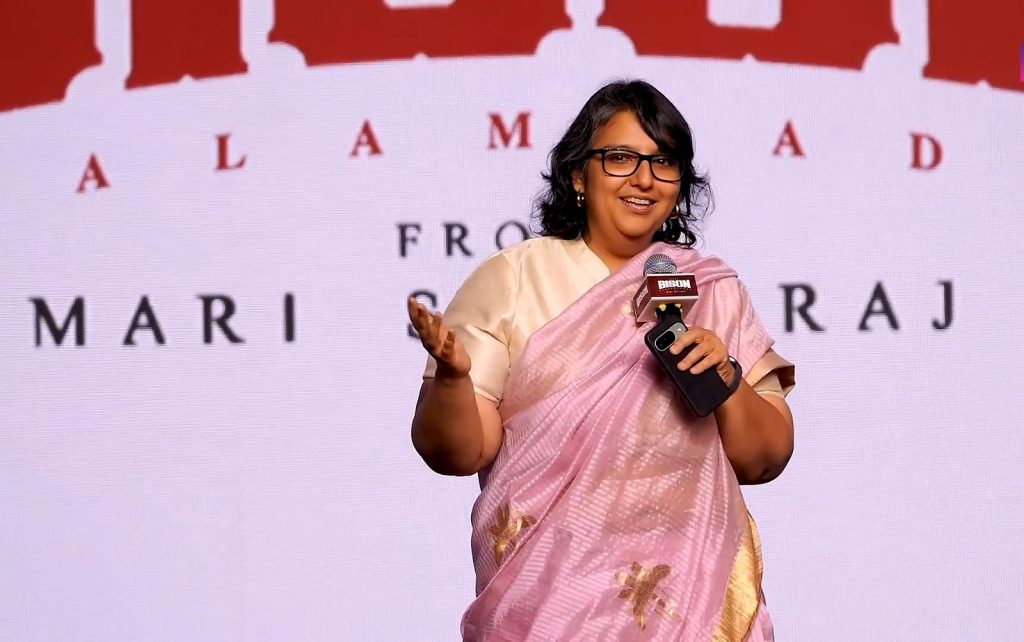
And then there’s the incredible Manipuri film also nominated in the Best Film category, which has maybe one of the finest presentations of an Indian character in drag. It’s not central to the story, but it is central to the cultural fabric of the film — and that is so incredibly powerful. Queer characters are everywhere in cinema now. We just need to start seeing that as success.
FII: You and your partner were among the petitioners in the Marriage Equality case. You’ve described your motivation as less personal and more democratic. But the Supreme Court ruled against. What does that verdict do to that belief?
Aditi Anand: I sometimes joke that my love for India is my most epic unrequited love story. Sentimentally speaking, that’s how the verdict felt to me. But let me also speak to some of the silver linings. It was incredible watching the case unfold — hearing what the judges had to say, and how progressive so much of that felt. Ultimately, it was heartbreaking because it felt like we lost on a technicality. The language of dignity and rights sat alongside a refusal to actually grant those rights. But the point was never only to seek validation for our own lives. It was to ask a larger question of the republic — who gets recognised, who gets protected, and who gets left to negotiate their existence outside the law. And just because the answer we received was inadequate doesn’t mean the question was misplaced.
FII: The Transgender Persons Amendment Bill was just passed in the parliament. Contrasting the NALSA judgement, the new law will take away the right of self-identification and will empower medical boards and bureaucrats. Effectively the state machinery now gets to decide – who a person fundamentally is? Our country with a dark colonial history of marginalised groups’ criminalisation and state bureaucracy’s role in it – What are the real dangers of the government’s efforts of bureaucratisation of determining one’s own identity? And how can we fight it collectively?
Aditi Anand: If this is the beginning of a broader Uniform Civil Code process — and it is happening without meaningful consultation with the people most impacted — then we are in for some very worrying times. Because this won’t remain contained. Any community whose interests, identities, or ways of living have at any point sat outside dominant norms has something to be concerned about. What is also worrying is the way the Bill has been drafted — the language, the intent. There is a very clear attempt to fracture solidarity within the community by offering so-called benefits or easier access to those benefits to some over others. The hope is that this engineered dissension creates internal division, stretches the community thin, and weakens collective resistance. The counter to that has to be a very clear recognition — this Bill does not just affect one section. It strips away dignity at a fundamental level. Once the state assumes the authority to define identity, nobody is untouched by that logic.
There is a very clear attempt to fracture solidarity within the community by offering so-called benefits or easier access to those benefits to some over others. The hope is that this engineered dissension creates internal division, stretches the community thin, and weakens collective resistance. The counter to that has to be a very clear recognition — this Trans Bill does not just affect one section. It strips away dignity at a fundamental level.
What also strikes me is the rhetoric around this — it increasingly sounds like something borrowed from elsewhere, almost like the language of a deep red state in the US. But that is not the terrain of our struggle in India. We have our own histories, our own frameworks, our own cultural negotiations around identity. We cannot allow borrowed rhetoric to define the terms of engagement here. Which means the response also has to be rooted locally. We have to decentralise. Engage with local government functionaries — district magistrates, municipal bodies, local representatives — people whose political survival is directly tied to the sentiments of their constituents. Pressure has to be built at the lowest and most immediate levels of governance and then move upward.
Because in India, implementation is where everything gets decided. And finally — protest fatigue is real. Communities cannot be expected to be in a constant state of mobilisation without strategy. Instead of multiple fragmented protests, there is value in thinking about a single, coordinated nationwide call — with strong build-up, press engagement, content creation, and a very clear, specific agenda.
FII: You’ve called Tamil cinema your “real film school.” Specifically in the context of caste, identity and political cinema, what did it show you about yourself and your own blind spots?
Aditi Anand: I would say it is rooted in four things — craft, trust and risk, shredding the superfluous, and a deep love and respect for the audience. On craft, it was astounding watching Mari Selvaraj and Pa. Ranjith on set. The sheer mastery of the medium is incredible. It actually makes me nervous to do this by myself now. Second, as a producer — trust and risk. You have to trust your creator, even when it comes at great personal risk. Then there is a ruthless clarity — anything superfluous that makes no impact on what the audience will see or hear is discarded. But that which changes the audience experience is honed almost tenaciously, without respite. And finally, the love of the audience. You have to love the audience if you want your audience to love you. At the same time, it showed me very quickly that sincerity is not the same as understanding. I think like many of us who come from a certain kind of liberal space, I believed that intent and empathy were enough. Tamil cinema — and more importantly, the people I have worked with within it — made it very clear that they are not.
Caste is not a subtext in India. It is structure. It informs who gets to speak, who gets seen, who is centred, who is allowed complexity, who is allowed anger. And I realised how much of my own gaze had been shaped by a certain mainstream Hindi cinema lens — one that flattens, generalises, and often recentres itself even when it is trying to be inclusive. Working in Tamil cinema forced me to listen differently. To understand that politics is not something you add onto a story — it is embedded in language, in casting, in locations, in who is named and who is not. It also made me confront the difference between empathy and proximity. You can feel deeply about something and still not fully understand it. So I think the biggest shift for me was humility — and the willingness to recognise that there are blind spots you don’t even know you have, until you step into a space that doesn’t revolve around you.
FII: Mainstream cinema stays comfortably silent when it comes to political questions and suppression of civil rights – or even worse it is becoming a propaganda tool for state machinery as often seen with every new release. Do you think cinema has a responsibility to respond to what is happening right now? And will Indian filmmaking ever show up?
Aditi Anand: So to begin with the last part first — Indian filmmaking has shown up. If you look across the South, you see powerful cinema of assertion, films that are rooted, political, and unapologetic about where they stand. The Hindi film industry, on the other hand, has been under severe strain. Everything that practitioners say or do — in their real lives and on screen — is watched like a hawk. The stakes are incredibly high. And those who have chosen to speak or stand up have often done so at great personal and professional cost. Some have, quite literally, lost their careers to their beliefs. I’ll also say this — the politics of many recent mainstream releases does not sit well with me. But I will fight till my last breath for filmmakers to be able to tell their stories, no matter how uncomfortable that makes me personally. Because the real problem is not that a certain kind of film is being made. The problem is that the counterpoint has been systematically devastated. And not because audiences rejected it — but because the space for it has been squeezed out, often through intimidation, fear, and pressure.
No cinema is apolitical. The choice not to engage is itself a political choice. Somehow, growing up in India of the 80s and 90s, one felt part of a larger project of nation-building — whether it was Mile Sur Mera Tumhara, or Ek Chidiya Anek Chidiya, or even something as simple as “each one teach one.” There was a sense, however imperfect, that culture was trying to stitch something together. Somewhere along the way, that has fallen by the wayside. And the line between patriotism and nationalism has become increasingly blurred — often by vested interests on both sides of a deeply polarised political aisle.
Nothing more than the genocide playing out like a soap opera on our TV screens is reflective of the fact that history is a cycle, not a linear path.
In my opinion, it’s time for us to start negotiating around issues rather than identities. If we can become a little less rigid about political colours, and engage more deeply with the substance of what is at stake, we might find a way to reclaim some of that power that cinema — and by extension, celebrity — once had to shape public imagination.
FII: The Supreme Court didn’t grant marriage equality. Censorship and political suppression is increasingly present. Queer stories still more or less remain a “niche” subject in India. Given all of that — are you optimistic?
Aditi Anand: I have been accused of oppressive optimism. So yes, I am fundamentally built to be optimistic. Umeed par duniya kayam hai. Recently, in a conversation about keeping sane in crazy times, a friend remarked — when did we decide that we don’t have to fight for our rights? When did we get so comfortable with the idea that what had been won was now permanent? Nothing more than the genocide playing out like a soap opera on our TV screens is reflective of the fact that history is a cycle, not a linear path. We find ourselves at an inflection point, which is giving us the opportunity to build solidarities that have existed in silos. It’s critical that we carpe diem this moment.
FII: The central question of your career, as you put it, is: who gets to tell the story? Now that you have a bigger platform than ever — as a queer producer, as a petitioner, as a parent — has your answer to that question changed?
Aditi Anand: No. If anything, the instinct has only crystallised. Reductive filmmaking and art is horribly boring. In pitching labs, they’ll tell you to pitch with context — “my film is the love child of this great film and that great film.” I completely reject that idea. If you can’t bring a story alive in the way you write, narrate, or describe it, then comparing it to other great works becomes redundant. That’s not to say you should only tell stories rooted in your own identity. But where you place yourself in that narrative — especially when it’s not personal — becomes very important. If you are an outsider to the story, then your point of view is observational. You have to be honest about that.
Secondly, I feel hope is a far more powerful narrative tool than we give it credit for. You can talk about struggle, oppression, darkness — all of that is real — but ultimately, giving agency to your characters, allowing them to empower themselves rather than be saved, is critical. And thirdly, I think condescension — towards mainstream cinema or towards audiences — is a jackhammer to any real connection. There is no moment more powerful than when people sit in a dark theatre and see themselves in your story.
About the author(s)

Vishal Sharma is a journalist and the former Assistant Editor at Feminism in India, where he has been reporting and editing since 2023. He covers caste, LGBTQ+ rights, disability, electoral politics, and press freedom. His work ranges from the BJP's caste census politics to queer disability rights to the environmental ethics of AI.
When he is not editing or writing, he is somewhere in the mountains. He is from Uttarakhand and would rather be trekking.