In 1594 Akbar issued his order in which he expressed his political and socio-cultural ideas commanding that: “Women should not usually be allowed to ride on horses.” The next year, as the Mughals marched south to Ahmadnagar, Chand Bibi Sultana took a very active stand against this edict. She rode into battle in armour and drove back the royal troops. But Abu’l Fazl’s Ain-e Akbari is not just a note; it is the imperial ideology where the greater Deccan is seen as the rebel, and women in command are aberrations.
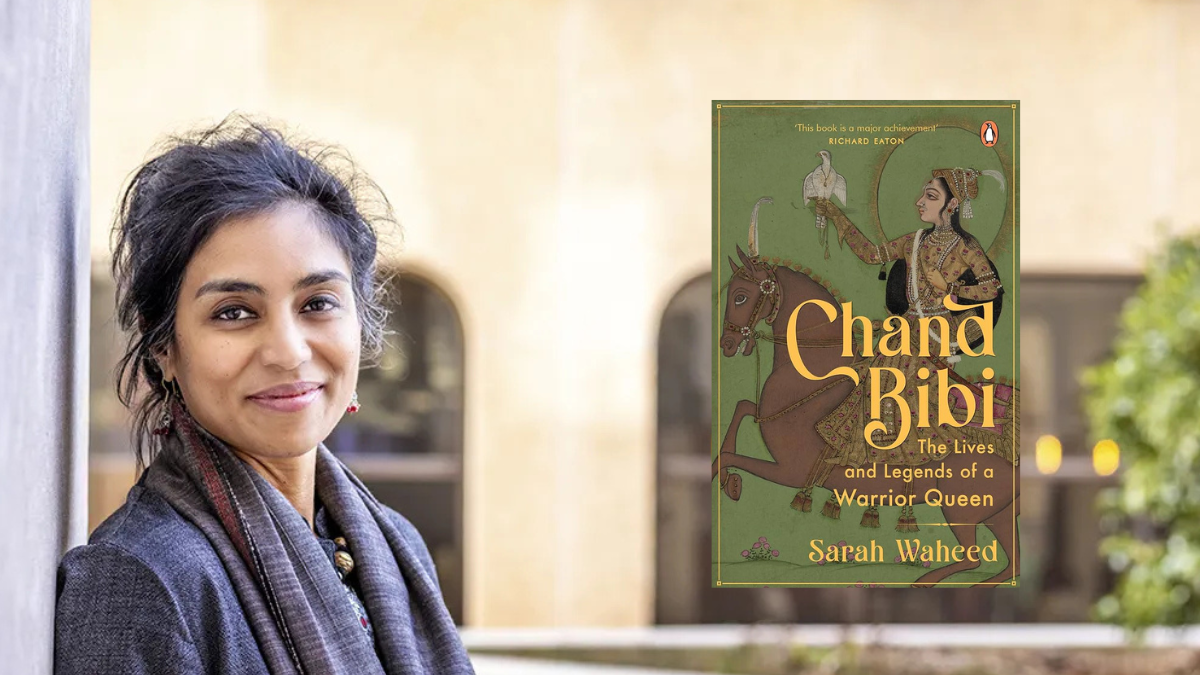
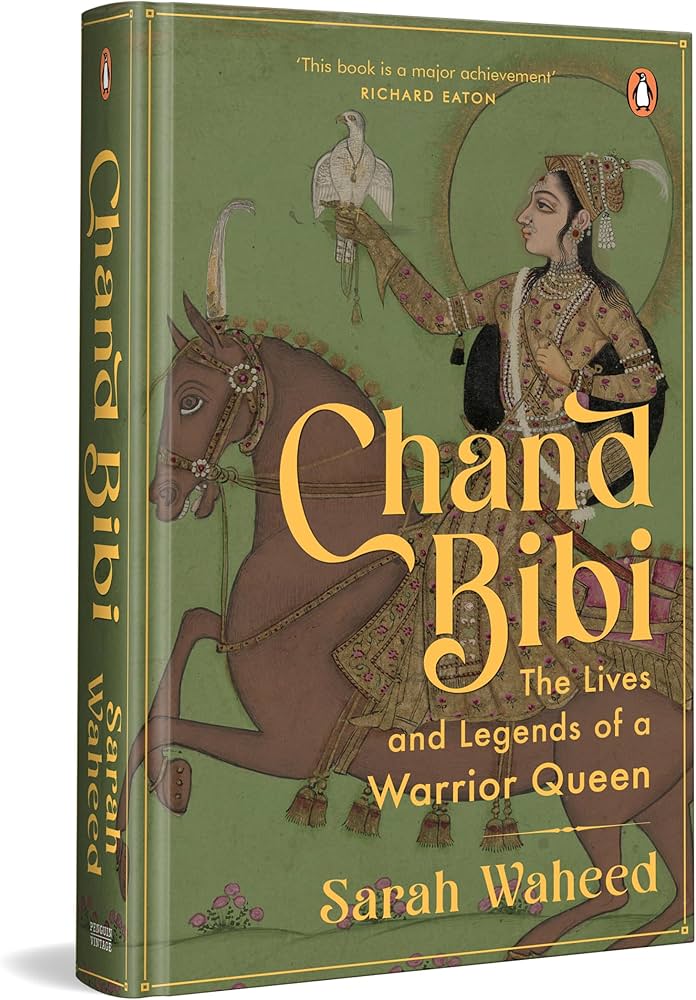
Centuries later, colonial writers like Mountstuart Elphinstone spun a new story in which Chand Bibi was called “one of the most distinguished women that have ever appeared in India,” when in reality she was a very different woman through the lens of a siege. Sarah Waheed’s book Chand Bibi: The Lives and Legends of a Warrior Queen debunks the myths surrounding Chand Bibi (1550-1600).
Qur’ānic Precedent and Matrilineal Power
Chand Bibi was not the first female ruler of Ahmadnagar; her mother preceded her. After the death of Sultan Hussain Nizam Shah I in 1565, Queen Khunza Humayun assumed the reins of the Nizam Shahi state, ruling as regent for five years (1565–1570). Chronicler Taha Taba’i observes without hesitation that “the nobles and officers of state obeyed her in all things as though she was king.” He adds, “She managed all affairs, whether of war or of peace, with wisdom and prudence.” That authority was based on actual field experience: Khunza Humayun had ridden beside her husband in campaign.
At the Bharat Itihas Samshodhak Mandal in Pune, five miniatures within the 1565 manuscript Tarif-i Husain Shah Badshah Dakhan depict the queen sitting on the throne right beside the sultan. Art historian Namrata Kanchan suggests that the text was commissioned by Khunza Humayun herself to bolster her regency, rendering it the oldest extant portrait of a royal couple produced in South Asia under a woman’s patronage. The visual victory was short-lived. In 1569, her son Murtaza took direct control of state affairs, locked his mother in prison, and ordered artists to scratch her face out of the royal book. Her features were defaced in four paintings, leaving a large pale blue smudge. Only one image came through clearly: Khunza Humayun, among her women, picking fruit in a quiet garden.
Chand Bibi grew up within this matrilineal tradition, one grounded as much in scripture as in precedent. Chronicler Taha Taba’i famously described Chand Bibi as “that Bilqis of the age,” referring to Queen Bilqis (the Queen of Sheba), the only female ruler commended in the Qur’an. Islamic feminist scholars Amina Wadud and Amina Inloes emphasize that Bilqis rules through consensus and diplomacy rather than force. In Shi’a hadith literature, Bilqis is depicted prostrating before God as his equal, not as Solomon’s subordinate. By calling her Bilqis, sixteenth-century chroniclers gave Chand Bibi a rooted theological vocabulary for female sovereignty, centuries before European notions of queenship arrived.
The Counter-Archive: Ruins, Erasure and Named Silence
To write the history of Chand Bibi is to struggle against the grain of official archives. Male chroniclers compiled early modern histories for male patrons. Waheed takes on texts such as Firishta’s Gulshan-i Ibrahimi, Taha Taba’i’s Burhan-e Ma’asir, and Nihavandi’s Ma’asir-e Rahimi, laying bare their biases before moving beyond the library altogether. She walks the wild stone ruins of Farah Bagh in Ahmadnagar, crawls through underground karez water channels, and examines an abandoned cenotaph near Ahmad Nizam Shah’s mausoleum in Bagh-e Rauza. Local memory still refers to it as Chand Bibi’s tomb. Stonemasons started dressing the slab but left halfway through, leaving an open stone arch over an unsealed grave chamber. Material culture also offers a window onto female self-fashioning.
A rare miniature painted by Shahpur Khorasan during Chand Bibi’s lifetime depicts an all-female court: the queen sits on an octagonal throne holding a wine flask, flanked by eight women in Turkish turbans trimmed with pearls. Its Persian inscription reads: “The sacred image of the Queen of the World, Chand Bibi, leader of the Dakkhan.” Waheed also traces what chronicles hide, including local stories of Chand Bibi keeping a diary during her imprisonment at Satara Fort. If authentic, the manuscript would be the oldest known autobiographical work by an Indian Muslim woman. Waheed’s most important methodological approach is to read court records alongside ruined buildings and oral memories. The chapters on Ahmadnagar are stronger because they are based more on fieldwork, while the sections on Bijapur rely more on published secondary sources.
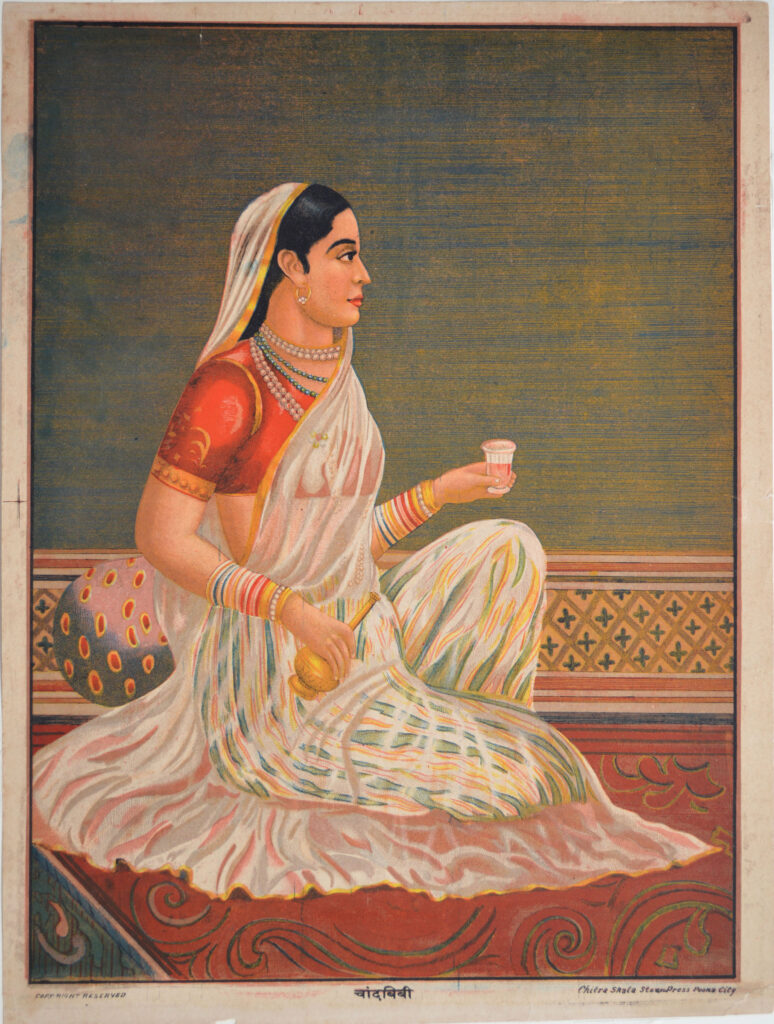
Court chronicles also reveal a distinct pattern in their recording of non-royal women. Chroniclers usually make female attendants invisible, yet accounts of Chand Bibi’s death by suicide suddenly give them full names: “Chand Bibi, Kalmakh and Noor Bibi—these three companions of Chand Bibi Sultan jumped into the well of acid.” Neither Kalmakh nor Noor Bibi shows up anywhere else in court records. Their names went into history only when their deaths could be used to frame a moral story of mass suicide for female purity. Only when women died as symbols of family honour did male historians preserve their names.
Three Demises, Three Records
Waheed does not choose a single narrative when assessing how Chand Bibi died. Instead, she breaks the event into three distinct strands: murder in Chapter 10, suicide in Chapter 11, and escape in Chapter 12. Waheed does not force a false unity on these stories. Instead, she questions who recorded each version and why. The murder plot was narrated by palace conspirators who felt it was necessary to present the story as a suicide.
In contrast, the villagers and shrine keepers tell a different tale about a successful escape through the secret water tunnels into the Sahyadri mountains. Waheed sheds light on Chand Bibi’s death. She shows that her betrayer is a man named Jita Khan, a former slave who rose to become a military leader and advisor but later allied with the rebels in the palace and revolted alongside them.
In 1595, when the Mughal troops broke through the outer wall of Ahmadnagar, Chand Bibi herself led the defence. She wrapped her veil around her waist, put on armour and picked up a spear, transforming the veil from a sign of seclusion into a symbol of resistance. She also demonstrated sound military judgement by ordering reinforcements from Bijapur to fill their cannons with small copper coins. These coins were minted in Nizam Shahi mints and were used to cut through Mughal chain mail at close quarters.
The Stakes of This History Now
This history also links to the present. Malik Ahmad Nizam Shah, the son of a Hindu Brahmin converted to Islam, founded Ahmadnagar in 1494. Its history doesn’t fit neatly into religious categories. Court culture often defied religious boundaries. The Vijayanagara rulers dressed in Persian-style court dress and even called themselves “sultan.” Another example is the 1565 Battle of Talikota, fought for land and political power, not religion.
Waheed builds on the work of Richard Eaton and Ira Mukhoty to recover this shared history of the Deccan, much of which has been obscured by colonial, nationalist and communal narratives. This is not just an academic debate. It also speaks to current politics, such as the renaming of Ahmadnagar as Ahilyanagar, which is indicative of how historical memory is being re-shaped.
As Waheed says, “Her story is not yet over. We are still writing it.” She explores the history of South Asia through the lens of fallen tombs, court records, and personal diaries with damaged images, reminding us how parts of South Asian history have been lost or erased. The Bijapur sections are more reliant on secondary sources than the field-based Ahmadnagar chapters, but the main contribution of the book is clear. It reveals that female rule in the Deccan was not merely a product of the lack of male heirs. It was a recognised political institution with its own traditions, ideas, and practices. This book opens up an important new direction for research for scholars of South Asian feminist history.
Chand Bibi: The Lives and Legends of a Warrior Queen by Sarah Waheed is published by Vintage Books / Penguin Random House India
About the author(s)

Roshan is a Senior Research Fellow at the Centre for Political Studies, Jawaharlal Nehru University, New Delhi. His doctoral research examines witch-hunting as a form of gendered violence in West Bengal, with research interests spanning gendered violence, ritual economy, caste-gender intersectionality, and legal impunity. A recipient of the National Youth Icon Award 2025 in the field of theatre and performance, he has spent over a decade engaging with performance as a site of political and cultural inquiry.