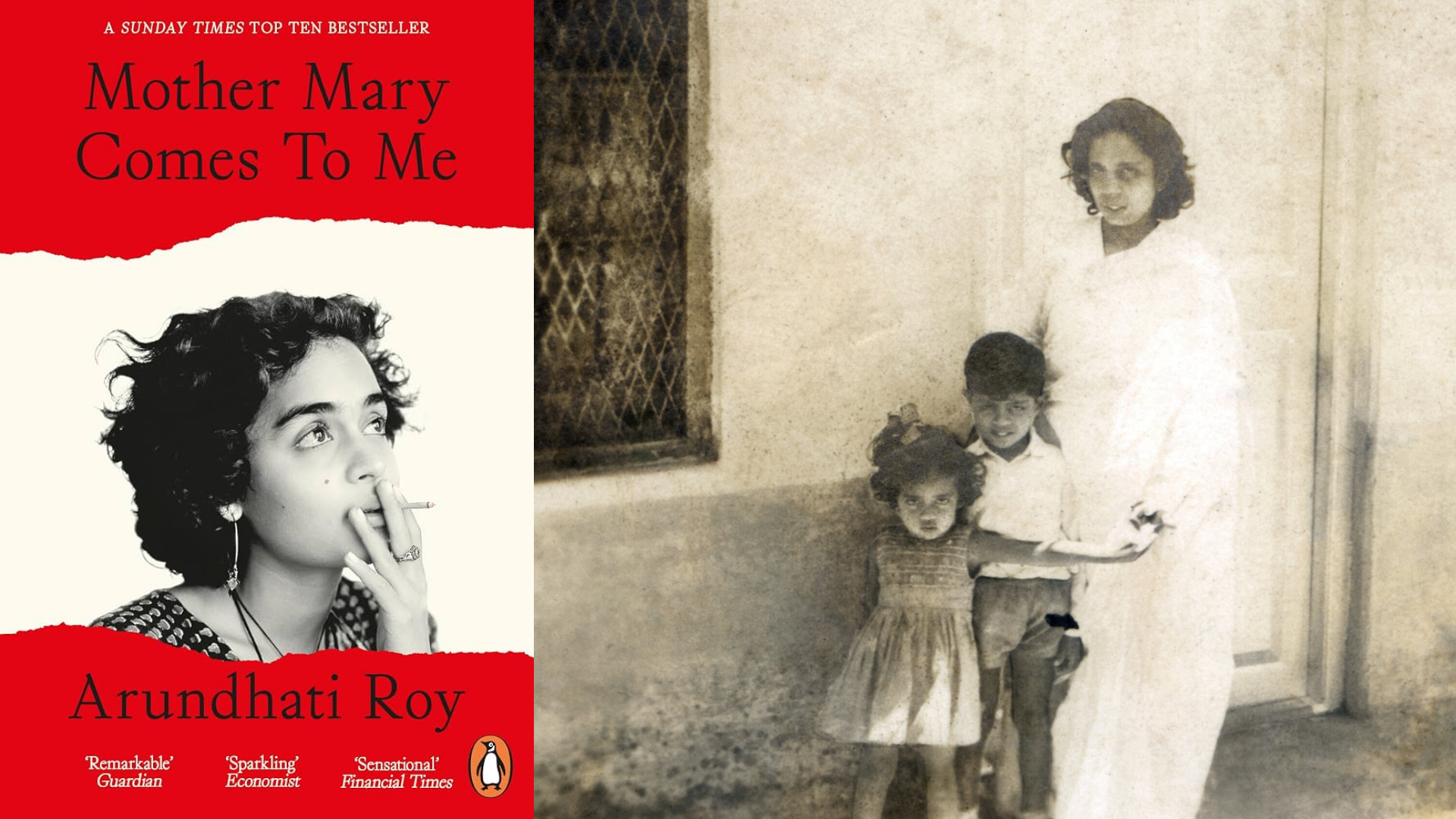
When Arundhati Roy’s Mother Mary Comes to Me was released last year, much of the conversation around the memoir centred on a question that seemed almost as difficult as the relationship it described: What does a daughter owe her mother in the retelling of her life?
Roy’s portrait of her mother, formidable and at times deeply uncomfortable, was praised for its candour, even as a handful of readers felt uneasy about the liberties Roy took in portraying her mother. A year later, the memoir continues to evoke strong emotional responses from readers. This piece celebrates the anecdotes from the book that remain startlingly alive, offering timeless lessons in motherhood, love, politics, and writing.
Seeing beyond the mother
The most important thing that Roy’s memoir does is that it liberates mothers from the pressures imposed on them by a patriarchal society. In a culture where women’s identities are shrunk to just motherhood, Mary Roy takes deep offence when someone asks her at a wayside stall if she was Arundhati Roy’s mother; remarking, ‘I felt as though she had slapped me.‘ Roy is able to celebrate this quirkiness, recognising the deeper roots of her mother’s rage by seeing it as a symptom of her mother’s own struggles against oppressive social structures that seek to define and diminish her.
One of the most important anecdotes in the memoir recounts Roy’s childhood memory of attending a birthday party in Kottayam. There, watching a tender, affectionate mother with her child, Roy is overcome with longing for a mother who could love her in the same way. But that longing vanishes the moment she sees the woman’s husband toss an envelope on the floor and shout, ‘Woman, there’s a letter for you.’
In that instant, as the woman bends down to take the letter, Roy thinks, ‘I didn’t want a mother like her.‘ It’s remarkable that even as a young child, Roy could grasp the quiet strength of her own mother who refused to bend. It’s this spirit of defiance that Roy chooses to celebrate in her ferocious, unyielding mother, whom she calls her ‘gangster’, and whom she seeks to immortalise in these pages.
Love of a daughter
Roy repeatedly expresses astonishment at her mother’s capacity to mistreat her brother, LKC: ‘It was remarkable that Mrs Roy felt able to say these terrible things to her son in this land of son-worshippers.‘ She goes on to reflect, ‘My brother and I grew up in the cleft between that syrupy dream and our capricious nightmare, not always knowing which was worse. On balance, if we had to choose between the two, I think I’d choose our nightmare and he, the dream.‘ And it is no coincidence that only a daughter could see and acknowledge the raging struggles of her mother within that syrupy nightmare.
Yet Roy doesn’t let this truth sit comfortably. She refuses to look at things in a purist sense. She complicates it, acknowledging the damage within the dynamic: ‘Because he [LKC] was the only man she [Mary Roy] could reach, the only man she could punish for the sins of the world. The way she was with him has queered and complicated my view of feminism forever, filled it with caveats.‘
Roy’s most radical act is not that she tells the truth about a difficult mother. It is that she refuses to choose between truth and love. The memoir explicates that Mary Roy was an extraordinary woman, that Mary Roy made her leave home, that Mary Roy was sometimes unjust, that Mary Roy resisted patriarchy, that Mary Roy reproduced some of its violence, and that none of these truths has to cancel out the others.
Breaking love laws
In her Booker-prize winning novel, The God of Small Things, Arundhati Roy broke the love laws that prescribe who should be loved, and how, and how much. In her memoir, Mother Mary Comes to Me, she does it again. In laying bare the fragilities of her mother and the complicated, sometimes impermeable terrain of their bond, she liberates the idea of motherhood from the one-size-fits-all ideal of perfection, allowing instead for a more unruly idea of love, one that resists the tidy love laws and embraces contradictions.
In laying bare the fragilities of her mother and the complicated, sometimes impermeable terrain of their bond, she liberates the idea of motherhood from the one-size-fits-all ideal of perfection, allowing instead for a more unruly idea of love, one that resists the tidy love laws and embraces contradictions.
In Roy’s own words, ‘[I]n the pages that follow it might be confusing for readers who are searching for conventional declarations of love, coupledom, marriage, divorce, separation and love affairs to understand how I lived (live) my life. I often don’t understand it myself. I have stopped trying.’ It is her mother’s unrelenting rage to not abide by laws that encourage Roy to pursue the same path.
In a refreshing take on love, family, money, and charity, she presents the world that becomes possible when we break the rules of love that limit whom we should love, how, and how much. And this book becomes the ultimate testimony of that love. As a reader, you will only see it as an expression of love once you liberate yourself from these limiting love laws.
While Mary fights for the inheritance rights of Syrian Christian women, an older woman asks Mary, ‘Why are you trying to destroy our beautiful community?‘ Roy recalls the urge to tell her that her mother is not just fighting for equal inheritance; she is actually fighting for the right ‘not to be a perfect mother, for the right not to be a nice, obedient woman‘.
Just as Mary’s Supreme Court verdict carved a path towards equal inheritance rights for women, Arundhati’s writing blazes a trail of its own in enabling readers, especially women, to free themselves from the stifling grip of expectations and the suffocating need for approval. Just like her writing career, Roy uses every page in the book to express her resentment against everything she does not believe in. It is rich with pointed critiques of capitalism, solidarity with Gaza, indictments of authoritarianism at home, and condemnation of educational institutions that uphold systemic inequities.
The language of love and authenticity
Roy characterises the language of her writing: ‘[L]anguage was outside me, not inside me. I knew it would not come to me on its own. I needed to hunt it. Down like prey. Disembowel it, eat it. And when I did, I knew that language, my language would ease the way blood flowed through my body.…It wasn’t a non-violent, vegetarian dream.‘ Just like the language she describes, the memoir is meant to be devoured, debated, felt deepy, and experienced violently through love. Her language allows us to reimagine an alternative to living and loving, something tangible, something beyond what is.
Books that don’t just tell a story but awaken something in you are rare. They remind you that dreams aren’t just ideas, but alternate realities waiting to be lived. This is one of those books. Many people see this as a story about Mary Roy. This is as much, if not more, the story of a daughter raised by a mother who refuses to take whatever leftovers are handed to her and demands more.
The memoir itself emerges as a manifesto of belief in intuition, in rebellion, and in carving a path that’s true to one’s inner voice. Roy doesn’t just write about other worlds; she lives as if they’re possible. And suddenly, you start to acknowledge and embrace these peripheral worlds within yourself too.
About the author(s)

Urvi Sharma is an Assistant Professor of English and Cultural Studies at Amity University, Punjab. She specialises in studying how gender dynamics mediate our everyday lives. When she’s not explaining why men are responsible for 99 of the world’s 100 problems, she’s reading memoirs by womxn to gather citations for the remaining one.