Growing up in Kashmir, one encounters distinctive forms of religious participation that are otherwise uncommon. This is particularly true when it comes to Shia women during Muharram, the first month of the Islamic calendar, which is often commemorated with communal mourning. This is owing to the martyrdom of Hussain, Prophet Muhammad’s grandson, and his family in the Battle of Karbala.
I would see my mother, along with my aunts, joining Muharram processions at midnight. Whereas my father, a stoic, middle-aged man, wept watching sermons televised live from some corner of the valley. All of this was often accompanied by my grandmother’s obligatory distribution of sharbat in the early dawn of Ashura, the tenth day of Muharram.
Muharram allows women access to the silence of early dawn, the noises of the night, and discussions in communal spaces about everything ranging from society to local politics, all of which blur the rigid line between private and public practice of religion.
Religious expression and the gendered private-public divide
These obscuring lines between the private and public spheres are rare but significant, given that the contemporary institutions of politics, religion, state, and family are based on them. In patriarchal societies, men occupy public spaces, whereas women are relegated to the private. This private-public divide also exists when it comes to religious expression. Owing to this divide, men assume the responsibility of dispensing ‘important’ religious duties in public, while women’s devotion is confined to private expressions.
However, in a ground-breaking paper titled Gender and Religion: Deconstructing Universality, Constructing Complexity, sociologist D Paul Sullins challenges this notion by critically examining the umbrella term ‘religiosity’. He concludes that there are no universal gendered differences in religiosity. Who is more religious depends on how one measures religiosity. If religiosity is measured through private practice and devotion, women appear more religious in many communities. However, if measured through public participation in religious activities, gendered patterns vary across societies.
For example, in many European societies, where state and religion are distinct entities, women report higher levels of church attendance and personal devotion. While in Muslim or Jewish communities, men report equal or higher levels of participation in public religious practices. Specifically, a larger number of Muslim men attend public religious activities such as prayer in mosques than Muslim women.
One may argue that public spaces of worship are largely considered male spaces, where women must negotiate with existing patriarchal norms to gain access.
Drawing from it, one may argue that public spaces of worship are largely considered male spaces, where women must negotiate with existing patriarchal norms to gain access. This is true for most mosques in India as well, where little to no space exists for women to pray. Further, key religious roles, such as that of the Imam (leader of the congregation), and religious symbols, such as the minbar (pulpit), remain out of women’s reach. While there might be isolated instances of women negotiating for more space in mosques, such denial of access is a common, if not accepted, practice.
How Muharram allows women to reclaim public spaces
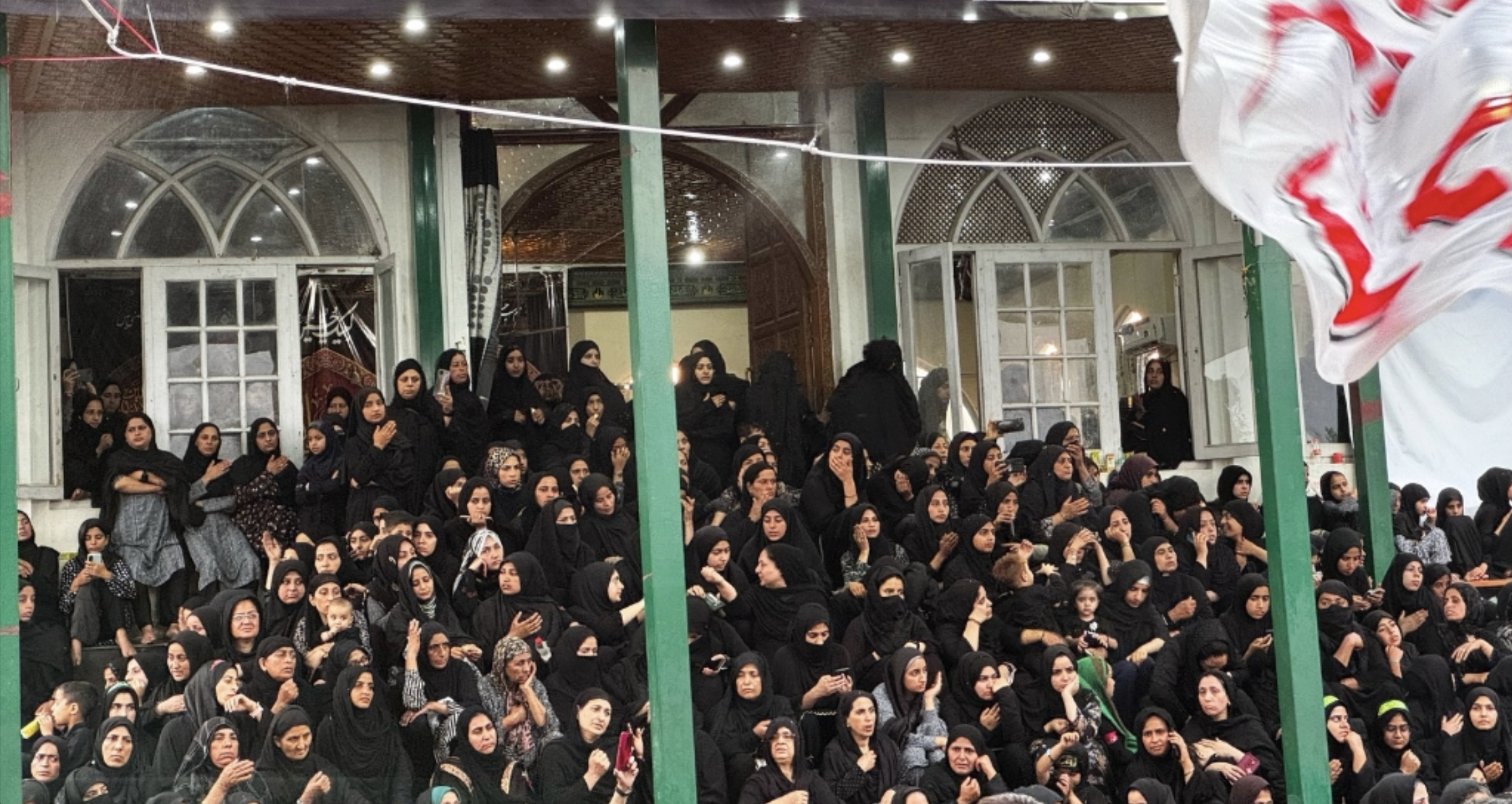
However, during Muharram, these gendered spaces need to be altered to accommodate the large numbers of women who engage with their religion publicly. If one happens to attend a Muharram majlis (gathering), it is not uncommon to see large numbers of women across all age groups. While domestic burdens may keep women from attending other communal and religious activities, for the majlis, household chores are put on hold, cooking is postponed, and children are taken along. Within mixed-gender majlis, women’s participation is often equal to that of men, and it is also not unusual to see the women’s sections more crowded than the men’s.
While domestic burdens may keep women from attending other communal and religious activities, for the majlis, household chores are put on hold, cooking is postponed, and children are taken along.
In a mixed-gender majlis, men may lead the gathering by reciting Marsiya and Nowha (forms of devotional poetry and recitation), but women join in with equal rigour, with both voices carrying sorrow and profound grief. In a few parts of the valley, women also accompany men in public processions (jhaloos), making their mourning, grief, and devotion as much a public affair.
While minbar still remains out of reach for women, in mixed-gender gatherings, projectors or good acoustic arrangements are made for the women’s sections. When these arrangements are inadequate, women make their voices and displeasure heard, ensuring organisers make appropriate arrangements each year.
Through these tools, Shia women carve out spaces in public for themselves which are otherwise not readily available to them.
Besides the mixed-gender majlis, women also arrange women-only majlis, which men are barred from. These majlis not only have women participants, but also women leaders (Zakira) who narrate the incidents of the Battle of Karbala and lead discussions on relevant and important socio-political issues. Through these tools, Shia women carve out spaces in public for themselves which are otherwise not readily available to them.
Majlis and the politics of grief and memory
Considering the overwhelming participation of women in the majlis, one is bound to wonder what propels Shia women to assert their claim to public spaces during Muharram. The answer can be found in the Battle of Karbala, specifically in Lady Zaynab. She is the sister of Imam Hussain, who made a defining choice: Instead of staying in Medina with her husband, she travelled with her brother to Kufa, along with her two sons, to build support against the tyrannical rule of the Umayyad Governor, Yazid I.
Zaynab’s choice changed not only her own life but the course of Islamic history. After most of her family was massacred for resisting the autocratic rule of Yazid I, Zaynab kept the movement of resistance alive in her capacity as a prisoner of war. From her powerful speech against the governor to spreading the accounts of the structural brutality of the Umayyad Caliphate, Zaynab kept the memory of Karbala alive.
Her efforts to expose the misdeeds of the regime and gather masses for communal remembrance made her imprisonment more dangerous than her freedom. Through these tools of resistance, Zaynab gradually shattered the carefully cultivated image of the regime, which led to its eventual collapse. The tradition of the majlis is thought to have originated here, with Zaynab.
Through majlis, Zaynab’s story is not merely recalled; it is re-enacted as a political tool of resistance.
Her significant role in immortalising Karbala in public memory gives Shia women an impetus to play their part in continuing Zaynab’s legacy of resistance. Today, Shia women continue to look up to her as a figure of defiance and as a source of inspiration to stand against oppression. Through majlis, Zaynab’s story is not merely recalled; it is re-enacted as a political tool of resistance.
Now and then, this spirit of resistance comes to the forefront, such as when Shia women participated in rallies against the ongoing genocide in Palestine or during the recent large-scale donation drive to support war victims in Iran. By standing up against oppression, these women continue the legacy of Lady Zaynab. It is through her that most Shia women assert their claim to public spaces. However, thirteen centuries since Karbala, she is instrumental in encouraging them to stand up for justice and truth, and against tyranny.
References
D’Souza, D. (2014). Partners of Zaynab: A gendered perspective of Shia Muslim faith. University of South Carolina Press.
Hyder, S. A. (2008). Reliving Karbala: Martyrdom in South Asian memory. Oxford University Press. https://doi.org/10.1093/acprof:oso/9780195373028.001.0001
Madelung, W. (2004). Ḥosayn b. ʿAli I. Life and significance in Shiʿism. In Encyclopaedia Iranica (Vol. XII, Fasc. 5). Encyclopædia Iranica Foundation.
Nyhagen, L. (2019). Mosques as gendered spaces: The complexity of women’s compliance with, and resistance to, dominant gender norms, and the importance of male allies. Religions, 10(5), Article 321. https://doi.org/10.3390/rel10050321
Prickett, P. J. (2015). Negotiating gendered religious space. Gender & Society, 29(1), 51–72. https://doi.org/10.1177/0891243214546934
About the author(s)