Few social virtues are as exacting as respectability. Bound intimately to a fragile economy of feminine honour, it teaches women not merely how to behave, but also how, and in what ways, to desire, laugh, grieve, and transgress. Those who fail to internalise these scripts are often cast as aberrations: as figures of excess, indecency, and social discomfort.
It is precisely such a figure who stands at the centre of Ismat Chughtai’s characteristically incisive short story Vocation. (Mis)labelled a courtesan from the outset, the unnamed character is presented as a reckless coquette, whose defiance of gendered propriety and exhibitions of brazen ribaldry become causes of irate concern for the self-righteous narrator. Yet the story’s crucial reckoning arrives when the latter discovers that the sethani (wealthy woman) not only hails from an aristocratic lineage but is also a distant relative. In that singular moment, Chughtai lays bare the moral hypocrisies of a heteropatriarchal order that is quick to condemn women who refuse the consolations of respectable womanhood, while remaining deeply invested in the privileges they embody.
Nearly eight decades later, Rekha in Maa Behen appears as a curious descendant of this lineage of unruly women. Played by Madhuri Dixit, Rekha’s social precarity is two-fold: she is a middle-aged widow who has raised her two daughters single-handedly and, more inconveniently, has emerged as a repeated, almost witch-like presence in the sensational gossip of the colony, and a ready blueprint for feminine dishonour.
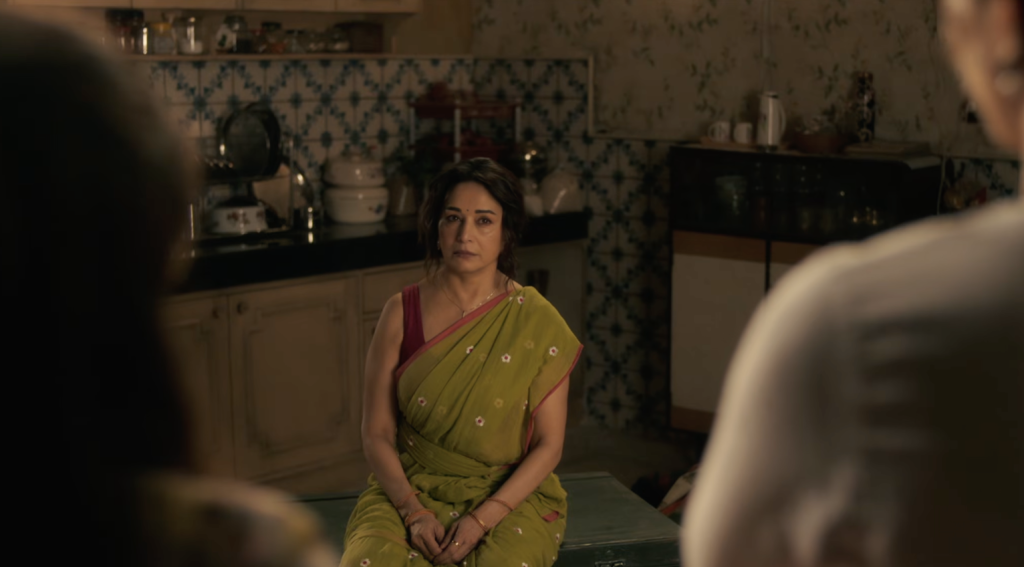
She is fond of sleeveless blouses and unfazed by public ogles, and appears to harbour little anxiety about employing a range of illicit means to sustain her livelihood. The film seems to frequently suggest that it is not only what Rekha does that unsettles society, but the conspicuous ease with which she does it.
Beyond the self-sabotaging mother
Perhaps more intriguing is Rekha’s refusal to inhabit the role of the self-effacing Bollywood mother. When she accidentally murders (or so she thinks) her neighbour, Charitra Gupta (Ravi Kishan), in her house, her immediate response is not self-abnegation, but a frantic attempt to emotionally manipulate her bemused daughters, Jaya (Triptii Dimri) and Sushma (Dharna Durga), into connivance.
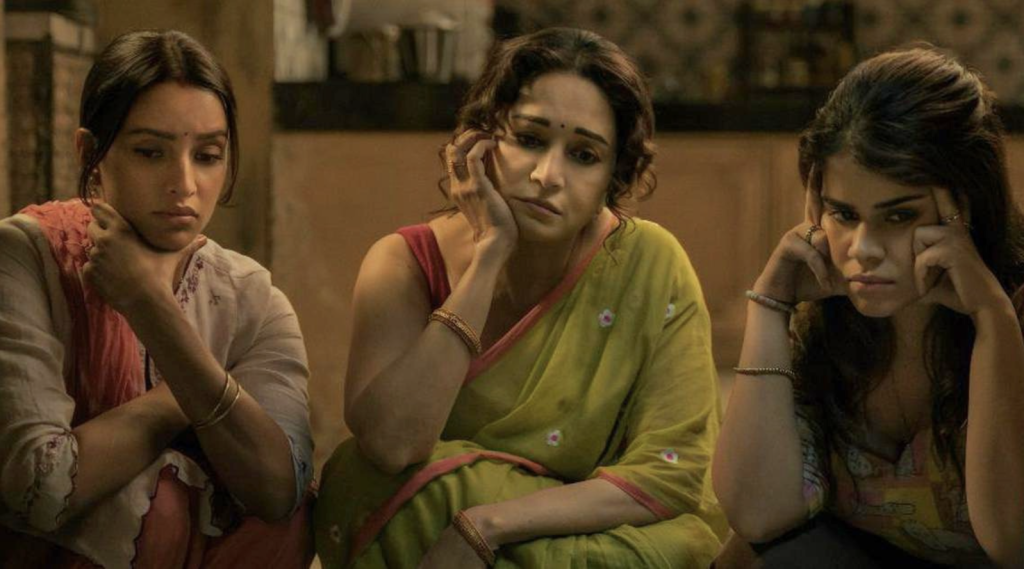
She threatens to implicate them whenever they protest and, in moments of refreshing candour, confesses that she positively detests the prospect of spending her days embroidering in jail. Yet Rekha’s self-interest is not antithetical to maternal care. At other instances, it is she who stands resolutely beside her daughters when they are shunned for perceived improprieties, unfitting dalliances, or public indecencies.
One gradually understands that all three women are, above all else, social pariahs, whose vulnerable existence, untethered to a male familial head, is itself sufficient cause for scrutiny, scandal, and moral stigma. Rekha is excluded from neighbourhood functions and weddings; her walls are repeatedly defaced with grotesque sketches of witches or casual enquiries about her ‘current rate’. For Rekha, washing away these routine inscriptions of humiliation and standing firm against periodic mob hostility becomes a way of life. For the colony, however, her continued refusal to be shamed remains a constant thorn in their side.
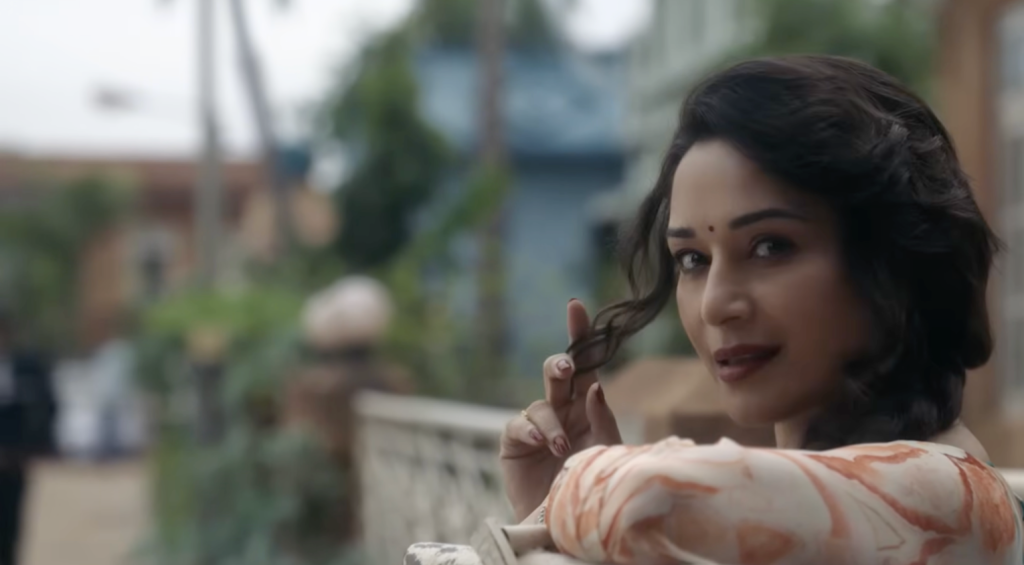
The film suffers from an uneven screenplay, yet excels in retrospective storytelling. Rekha’s initial portrayal as a femme fatale — with corpses allegedly buried beneath her marigold plants and fleeting glimpses of her purported licentiousness — foregrounds her as a character shrouded in unreliability. More than once, her daughters mock her ‘youthful’ waywardness: ‘Tumhara jawani to dhalta hi nehi hain. Kahin to rukogi? (Your youth never seems to fade. How far will you go?)’
The gaping misogyny of the society finds a fraught place in the microcosm of the family. Jaya and Sushma, despite their own indiscretions, appear distant, suspicious, and fretful of Rekha’s risqué indelicacies. As the narrative unfolds, however, these impressions acquire a different texture. Rekha’s life emerges as the cumulative product of sensational revisionism, selective outrage, and a deep-seated aversion to bawdy femininity. The rumours that surround her reveal far more about the anxieties of the colony than about the woman herself.
Rekha’s life emerges as the cumulative product of sensational revisionism, selective outrage, and a deep-seated aversion to bawdy femininity. The rumours that surround her reveal far more about the anxieties of the colony than about the woman herself.
What distinguishes Rekha in such a setting is not moral innocence but her refusal to seek absolution. She takes ownership of her actions and their consequences, refusing to be vilified for feeling, desiring, or making imprudent choices. Thus, we see her carrying Sushma, a baby conceived out of wedlock, to term, and refusing to feel rueful about it. To the colony, her obstinacy, and more symbolically, her sleeveless blouse, becomes an extension of this waywardness; for Rekha, however, it functions as a quiet totem of self-possession. She neither seeks reintegration nor performs the repentance so often demanded of unruly women. Instead, she inhabits her pleasures, immoderations, and deviances with an ease that renders her fundamentally illegible to the moral universe around her.
Laughing in the house of honour: the politics of impropriety
In one of the film’s most telling moments, Rekha and her two daughters erupt into maniacal laughter at the very invocation of ijjat (honour), the militant refrain that had shadowed their lives for years. The word sits awkwardly among them, almost foreign in its familiarity, as their raucous laughter drains the term of its solemnity, transforming a threat of social ruin into an object of collective ridicule.
Their laughter does more than mock the threat of social disgrace; it exposes the tenuous foundations upon which such vacuous intimidations rest. By refusing to accord honour its customary authority, Rekha, Jaya, and Sushma wrest back a measure of agency from the structures that have long sought to discipline and define them.
Their laughter does more than mock the threat of social disgrace; it exposes the tenuous foundations upon which such vacuous intimidations rest. By refusing to accord honour its customary authority, Rekha, Jaya, and Sushma wrest back a measure of agency from the structures that have long sought to discipline and define them.
It is possibly from this radical refusal that Rekha’s greatest gift emerges. Both to her daughters and to the audience, she offers the possibility of a different feminine inheritance. She leaves behind no lessons in virtue or selflessness. Instead, she bequeaths the far messier legacy of a woman who continues to yearn, to err, to snicker, and to survive on her own terms. At a time when screen cultures remain increasingly invested in redeemable female characters, Rekha remains gloriously, inconveniently flawed. She is excessive, capricious, and at times selfish; yet the film refuses to treat these qualities as failures requiring correction. Her choices are not rehabilitated into propriety. They simply exist.

Perhaps this is where the joy of unrepentant defiance truly lies. What possibilities emerge when women cease to organise their lives around the preservation of honour? What forms of agency become imaginable when remorse is no longer the obligatory companion of feminine transgression? And what might it mean to take seriously women who, like Rekha, refuse to become cautionary tales?
About the author(s)

Ananya is a doctoral candidate at the Centre for English Studies, Jawaharlal Nehru University. Her research examines the figure of the adulteress in post-globalisation South Asian fiction, as a means of thinking through difficult questions of marriage, motherhood, desire, domesticity, and transgression. She is particularly interested in the politics of waywardness, amongst others, and the myriad ways in which popular culture reinvents itself.