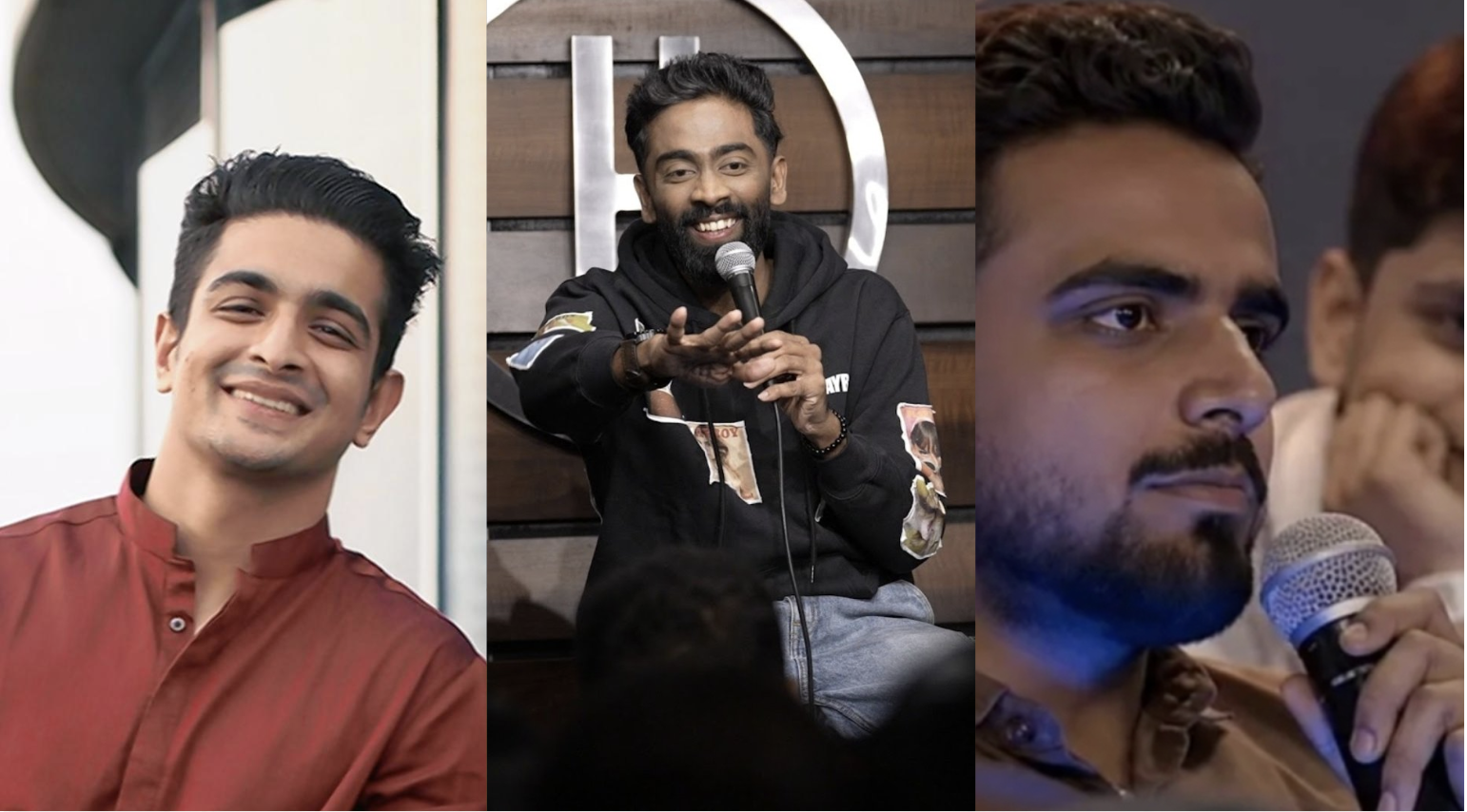
Comedy outrage works as a cultural mirror, revealing the latent moral values of a nation. But what does it mean when the outrage itself is unequal? A side-by-side look at two recent controversies that rocked the fast-emerging stand-up comedy sphere in India — the India’s Got Latent (IGL) debacle and the Himanshu Jangra and Pranit More disaster — exposes the distressing answer.
The massive IGL controversy of early 2025 involved comedian Samay Raina and guest judge Ranveer Allahbadia, where the latter posed an explicit, incestuous hypothetical to a woman contestant. The content was crass, thoughtless, and by any reasonable standard, a spectacular failure of judgement. Everything after that detonated with extraordinary force: FIRs were filed across the country; Apoorva Mukhija, the only woman panellist, faced heavy online abuse, death threats, and rape threats; ‘patriotic forces’ severely damaged the studio where the show was filmed; and the government machinery was quick to step in, too.
The National Human Rights Commission (NHRC) got involved, the Mumbai Police visited the studio, and the Supreme Court was furious. The controversy became almost a national referendum on ‘obscenity’. Yet the content that triggered it was a joke in poor taste on a roast-format show, not a widely held worldview.
Fast forward to June 2026. During a crowd-work segment at a show, comedian Pranit More laughs along when an audience member, Himanshu Jangra, casually recounts expecting sexual ‘recovery’ after spending INR 370 on a date. Jangra goes on to even discuss the outrageous details of the incident, to which More replies with outlandish enthusiasm. The audience also joins More, failing to hold any accountability themselves. More calls it ‘Peak Gurgaon content’ and literally rewards him for being ‘too funny’. The clip goes viral: social media erupts; the National Commission for Women (NCW) issues statements; a clickable news cycle churns; and More offers a second heartless apology, saying that he got ‘carried away’. But the scale and institutional gravity never came close to the IGL hysteria.
The asymmetry and who gets to be angry and who is punished
Let’s be clear about what we are comparing. The IGL moment was a bad joke: vulgar, offensive, and stupid. The moment on More’s show, on the other hand, was an active endorsement of a value system that has corrosive social implications. While the former harmed public morality and decency, the latter ridiculed bodily autonomy, consent, and dignity.
Vulgar jokes are primarily a speech issue, and consent violations are an autonomy issue. By most measures of social and constitutional harm, the second scenario is the more insidious one. Yet it was the IGL controversy that received unprecedented public and institutional scrutiny: probably because it was arguably also about protecting a cultural taboo (incest-adjacent content, parents, family honour) that cuts across gender lines. The biryani ‘joke’ is specifically about women’s autonomy in dating: a narrower and, unfortunately, more contested terrain. It is this contestation, and this unequal outrage, that reinforces the belief that comedy outrage can reflect the mindset of a country; in this case, a deeply embedded patriarchal mindset.
In only a month, the country has almost forgotten the episode. Why are we not angrier or even as angry as we were at the IGL debacle when a comedian uses their platform to validate misogynistic, dehumanising, and disempowering ideas about women? Why are we not holding the audience accountable? Most of the strong responses online have been by women and stand-up comedians. Unfortunately, the expression of anger is so fundamentally gendered that women alone cannot move the societal needle. By not being angry enough as a society, we are telling men that this behaviour is acceptable, and that we even find it funny.
The silence of the public morality police on the More controversy is revealing in its own right. Indian obscenity law has never been short of ambition, with provisions targeting vulgar speech and indecent gestures being invoked with remarkable fervour whenever the target is explicit enough to generate political consensus. Yet provisions that could recenter a woman’s autonomy and consent as the primary legal concern, and that which could treat the normalisation of sexual entitlement as a harm worth punishing, remain conspicuously underused. This is not a shortcoming of the law, but of the legal system.
Consent and autonomy, rather than collective moral discomfort, should form the basis of legal scrutiny in a constitutional democracy. Feminist jurisprudence has long argued for a shift from morality-based to autonomy-based regulation. This is not merely academic; it determines whose violation the state chooses to recognise. The social contract is rendered futile if it protects public decency but not half the public. Until our legal and moral obligations succeed in ensuring women’s safety and dignity, we are not upholding constitutional morality; we are performing it.
When the Supreme Court mobilises over a joke in poor taste, but the legal machinery stays quiet over a comedian cheerfully platforming sexual entitlement, the law is not being neutral: it is making a choice. The IGL debacle mobilised the state; the More one should have mobilised it, too. That it did not tells us exactly whose morality the law is designed to protect.
About the author(s)

Vasudha is a law graduate and researcher with a keen interest in gender justice, climate policy, and legal reform. Beyond her research, she is an emerging writer with a love for reading, cooking, and the classical dance form Kathak.



A great food-for-thought, indeed. (Can’t say more since I haven’t been privy to the content that the author has got her gender sentiments hurt about in a very South Asian “whatabout” way, and I doubt I’ve even heard of Mr Pranit More before, either.)