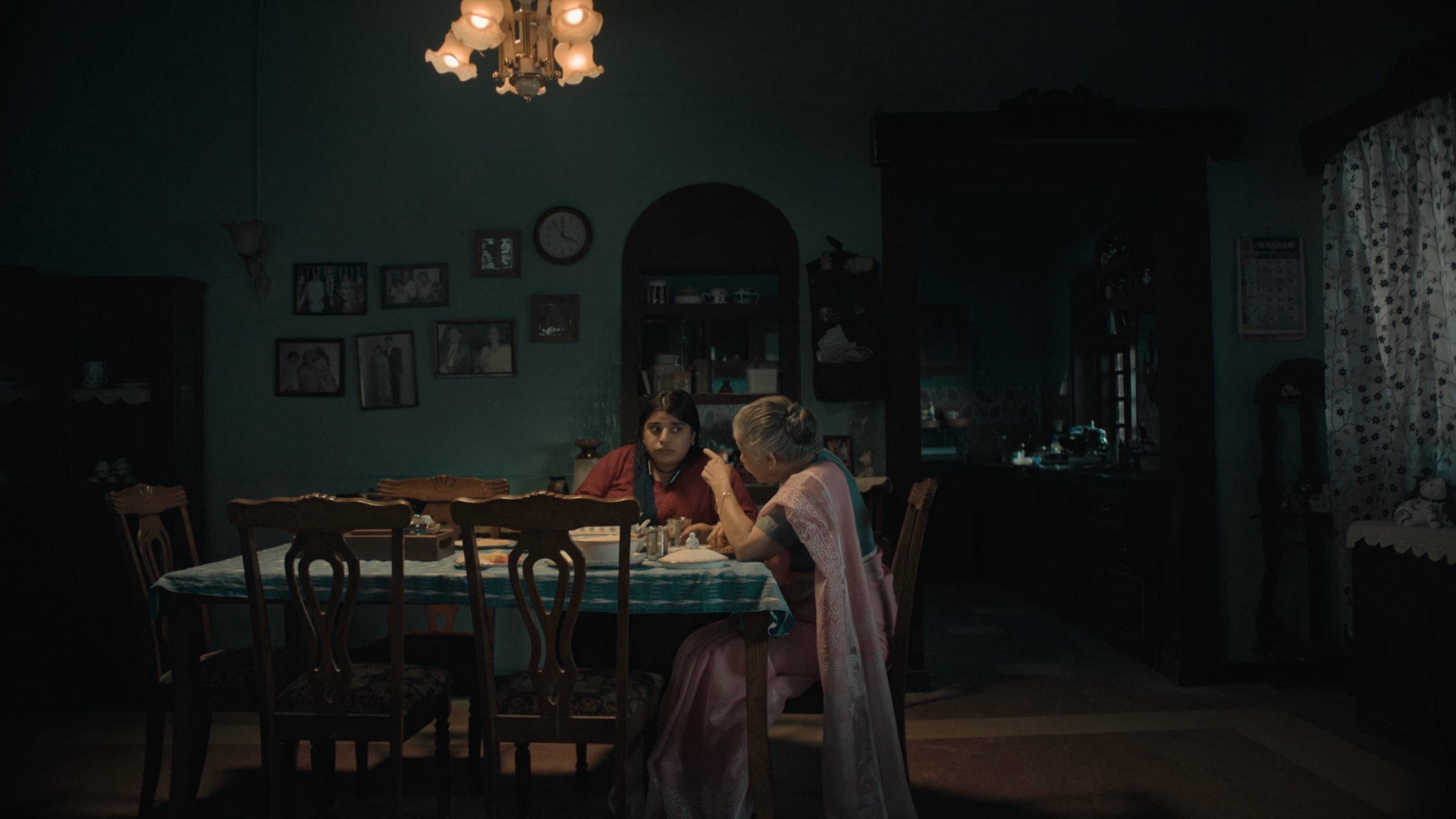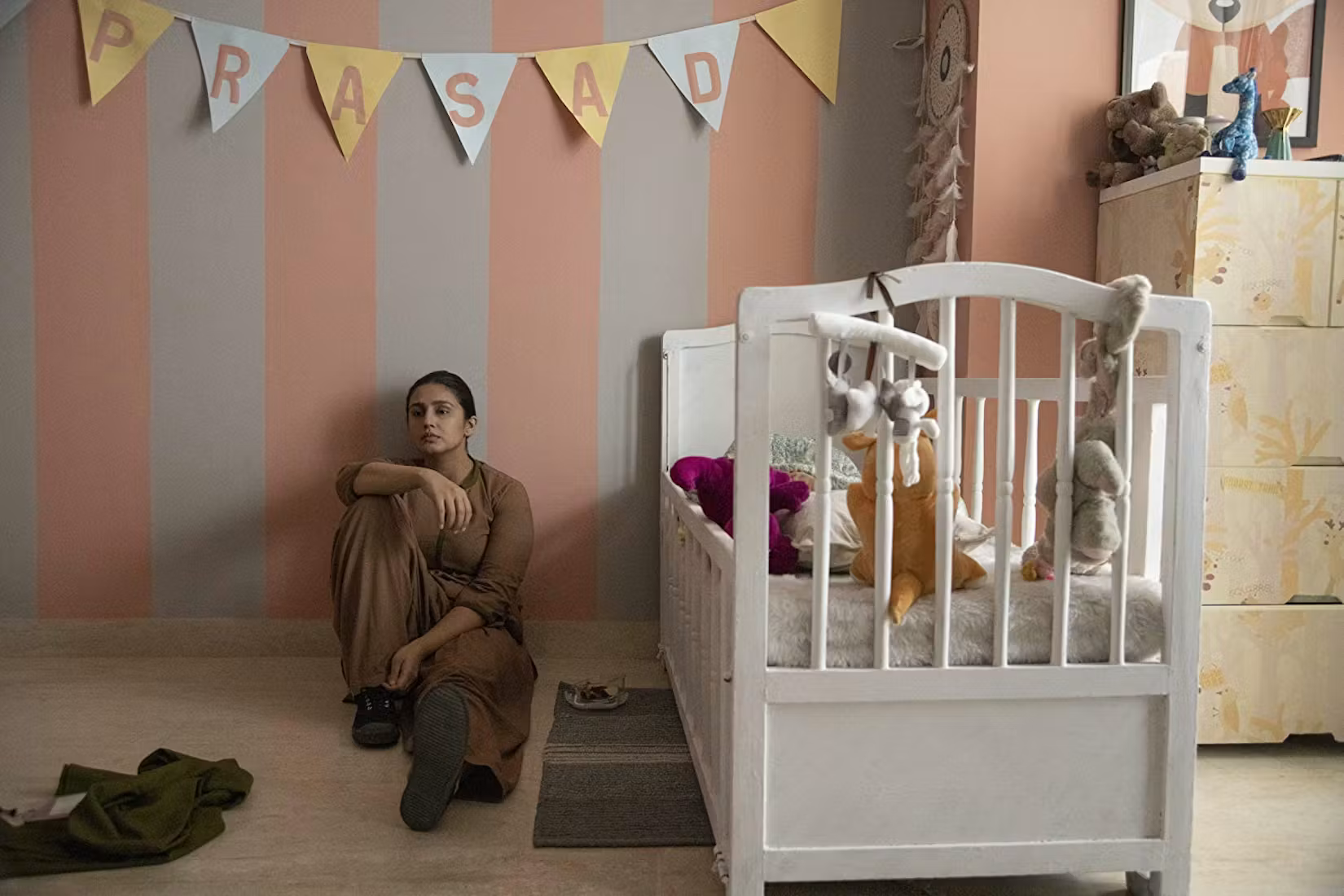
In the promotional art for almost any contemporary Indian dystopian thriller, the woman protagonist is sold to us as an icon of unbridled rebellion. She often stands smeared in soot, a jagged gash across her cheek, glaring directly into the camera. She looks dangerous and sovereign, yet the moment one streams these series, a predictable condition reveals itself. She is permitted to pick up a weapon, to scream at a tyrant, or to burn a detention centre to the ground, but strictly on one non-negotiable term: she is doing so because someone stole her child or threatened to hurt them.
When popular culture attempts to portray a woman dismantling an authoritarian state, it hits a creative ceiling. It cannot imagine her hating the regime on principle, for her radicalisation is rarely ideological; it is tied intimately to her reproductive biology.
Indian streaming platforms seem to have discovered a profitable formula for stories set at the end of the world. Shows like Leila, Ghoul, and Betaal have frequently been cited as bold exercises in subversive storytelling. Yet when popular culture attempts to portray a woman dismantling an authoritarian state, it hits a creative ceiling. It cannot imagine her hating the regime on principle, for her radicalisation is rarely ideological; it is tied intimately to her reproductive biology.
The sanctified womb: motherhood as an ideological prerequisite
In her 1976 treatise, Of Woman Born, Adrienne Rich drew a sharp distinction between two realities that patriarchal culture deliberately conflates: mothering, which denotes the intimate biological experience of creating life, and motherhood, which functions as a coercive political institution designed to monitor and claim it.
The institution dictates that a woman’s ultimate social allegiance belongs to her offspring. Rich exposed the core strategy of patriarchal governance: the state does not merely control women from the outside, but conscripts their physiology to do the policing from within. When a fictional protagonist attacks a fascist regime solely to recover her kidnapped child, the patriarchal gaze does not view her as a sovereign citizen rebelling but quietly reabsorbs her rebellion into domestic obligation.
Look at the opening sequence of Netflix’s Leila. Shalini (Huma Qureshi) sits by her swimming pool sharing an illicit cigarette with her husband, Riz, a Muslim man. Minutes later, state enforcers breach the gate, beat Riz into the concrete, and drag their half-Hindu, half-Muslim daughter, Leila, away. Shalini, on the other hand, is consigned to a Shuddhikaran (purification) facility.
To the custodians of Aryavarta, a savarna woman’s womb is community real estate, and Shalini’s real crime was not merely loving a Muslim man; it was taking an upper-caste body out of the approved marriage economy.
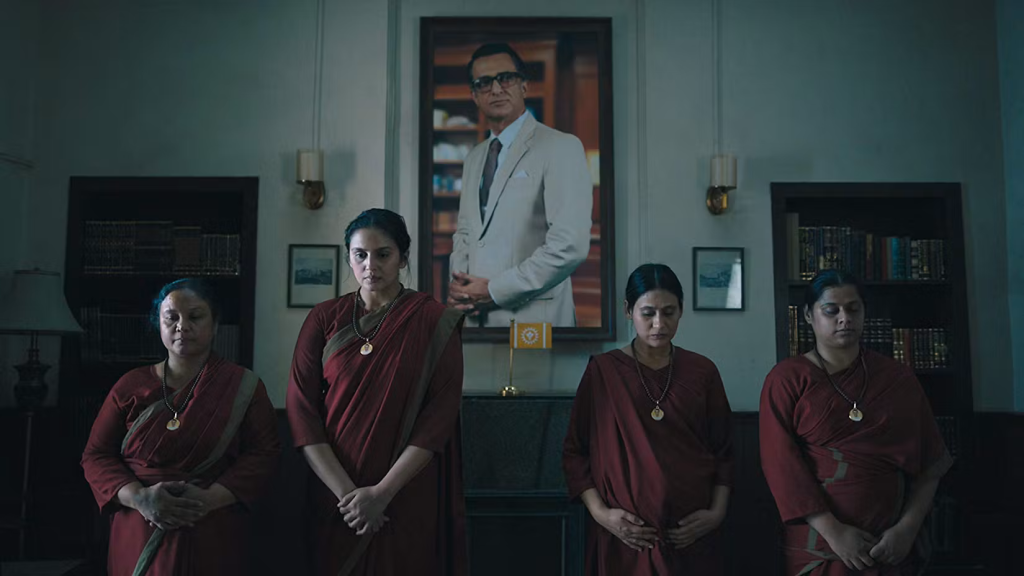
The ashram scenes capture a suffocating cruelty: rows of women in coarse grey sarees, their heads shaved to strip them of individual agency, forced to drink cow urine while chanting slogans for Aryavarta, the totalitarian, dystopian state where the show is set. However, notice what the regime is actually punishing Shalini for. It is punishing her for ‘endogamous treason’. To the custodians of Aryavarta, a savarna woman’s womb is community real estate, and Shalini’s real crime was not merely loving a Muslim man; it was taking an upper-caste body out of the approved marriage economy.
The state did not lose Shalini’s allegiance when it built the slums; it lost it the afternoon it emptied her swimming pool.
Because her motive for resisting the state remains bound to her child, Shalini’s rebellion remains narrow. She scales the hundred-foot concrete walls separating elite sectors from open-sewer slums, but never registers caste apartheid as a systemic evil because her political outrage never extends beyond kinship. The state did not lose Shalini’s allegiance when it built the slums; it lost it the afternoon it emptied her swimming pool.
Reproductive futurism: fighting for the child, never the citizen
This hyper-fixation on the maternal rescue mission operates on what American academic and literary critic Lee Edelman terms ‘reproductive futurism’. In No Future, Edelman argues that the contemporary political order is held hostage by the figure of the Child. The figure of the Child is deployed as an ideological shield, whereby every draconian surveillance statute passed, every ghetto wall erected, and every civil liberty extinguished gets rationalised through one untouchable refrain: it is for the safety of our children. And this helps explain why contemporary dystopian fiction repeatedly locates women’s political awakening within the family rather than beyond it.

The supreme irony of the Indian feminist dystopia is that its heroines fight the fascist regime using its own emotional currency. In Leila, the dictator Mr Joshi justifies tracking citizens’ bloodlines in the present to protect the genetic sanctity of tomorrow, while Shalini wages her solitary war solely to protect her own private tomorrow.
In a media culture where a woman’s social validity expires the moment her reproductive window closes, the childless woman becomes an unthinkable figure as a heroine. Because the state holds no control over her womb and therefore cannot leverage her through a kidnapped heir, the fiction writer struggles to imagine her as a politically compelling protagonist.
On Indian screens, a woman without children is either reduced to a silent extra scrubbing the courtyard or turned into the sadistic warden wielding the cane. To exist in a speculative Indian future without reproducing is to be rendered invisible.
One only has to scan the background frames of these shows to see who gets discarded by this rule: the silent childless women inside the Shuddhikaran camps or the terrifying camp supervisor Guru Ma (Arif Zakaria), for instance. It is telling that a cisgender man was cast to play this archetype of sterile, punitive womanhood, as though even the imagination of female authority detached from motherhood must ultimately be displaced onto a masculine body.
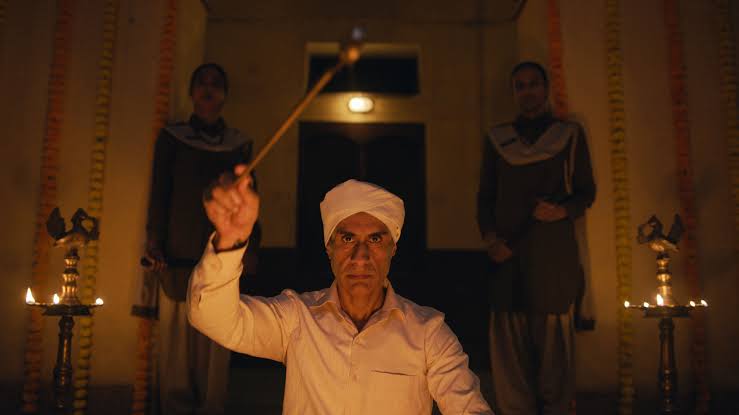
On Indian screens, a woman without children is either reduced to a silent extra scrubbing the courtyard or turned into the sadistic warden wielding the cane. To exist in a speculative Indian future without reproducing is to be rendered invisible.
The biological cage: dissent as a transactional art
This pattern isn’t unique to Leila. In Patrick Graham’s Ghoul. Radhika Apte plays Nida Rahim, an interrogation officer for the National Protection Squad. The series introduces Nida through an act of chilling autonomy, she turns her own father over to the secret police because he was teaching anti-government literature to his college students. It is a brilliant setup for a genuinely difficult protagonist: a young, brainwashed woman from a targeted minority community who chose state safety over filial loyalty, only to slowly wake up to the machine she serves.

However, watch what actually triggers her awakening inside the damp concrete corridors of that detention centre. Does Nida look at stripped, hooded prisoners being tortured and experience a crisis of conscience? Not at all, instead, she discovers that the regime quietly murdered her father in his holding cell, and with one quick plot beat, a story about an ideological mutineer shrinks into a standard Bollywood revenge track. She summons a mythological demon not to liberate the camp’s political prisoners, but to settle a family ledger.
Screen narratives frequently prioritise the rehabilitation of women’s rage into maternal care, overlooking the potential for protagonists who exist outside of this domestic framework. If the objective is to move beyond the tropes of the maternal saviour, the focus must shift to characters whose political motivations are not tied to their reproductive status.
This is not to suggest that motherhood cannot be a site of political resistance. However, a pattern emerges when speculative media treats the womb as the only legitimate source of women’s political agency. The current landscape of Indian speculative fiction often relies on the maternal figure to justify rebellion, thereby limiting the scope of women’s dissent.
Screen narratives frequently prioritise the rehabilitation of women’s rage into maternal care, overlooking the potential for protagonists who exist outside of this domestic framework. If the objective is to move beyond the tropes of the maternal saviour, the focus must shift to characters whose political motivations are not tied to their reproductive status. This raises necessary questions for the genre: What possibilities emerge when women cease to organise their resistance around the preservation of the family? What forms of political agency become imaginable when maternal devotion is no longer the necessary companion of female transgression?
About the author(s)

Manya Suri is a postgraduate student at the Centre for English Studies, Jawaharlal Nehru University. Her research sits at the intersection of digital culture, film studies, and popular media, with a specific focus on how these platforms mediate and reinforce gendered power dynamics. She is particularly interested in how contemporary digital landscapes and cinematic forms intersect to shape cultural discourse.