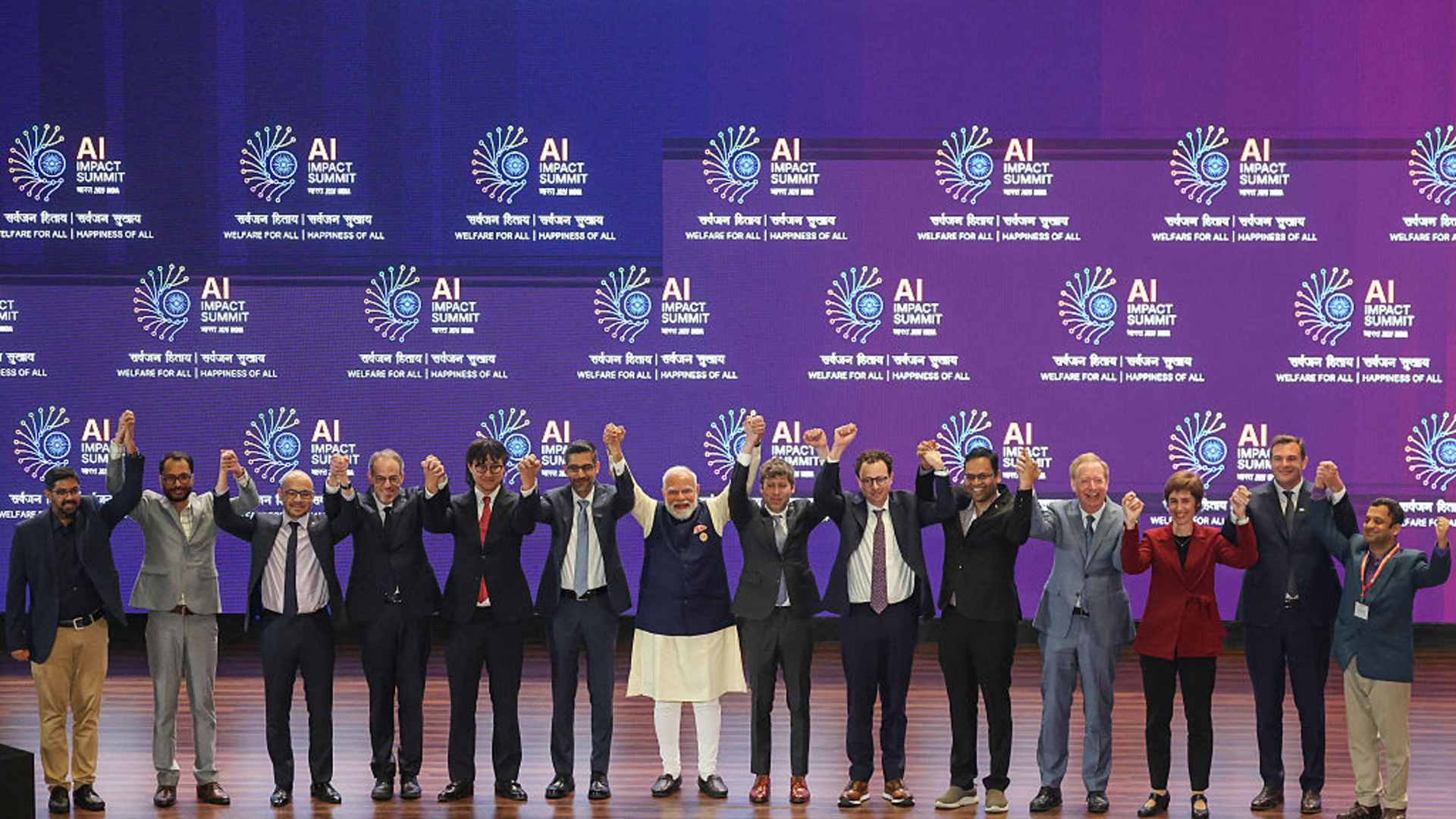
In February 2026, India hosted AI policymakers from around the world at the AI Impact Summit, positioning itself as the Global South’s answer to Western AI dominance — a nation building sovereign digital infrastructure on its own terms. India sought to speak on behalf of countries shut out of an AI order shaped in Washington and Beijing, under the banner of ‘Democratising AI and Bridging the AI Divide.’
The report outlined the stark disconnect between India’s official AI rhetoric and the reality of AI-propelled discrimination, repression, and violence against marginalised communities within the country.
But days before the summit began, a civil society report released by the Center for the Study of Organized Hate (CSOH) and the Internet Freedom Foundation (IFF) painted a very different picture. The report outlined the stark disconnect between India’s official AI rhetoric and the reality of AI-propelled discrimination, repression, and violence against marginalised communities within the country. The very hierarchies that India claims to dismantle are being replicated at home, drawing from the same extractive logic of algorithmic colonisation, but now natively produced.
Surveillance as policy
The report describes how generative AI tools are being used by Narendra Modi’s right-leaning ruling party, the Bharatiya Janata Party (BJP), to survey, monitor, and subsequently demonise Muslim communities across the country. It outlines a troubling pattern of AI-enabled mass surveillance, targeted exclusion from welfare systems, and the deletion of minority voters from election rolls.
Further, law enforcement agencies have begun deploying predictive policing algorithms and facial recognition technology across several states, without legal authorisation. In addition to this, there has also been discussion about deploying AI tools to identify alleged ‘illegal’ Bangladeshi immigrants based on their speech patterns, tone, and language. This comes amid reports of Muslim citizens being forcibly deported to Bangladesh on suspicion of illegal immigration, without due process.
Communal polarisation has long sat at the centre of the ruling party’s playbook. Generative AI industrialises it, making such targeting cheaper and letting it personalise at scale.
None of this is incidental to the method. Communal polarisation has long sat at the centre of the ruling party’s playbook. Generative AI industrialises it, making such targeting cheaper and letting it personalise at scale. AI-generated content is consistently being shared by official social media accounts, promoting divisive anti-minority messages and depicting violence against Muslims.
The colonial inheritance
Traditionally, colonial power sought control of the political, economic, and social sphere through direct military conquest and resource extraction. However, it subsequently evolved into consolidating power by disseminating ideologies through media, education, and popular culture. Algorithmic colonialism, as has been well documented, is the latest iteration of this, operating through invisible structures of data, code, and surveillance.
India is not merely a subject of algorithmic colonialism, absorbing systems designed by its colonisers; it is also simultaneously building and deploying that same architecture on its own citizens.
In India, this is unfolding with a paradox at its centre. India is not merely a subject of algorithmic colonialism, absorbing systems designed by its colonisers; it is also simultaneously building and deploying that same architecture on its own citizens, often along the very fault lines of caste and religion that the colonial administration itself once exploited to govern the country.
While algorithmic colonisation in Western contexts operates primarily through profit incentives and market-driven domination, Eastern models reflect a state-centric authoritarian approach. Despite these divergences, both systems operate on a similar extractive logic, and both threaten epistemic autonomy and hinder efforts for digital sovereignty.
India sits at the intersection of the two. India runs a state-centric model of control while leaving the commercial market largely open, often using foreign or off-the-shelf tools to carry out the state’s work. The result is market-driven data extraction propelled by the exclusionary intent of a majoritarian ruling party. Rather than breaking with either model, India has consolidated the extractive core of both.
The result is market-driven data extraction propelled by the exclusionary intent of a majoritarian ruling party. Rather than breaking with either model, India has consolidated the extractive core of both.
India is now presenting itself as a role model, the country that will show smaller and poorer nations how to build AI capacity without bowing to American or Chinese terms. Yet the summit never answered the question the country’s own civil society was raising outside the halls: capacity for what and for whom. Building sovereign AI models to use as levers within systems of repression against its own citizens does not create independence from algorithmic colonialism, but merely shifts ownership of it.
India’s AI governance framework
At the core of these issues lies India’s policy approach to AI governance in itself. The AI Governance Guidelines, published in November 2025, favour voluntary self-regulation over binding accountability mechanisms, and explicitly state, ‘All other things being equal, responsible innovation should be prioritised over cautionary restraint.’
Built from Western templates, the guidelines carry over the concept of an abstract citizen who has no caste or creed and offer no safeguards for the vulnerable communities that exist within India’s complex communal hierarchies. No provision exists to address citizens oppressed along the lines of caste, religion, sexuality, and gender — the very people who require the strongest legal protection.
It is imperative that the state look beyond the voluntary commitments made by technology companies and urgently acknowledge the necessity of robust regulation to mitigate the negative consequences of the design, development, and deployment of AI systems.
CSOH and IFF, the organisations behind the report, urge global leaders to demand and commit to rights-based regulations with clear obligations throughout the AI value chain to prohibit the use of AI for mass surveillance and predictive policing, to require transparency and independent oversight for all public-sector AI deployments, and to prioritise the voices of affected communities in AI governance discussions.
It is imperative that the state look beyond the voluntary commitments made by technology companies and urgently acknowledge the necessity of robust regulation to mitigate the negative consequences of the design, development, and deployment of AI systems, especially on marginalised communities in India.
About the author(s)

Abirami holds a Master's in Development Studies from IIT Madras and currently works within the space of public policy, driven by a pursuit of a more inclusive and equitable world. She approaches her work as a continual process of learning and unlearning, grounded in the belief that meaningful change begins with asking the right questions.