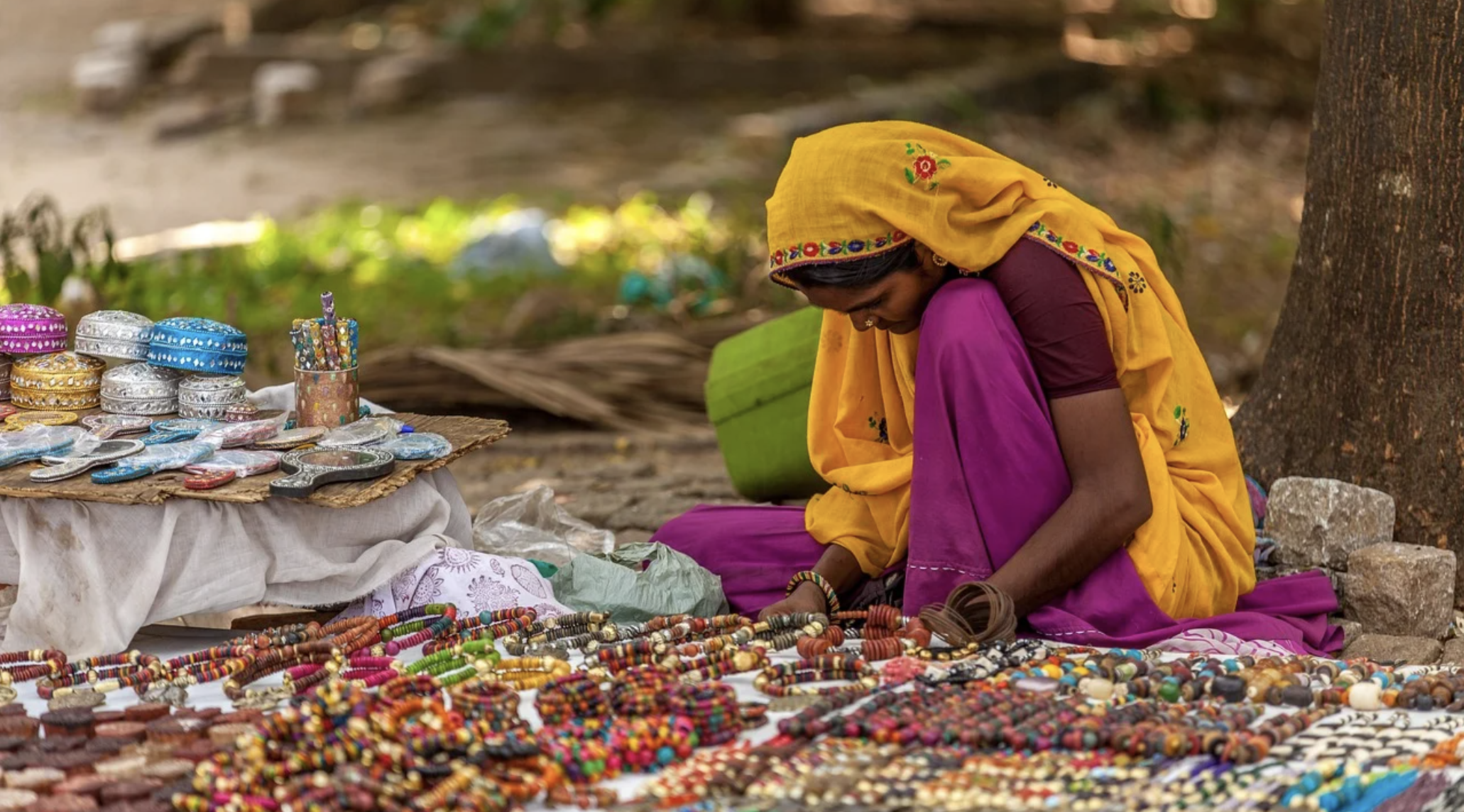
At 5:00 AM, before Delhi’s markets, lanes, and streets fully wake up, 42-year-old Rekha arranges vegetables under the dim, flickering streetlight near the Munirka metro station. By noon, she would have already bargained with dozens of customers, called home twice or thrice to check on her two children, and, in all likelihood, would have skipped lunch. For thousands of women street vendors like Rekha, every day is a struggle between survival, safety, and dignity in the nation’s capital.
For thousands of women street vendors like Rekha, every day is a struggle between survival, safety, and dignity in the nation’s capital.
Street vendors remain an essential and inseparable part of Delhi’s everyday life. From vegetables to groceries, clothes to affordable accessories, and flowers to trinkets, almost everything can be found at these street-side stalls, making life a little easier for the city’s residents. However, despite the fact that these vendors play such a crucial role in the city’s economy, their struggles often go unnoticed.
Meagre earnings and endless uncertainty
For women street vendors in particular, daily income is often uncertain and barely enough to sustain a family. For some, entering street vending comes not by choice but out of necessity. ‘There was no other work available, and I have a child to feed,’ says one vendor near the INA Market as tears roll down her face. Rising household expenses, increasing food prices, and LPG shortages often create an unavoidable pressure on daily survival, thus pushing women into street vending.
While some quote rising expenses, others are forced into street vending due to difficult family circumstances. Alcoholic husbands or an unstable household often force them to take up this work. For many, street vending also becomes a way to provide extra income for an already large family that struggles to survive on a single source of income.
While some quote rising expenses, others are forced into street vending due to difficult family circumstances. Alcoholic husbands or an unstable household often force them to take up this work.
Women street vendors don’t just struggle financially; they suffer the ‘double burden’ of managing both work and household chores. Often being forced to play three roles — housewife, mother, and worker — leaves them stressed and affects their well-being. After spending long hours on the streets, many return home to cook, clean, and care for their children and families. Regardless of the challenges they encounter, their child’s future is what truly matters to them.
Further, they struggle due to a lack of adequate sanitation infrastructure. While Delhi has an extensive network of public facilities, the overall system often fails to meet basic standards. A severe shortage of clean and accessible public toilets, along with poor hygiene and sanitation conditions, remains a major challenge. The inadequate maintenance of these basic amenities adds to the daily hardships faced by women vendors. Imagine spending 10 to 12 hours on the street with little to no access to clean toilets, drinking water, or rest areas.
In crowded markets such as Sarojini Nagar, Lajpat Nagar, and Janpath, for instance, one can often see Banjara vendors, mostly women, spending the entire day on their feet, often with their children by their side. Although public toilets are available in these areas, accessing them, especially during peak hours or while menstruating, can be difficult. These facilities are often the only option available to street vendors for relieving themselves, leaving them dependent on inadequate and poorly maintained infrastructure.
The impacts of climate change and heat stress
Beyond income uncertainties and inadequate infrastructure, climate change also poses a risk to women street vendors in Delhi. With extreme weather events come new struggles for survival, impacting the health and daily earnings of street vendors. For women vendors, in particular, Delhi’s extreme weather conditions often impact their ability to earn.
Beyond income uncertainties and inadequate infrastructure, climate change also poses a risk to women street vendors in Delhi. With extreme weather events come new struggles for survival, impacting the health and daily earnings of street vendors. For women vendors, in particular, Delhi’s extreme weather conditions often impact their ability to earn.
During severe heatwaves, many women vendors spend hours sitting and working under the scorching sun. As several deaths reported every year due to heatwaves prove, such exposure to soaring outside temperatures can quickly become life-threatening. Rising temperatures are silently affecting workers who work outdoors, especially women. The Periodic Labour Force Survey (PLFS) found that nearly 90 per cent of India’s workforce is employed in the informal sector, leaving workers with little to no protection from climate-induced income loss.
The struggles continue through the seasons. During the monsoon, rainwater enters their roadside stalls, damaging their goods. Winters, on the other hand, affect their health and sometimes even become a threat to lives, as they are forced to sit for long hours in the freezing cold and work. And since their livelihood depends entirely on their daily earnings, they cannot afford to stay home, be it hot, cold, or wet outside.
Safety risks and the threat of eviction
For many women vendors, the struggle is not limited to making a living in the capital, but also to being safe in public spaces, especially at night. Parvati, a 32-year-old woman selling dupattas near Patel Chowk metro station, says that early mornings and late evenings are often the most frightening parts of her day. ‘Some pass comments, and being surrounded by several auto drivers creates discomfort. Some stare, while a few others unnecessarily try to talk.’
Parvati, a 32-year-old woman selling dupattas near Patel Chowk metro station, says that early mornings and late evenings are often the most frightening parts of her day. ‘Some pass comments, and being surrounded by several auto drivers creates discomfort. Some stare, while a few others unnecessarily try to talk.’
In January 2026, an 11-year-old girl who sold roses at a traffic signal in Central Delhi was allegedly kidnapped and raped by an e-rickshaw driver, who was later arrested. Reports suggested that the driver lured her away with the promise to help sell her flowers. The girl was taken to a forested area, sexually assaulted, and left unconscious. This single incident exposes the harsh realities of street vending that many women in the informal sector are exposed to every day. However, like many other women vendors, Parvati continues to work under the constant pressure of managing her fears while striving to earn a living.
Street vending also exposes vendors to forced evictions and confiscation drives by authorities. Although the Street Vendors (Protection of Livelihood and Regulation of Street Vending) Act, 2014, provides legal protection against arbitrary harassment and eviction, and mandates prior notice before eviction or relocation drives, numerous news reports indicate that the reality remains markedly different. Women and girls engaged in street vending continue to face a range of challenges, including harassment and forced evictions by city authorities. This highlights a significant gap between policy provisions and their implementation.
In a city that never truly stops moving, these women continue to sit quietly behind their stalls day after day. People may stop to buy vegetables from them, bargain over a pair of jhumkas, pick up a sunflower bouquet at a traffic signal, or stop by for a cup of tea they sell. Yet their struggles often go unnoticed.
In a city that never truly stops moving, these women continue to sit quietly behind their stalls day after day. People may stop to buy vegetables from them, bargain over a pair of jhumkas, pick up a sunflower bouquet at a traffic signal, or stop by for a cup of tea they sell. Yet their struggles often go unnoticed.
For many women vendors, these streets are not merely places of work; they are spaces where they spend much of their lives. Here, they navigate daily exhaustion and fear, shoulder responsibilities, and hold on to hope, all at once. Their day begins long before sunrise and often continues even after the city falls asleep, then they return home to domestic responsibilities. Juggling between struggle and survival, these women step out every day with the hope of earning a little more than they did yesterday.
The quotes in this piece are the author’s free translation from Hindi to English.
About the author(s)

Neha Kumari is a journalist with Akashvani (All India Radio) and a graduate of the Indian Institute of Mass Communication (IIMC). Passionate about writing and storytelling, she enjoys covering human-interest stories, art, and culture while exploring innovative forms of digital storytelling. In her free time, she can often be found reading books or thinking about her next article, story, or creative project to design.


A powerful and eye-opening article that highlights the resilience of women street vendors in Delhi. It brings attention to the daily challenges they face balancing livelihood, safety, family responsibilities, and harsh working conditions. Their contribution to the city’s economy deserves greater recognition, support, and gender-sensitive policies that ensure dignity, security, and equal opportunities for all. Well done! Keep writing.