When we listen to the debates about elections and voting behaviour in India today, a familiar pattern appears: women voters are often discussed as welfare scheme beneficiaries rather than as political actors with the authority to make decisions. This pattern is increasingly visible after the 2023 state elections of Karnataka, Telangana and the more recent discussions around Bihar. The free bus schemes such as Shakti Yojana and Mahalakshmi Scheme operating respectively in these southern states are some of the most discussed along with the long-standing welfare measures operating in Bihar. These discussions often end with a simple conclusion: women voted for the material incentives.
What Is Political Mansplaining?
Welfare undoubtedly influences voting behaviour; it shapes the electoral choices of both men and women. But when women’s votes are being reduced to welfare votes, it resembles a deeper pattern. Their political reasoning is not only being interpreted in a simplified way but also being reduced and dismissed, and their stories are being narrated by male-dominated panels of experts. It is not just over-simplification, it’s a form of political mansplaining, with negative implications for democracy and gender equality.
When women’s votes are being reduced to welfare votes, it resembles a deeper pattern. Their political reasoning is not only being interpreted in a simplified way but also being reduced and dismissed, and their stories are being narrated by male-dominated panels of experts.
Mansplaining in politics is not just about interruptions in television debates; it operates in a more subtle and structural way. It shapes whose interpretation is treated as legitimate and authoritative, and whose voices are sidelined.
When a significant portion of the political commentary reduces women’s votes to welfare votes, what impact does it have? It promotes the misogynistic notion that women voters are “emotional”, not rational. The sexist assumption here is that women are less likely to evaluate multiple issues such as unemployment, inflation, governance etc.
Mansplaining and misogynistic views against women voters
While the studies by Centre for the Study of Developing Societies-Lokniti have shown that women voters evaluate multiple concerns, including price rise, unemployment, corruption, and law and order, the political mansplaining is rooted in deep patriarchal biases of political pundits who are predominantly men. Women do not vote as a single bloc; their choices vary according to their class, religion, income, and region.
These findings highlight the simplistic nature of the claim: welfare alone determines the electoral behaviour of women. Political mansplaining begins when that complexity is ignored.
Beyond the Narrative of “Freebies”: What Welfare Actually Means
Welfare schemes not only contribute to immediate financial savings; they also produce effects beyond this. Consider the free bus travel scheme, Mahalakshmi, operating in Telangana. After its introduction bus ridership has increased significantly, but these statistics tell us only a part of the story. While I was interacting with a beneficiary of this scheme, she said, ‘Earlier, even bus fare I had to ask and get from my husband, now I am travelling on my own. Through this free bus travel, I am saving around 2,000 rupees every month, using it for my children’s educational needs and other household expenses”. For her the scheme is not only about money, it’s about autonomy and dignity.
For many such women, such schemes positively impact their everyday mobility and decision-making power, but these dimensions never appear in such electoral commentary. A similar pattern emerged in Karnataka after the introduction of Shakti scheme. Reports by Hindustan Times described how the women beneficiaries of this scheme experienced tangible changes in their daily lives. Sarala, a domestic worker, travels daily from Ganganagar to Hebbal in Bengaluru and said the scheme is allowing her to save 20 rupees each day; these small savings could be used for her household expenses.
This scheme is meaningfully benefiting students too. Shashikala, studying at Malleshwaram Girls PU College, said the savings from the scheme are helping to support her education after the recent loss of her father, while her mother now works as a construction labourer to sustain the family.
These stories tell that welfare is not only experienced as financial relief; it can strengthen autonomy, expand mobility and increase the bargaining power of women within their families. Yet, post-electoral analysis often simplifies these experiences into a single explanation: women voted for “freebies.”
Welfare, Autonomy, and Everyday Freedom
A similar pattern can be seen in Bihar, where gender-targeted welfare measures such as the Mukhyamantri Cycle Yojana and the Mukhyamantri Kanya Utthan Yojana have operated in the state for years. Public commentary frequently portrays women voters in the state as loyal welfare beneficiaries, but reports from the ground suggest a more complex reality. One of the bicycle scheme beneficiaries told The Indian Express that receiving a cycle gave her a sense of “freedom” and allowed her to travel independently and continue her education.
For many such women, such schemes positively impact their everyday mobility and decision-making power, but these dimensions never appear in such electoral commentary.
Freedom, Mobility, and Independence. These are not merely electoral incentives.
Despite these layered experiences, post-election commentary often collapses them into a single narrative, ‘women vote for benefits’. End of the story. But whose story is that? When the lived experiences of women are replaced by the interpretations of male experts, their dependency is emphasised and agency disappears.
How Mansplaining Works in Electoral Discourse
Mansplaining operates in many interconnected ways. First through interpretive gatekeeping, television panels and media platforms often invite male analysts and commentators as they are the only legitimate interpreters of elections and voting behaviour; women voters rarely represent themselves as analytical voices. When we see prime-time debates about socio-political issues, elections, voting and governance, which are largely led by male commentators, it subtly conveys a message: women speak and male experts interpret. Infantilisation through welfare framing, another way of mansplaining. When women-focused welfare is portrayed mainly as emotional inducements, they are treated implicitly as politically less concerning. Although welfare affects men too, their electoral behaviour is rarely reduced to gratitude; meanwhile, the choices of women are often explained as choices shaped by welfare and women voters are reactive rather than reflective.
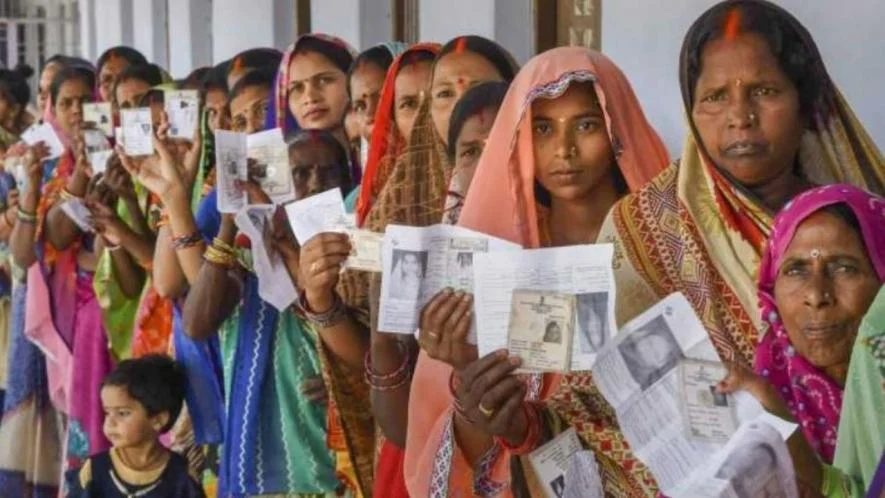
Additionally, this pattern reflects what scholars described as ‘epistemic injustice’; it is a form of injustice that occurs when the knowledge, experience, testimonies and analytical ability of someone as a producer of knowledge are dismissed or undervalued just because of who they are/their identity. In the electoral context, women’s explanations of why they vote are treated as secondary to expert commentary, and their political reasoning is replaced by narratives led by specialists that claim to know better. When the political reasoning of women gets simplified and their vote is always explained as welfare gratitude, it narrows the scope to acknowledge the aspect of deliberation. This is striking particularly when we see the recent electoral trends, where the voter turnout of women has matched or exceeded that of men in several elections, but are they being heard equally?
This way of framing the voting behaviour of women also affects how policies are discussed, welfare measures that expand mobility and improve access to public spaces may face the risk of being assessed as electoral tactics rather than as developmental interventions. Is this good for a country where women’s labour participation rate is significantly lower than men’s? Electoral analysis becomes weaker when it treats women voters as a uniform group, because they are not. Different women approach elections differently, their priorities vary across caste, creed, region etc. Recognising these differences is essential to understand how women engage with politics, ignoring them sustains a familiar hierarchy: men interpret politics while women are being interpreted.
Recognising welfare as a factor for shaping voting behaviour does not require the reduction of political agency and reasoning of half of the population, welfare shapes voting across genders and the problem here lies in how the electoral choices of women are narrated. Moreover, democracy does not simply rely on the right to vote but also on recognising everyone as an equal political actor with autonomy. Epistemic equality simply means acknowledging the ability of every citizen to interpret the socio-political phenomena and also recognising every individual as the potential contributor to knowledge production.
Therefore, questioning of electoral mansplaining is not about denying the influence of welfare schemes, it is about restoring the interpretive authority of women. Women vote, speak and lead, and their political reasoning deserves to be heard, not explained away.
About the author(s)