Stonewalling is often understood as silence. But for many queer and trans people in India, it feels far more active than that. It feels like walls closing in from every direction. Not suddenly, but gradually. Policy by policy. Decision by decision. Silence by silence. Until there is no room left to move, no institution left to turn to, and no language left to describe what is happening. This is what the last few years have felt like. The decriminalisation of homosexuality through Navtej Singh Johar v. Union of India in 2018 was seen as a turning point. But what followed was not liberation. It was a series of micro-aggressions, institutional failures, and deliberate policy choices that slowly closed every possible avenue of safety for queer people.
The consequences of this are not abstract. They are visible, for instance, in the lives that have been lost. Anjana Harish, who fled her home fearing parental abuse and later died by suicide. Arvey Malhotra, a student from Delhi Public School, Faridabad, who faced repeated sexual misconduct in his school washroom and died by suicide, with his mother Aarti Malhotra continuing to fight for justice. Pranshu, a young nail artist on Instagram who was relentlessly bullied for being effeminate as an assigned-male-at-birth individual, and many more such cases that may not have made it to the newspaper headlines but still exist in the vacuum of social apathy. These are not isolated tragedies. They are outcomes of an apathetic system that refuses to protect queer children.
The decriminalisation of homosexuality through Navtej Singh Johar v. Union of India in 2018 was seen as a turning point. But what followed was not liberation. It was a series of micro-aggressions, institutional failures, and deliberate policy choices that slowly closed every possible avenue of safety for queer people.
It was precisely to address this that activists, pedagogists and educators pushed for structural interventions. One such attempt was to introduce sensitisation through school systems, recognising that teachers, peers, and parents often lack the tools to engage with gender non-conforming and trans children with care. The proposed NCERT manual on gender and sexuality was developed by VQUEERAM (Vikramaditya Sahai), faculty at the Department of Gender Studies at Ambedkar University and an external member involved in drafting the manual. It aimed to create a framework to explain gender dysphoria, non-conformity, and the lived realities of queer students, while also offering practical steps for making schools safer spaces. It was dismissed for being “too woke”.
The manual was scrapped by the National Commission for Protection of Child Rights, and VQUEERAM was subjected to widespread abuse and vilification. What could have been a step towards preventing bullying and saving lives was shut down before it could even begin.
What followed was not a neutral replacement, but a regressive one. A manual authored by Jyotsna Tiwari, professor and head of the Department of Education in Art and Aesthetics at NCERT, replaced it. It conflated sex and gender, misrepresented queer identities, and reinforced harmful stereotypes. It framed trans existence through narrow, dehumanising lenses, invoking images of begging and ritualised appearances, while ignoring the vast realities of trans lives across professions, classes, and identities.
The message was clear. Sensitisation would not be allowed unless it aligned with a regressive, state-approved narrative. The Hijra community was looked at in the lenses of religion and pity, but trans physical safety and mental health were where the line would be drawn, as the new manual did not even have a word for gender dysphoria, as if seeking to deny that it exists altogether.
This was not an isolated incident. Efforts to introduce comprehensive gender and sexuality education with parents and kids in tandem were repeatedly dismissed as “woke propaganda” by right wing figures like Rajiv Malhotra and Vijaya Vishwanathan, who have authored works such as Snakes in the Ganges: Breaking India 2.0 and Who Is Raising Your Children?, where LGBTQIA+ identities and sensitisation efforts are framed as threats to Indian society and family structures and exposing children to woke narratives.
Right wing backlash against Inclusion
Even small attempts at inclusion were met with backlash. When Shiv Nadar School introduced the option of non-binary alongside male and female genders, it was quickly withdrawn after outrage, further reinforcing the idea that even language itself must be policed. It is understandable that parents could have been sensitized before introducing a new label which could take them aback, but it is not something to create a hateful furore about. At the same time, institutional representation has been compromised.
The appointment of Aparna Lalingkar, a cisgender woman, as an “expert” on the National Council for Transgender Persons raises serious concerns about the quality of representation being institutionalised. In her own writings and public statements, she demonstrates a fundamental misunderstanding of the distinctions between sex, gender, and sexual orientation, using stigmatising and dehumanising language, conflating transgender identities with intersex variations and referring to intersex people as having “sex deformities”. She has also suggested that homosexuality may arise due to upbringing, abuse, or social influence and has characterised gender sensitisation efforts in schools as “brainwashing” that leads children towards medical transition, even linking such efforts to demographic change and “anti-national” agendas. In social media statements, she has further drawn inaccurate and stigmatising distinctions between “tritiyapanthi” and transgender identities, misrepresenting established understandings within both community and academic discourse. These positions are not simply differences of opinion. They reflect a deeply regressive and scientifically discredited framework that risks shaping policy in ways that further marginalise the very communities the Council is meant to protect.
When those who misunderstand a community are appointed to represent it, representation itself becomes a form of erasure.
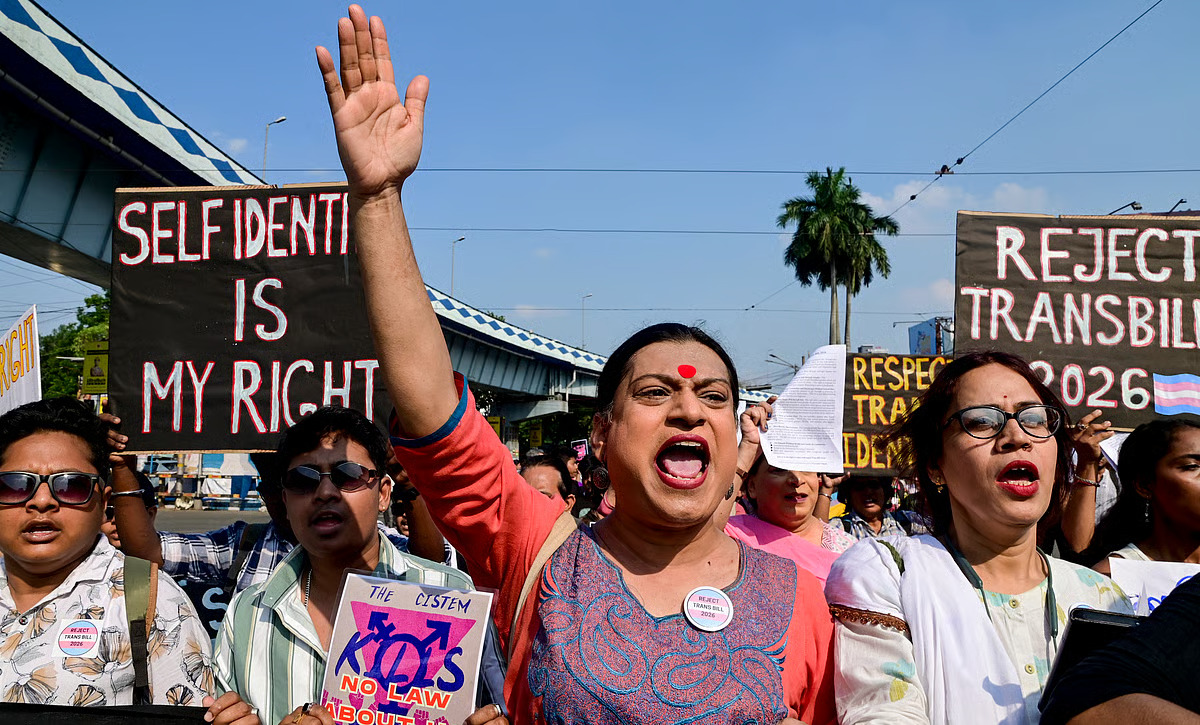
The Transgender Amendment Act 2026 adds another layer to this tightening structure. A vaguely worded clause criminalising “forced transition” opens the door to wide misuse.
Legal protections have also remained weak or largely performative. The so-called ban on conversion therapy exists more as a mandate on paper by the National Medical Commission rather than as a robust, enforceable safeguard coming from the Supreme Court. Despite sustained recommendations and interventions by Trinetra Haldar Gummaraju and Justice Anand Venkatesh, outdated medical frameworks continue to pathologise queer identities. Standard forensic medicine and toxicology textbooks still classify homosexuality, lesbianism, and transvestism under “unnatural sexual offences” or “sexual perversions”, historically placing them alongside incest and bestiality, and even describing lesbianism using deeply derogatory and dehumanising language. In such a context, a regulatory-level advisory without stronger backing from institutions like the Supreme Court remains insufficient to prevent harm. The absence of explicit legal protections against natal violence further compounds this vulnerability, leaving queer individuals, especially minors, exposed within the very spaces they are expected to call home.
Even within the domain of marriage, protections remain partial and precarious. Following legal developments after the marriage equality hearings, certain heterosexual frameworks involving binary trans persons have been recognised in practice, such as marriages between a trans man and a cis woman, a trans woman and a cis man, or a trans man and a trans woman. However, these limited recognitions do not amount to full marriage equality. More importantly, the current Transgender Amendment Act 2026 threatens to undermine even these fragile gains by calling into question trans identities themselves, including access to gender-affirming healthcare and identity documentation. The effects are functionally retrospective in how they impact trans lives, as provided by all previous acts and verdicts, including the 2019 trans protection act, which was already criticised for giving a district magistrate arbitrary powers. By questioning the legal recognition of trans identities, access to identity documents, and gender-affirming care, it places even those marriages that were entered into under earlier legal understanding in a state of uncertainty. Students who have applied for programmes that provide trans people scholarships are in hot water because their identities may lose recognition after this act. Lives that were built on fragile but hard-won recognition are once again pushed into precarity. At the same time, there remain no explicit protections against forced marriages imposed by families, leaving many trans individuals vulnerable to coercion, sexual violence, and lifelong erasure under the guise of social conformity.
And now, the Transgender Amendment Act 2026 adds another layer to this tightening structure. A vaguely worded clause criminalising “forced transition” opens the door to wide misuse. It allows suspicion to become grounds for action. It puts at risk not just organised community structures like gharanas, jamaaths, NGOs, and CBOs, but also the informal networks of care that queer people rely on to survive. This can also include friends and chosen family and becomes especially dangerous for minors escaping abusive homes.
When members of the National Council for Transgender Persons, including Kalki Subramaniam, attempted to raise these concerns, the response itself reflected institutional apathy. A scheduled meeting with Virender Kumar did not take place. The meeting was presided over by his senior economic advisor, Yogitha Swaroop. When questioned about the lack of prior consultation, Yogitha Swaroop reportedly stated that the ministry did not feel the need for consultation and believed it already knew what needed to be done. She further dismissed concerns around natal violence with the remark that “nothing can be done if parents abuse their children; they are parents after all”, reflecting a deeply concerning normalisation of abuse within family structures.
The message, once again, was clear. There would be no intervention within families, even in cases of abuse. This is what stonewalling looks like. It is not one law, one policy, or one decision. It is the cumulative effect of shutting down every pathway that could have offered safety. Sensitisation is blocked. Representation is diluted. Legal protection is weakened. Community care is criminalised.
At every level, the walls move closer. And in this closing space, queer and trans people are left to navigate violence with fewer tools, fewer allies, and fewer places to go. If this is not a concerted pattern, then what is? If this is not systemic erasure, then what are we witnessing?
About the author(s)