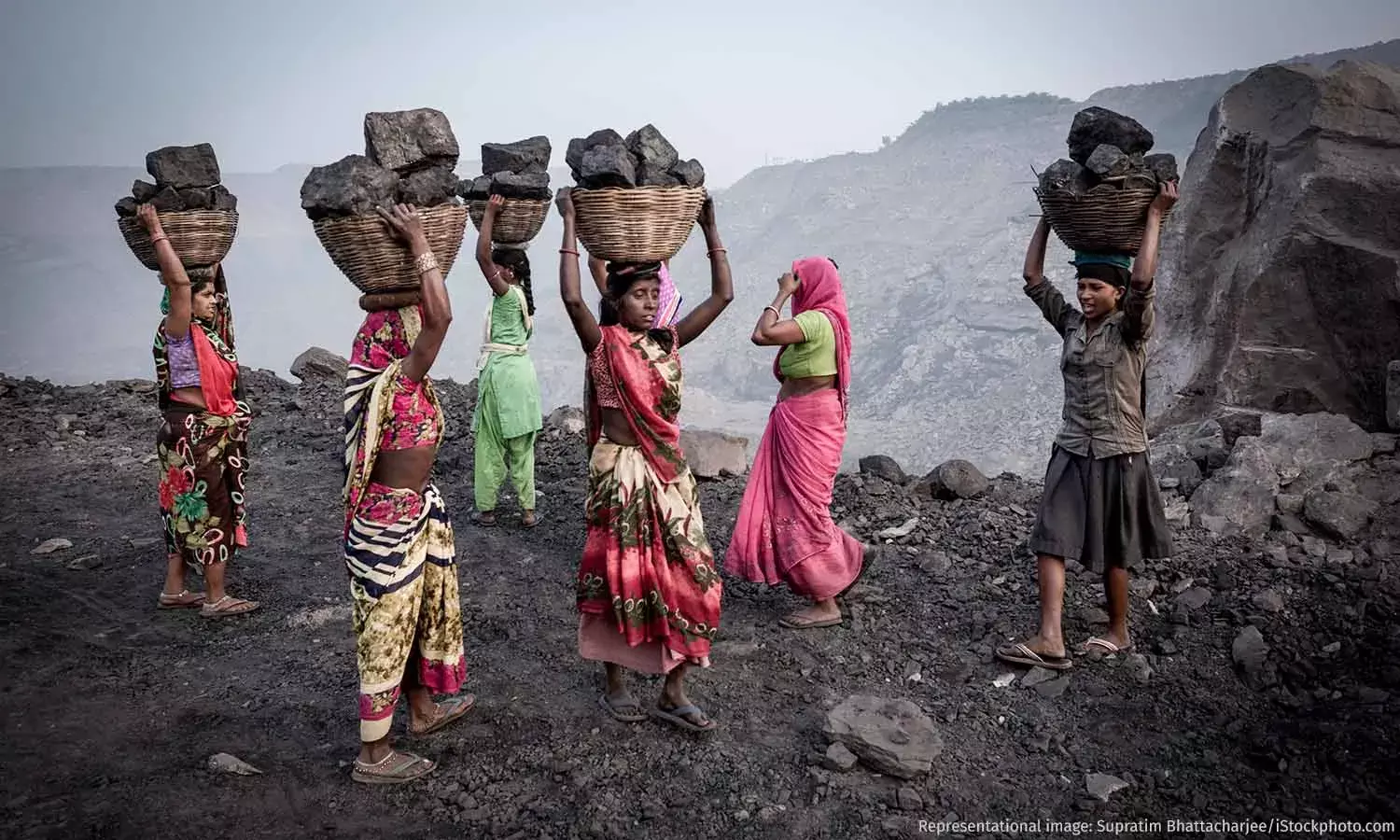
Jharkhand holds about 26-28% of India’s proven coal reserves, making it the largest coal-bearing state in the country. It also has a high percentage of the Scheduled Tribe population, at 26.3%, according to the 2011 Census. This population is concentrated in the same districts where coal extraction occurs. The geography of extraction links the Adivasi communities to the minerals. Essentially, the Adivasi communities are the ones from whom the minerals are taken.
The North Karanpura coalfield covers 1,420 square kilometres, mainly in Hazaribagh, Ramgarh, and Chatra districts. It runs through the Damodar River basin and lies beneath 203 villages. In 2022, NTPC’s North Karanpura plant, a 1,980 MW facility in Chatra, began operations. The Pakri Barwadih captive coal block has an extractable reserve of 642 million tonnes and a production capacity of 15 million tonnes a year. The power generated goes to the grid, while the ash is left behind.
Coal-based power plants create fly ash, which, according to the Centre for Science and Environment, is the second-largest waste stream in India. These plants produce hundreds of millions of tonnes annually. Ash ponds overflow, and ash slurry pollutes rivers. Residents near thermal plants in Jharkhand and surrounding states report food coated in ash, sick livestock, and blackened water sources. These accounts are substantiated by years of reports from groups working in these areas. The communities closest to the ash ponds are mostly Adivasi.
The impact on women’s health has been documented, though not thoroughly. A 2022 study in the Journal of Development Studies found that coal-fired power units increase the chances of anaemia among women and children at the time of a child’s birth. The states with the highest number of coal plants—Jharkhand, Odisha, Chhattisgarh, and West Bengal—also bear the brunt of these effects. NFHS-5 data reveal that Scheduled Tribe women have 39% higher odds of anaemia compared to the general population. Both the link between anaemia and coal plants, and the disparity in anaemia affecting caste and tribal groups are well-documented. In Jharkhand’s coal belt, both issues coexist.
Silicosis, a lung disease caused by long-term exposure to silica dust, is common in mining areas. It was declared an occupational disease under Schedule III of the Employees’ Compensation Act in 2024, making employers liable for compensation without requiring workers to prove causation. However, enforcement remains problematic. Informal workers collecting coal residue near ash ponds are not recognised as employees. They are considered self-employed, leaving them outside the protections of the occupational disease framework.
The Forest Rights Failure
The Forest Rights Act of 2006 aimed to recognise the rights of tribal and forest-dwelling communities over the land they have occupied for generations. This was an attempt to remedy historical injustices. The implementation record in Jharkhand reveals a different reality.
By 2025, Jharkhand had recognised less than 2% of its eligible Community Forest Resource area, one of the lowest rates in the country, compared to Maharashtra’s 36%. The total area potentially eligible for Community Forest Rights (CFR) in Jharkhand is estimated at 5.26 million acres, yet only a small fraction has been recognised. According to MoTA data reported by Down to Earth, of the 110,756 individual forest rights claims filed in Jharkhand by August 2025, 61,930 were approved, 28,000 were rejected, and 21,000 remained pending. Community forest rights, which would grant villages collective governance over forest resources, are largely unrecognised, even where individual titles have been issued.
The implications for women are significant. When community forest rights are granted, the Gram Sabha is given governance of the forest. In the Oraon and Munda customs, women’s involvement in Gram Sabha decisions is crucial for village governance. If these rights are denied and the forest is instead designated for a mining project, the economy based on forest resources—like mahua, kendu leaves, and medicinal plants—collapses. Women who primarily collect and sell non-timber forest produce in these communities lose their livelihoods when the land becomes a project.
The Adani Power plant in Godda district exemplifies this issue. From 2016 to 2018, the land acquisition for the 1,600 MW plant displaced tribal families from villages in Santhal Paragana, with reports of forced acquisition and protests against the process. This pattern—where mines or plants are prioritised and rights settlements follow later, if at all—is common across Jharkhand’s coal districts. Since independence, 1,710,787 people have been displaced in Jharkhand for power plants, mines, and other development projects.
The Ujjwala Contradiction
The Pradhan Mantri Ujjwala Yojana (PMUY), the LPG connection scheme, claims 10.33 crore beneficiaries nationwide. It is often cited as proof that the government is improving women’s health in low-income households by reducing reliance on biomass fuels. While the number of connections is authentic, it does not reflect actual usage.
As of 2024-25, PMUY beneficiaries average 4.4 LPG refills per year. A household that cooks three meals a day typically uses a cylinder every 30-45 days, meaning 8-12 refills per year would indicate full reliance on LPG. Given that PMUY beneficiaries have an average of only 4.4 refills, most are still using biomass, firewood, coal dust, and agricultural waste for most of their cooking. A qualitative study in tribal Odisha, published in 2025, found that economic factors such as high refill costs and subsidy delays consistently push households back toward traditional fuels, a trend most evident among tribal women.
In Jharkhand’s coal belt, the available biomass often consists of coal dust and fragments taken from mine waste, the cheapest local fuel. Women unable to afford LPG refills resort to burning what is nearby—the byproducts of an industry long present in their communities. The Ujjwala scheme provides connections but does not resolve why these connections go unused, or what women are burning instead. The scheme also overlooks the impacts of silicosis and occupational lung disease. It categorises itself as a clean energy initiative, not a health program. The women most affected by proximity to coal extraction are the same ones likely to have a PMUY connection, but cannot afford to refill.
What Accountability Would Look Like
The Forest Rights Act has a grievance mechanism; rejected claims can be appealed to the Sub-Divisional Level Committee and then to the State-Level Monitoring Committee. However, in practice, this appeals process is often underused, underfunded, and difficult for women claimants to navigate without legal support. The 28,000 rejected claims in Jharkhand represent families whose rights remain unrecognised, with no clear way to reverse the decisions.
PESA, or the Panchayats Extension to Scheduled Areas Act, was implemented in Jharkhand in late 2025, twenty-five years after statehood. Tribal leaders and activists warn that the 2025 rules weaken, rather than enhance, autonomy. Sections protecting customary law are diminished, the term ‘community ownership’ has been dropped, and the responsibility for recognising Gram Sabhas has shifted to district authorities rather than remaining with the communities.
Silicosis as a recognised occupational disease only matters if enforcement reaches the informal workers exposed to it. Creating a welfare fund financed by a cess on extractive industries in tribal districts could provide direct health support to affected villages. However, such a fund does not exist.
There are multiple frameworks available. The Forest Rights Act, PESA, the Maternity Benefit Act, the Occupational Safety Code, PMUY, and the National Health Mission and for silicosis, a separate board along the lines of what is there in Rajasthan – all address different aspects of the challenges Adivasi women face in Jharkhand’s coal belt. The issue is not a lack of legislation. It is the persistent political decision to prioritise extraction over the communities affected by it and to create welfare programs that may establish connections but fail to address underlying conditions.
Jharkhand generates power for the national grid. The ash from this production settles on the villages where it happens. Women in those villages have fewer recognised land rights, lower LPG refill rates, and a higher risk of occupational disease than current policies acknowledge. The gap between policy and reality is where the true politics of extraction lies.