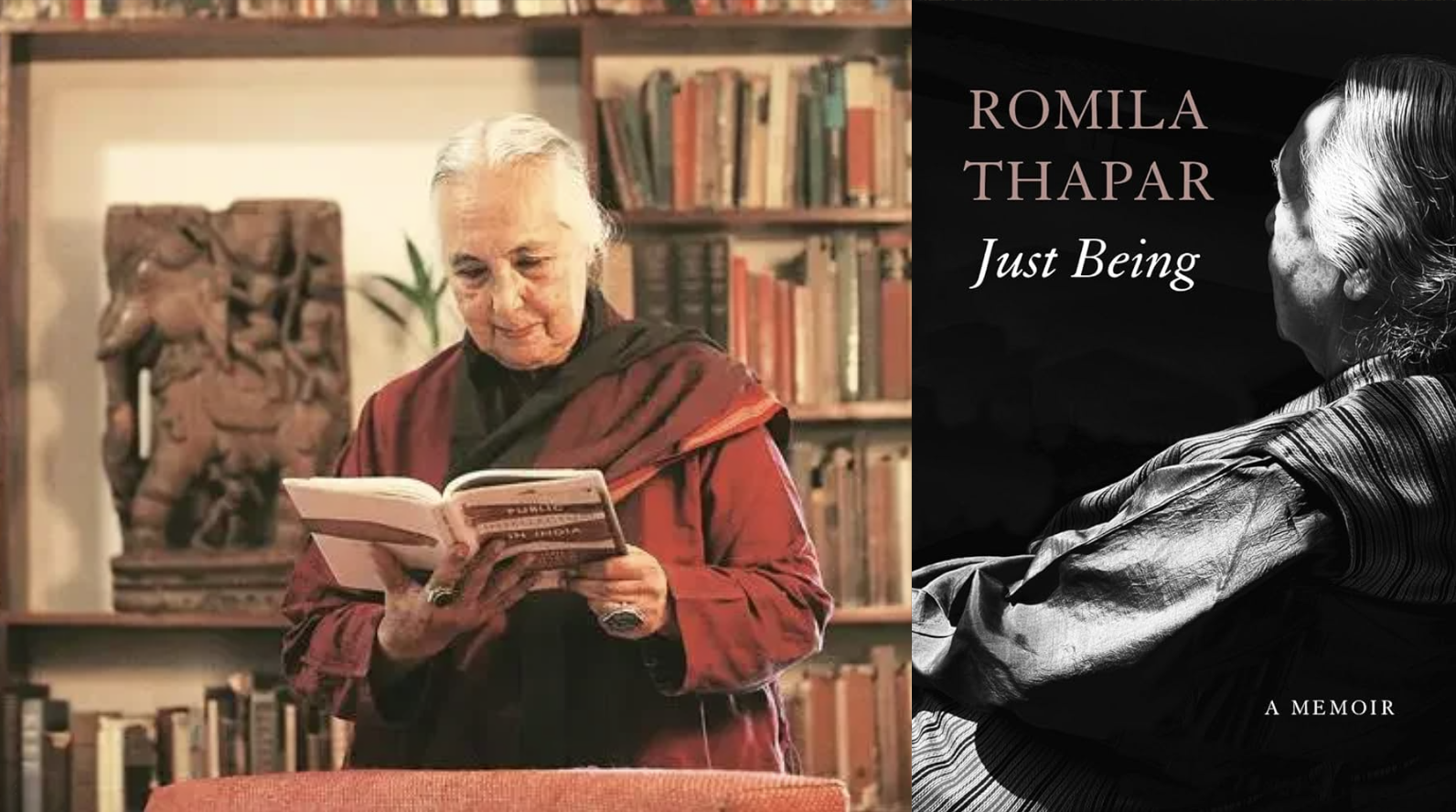
Romila Thapar’s recently released memoir, Just Being, is many things at once. It is a manifesto for historians, a touchstone for academic researchers, a chronicle of familial relationships and emancipatory friendships, a travelogue where every anecdote detonates into a larger question about history, ethics, language, and civic responsibility. Yet beneath these various strands is the portrait of a fiercely autonomous woman, one who insists on the right to live her life, to simply be, on her own terms.
Arranged with the tidy chronology that one expects from a historian, the memoir begins with the unlikely circumstances of Thapar’s arrival into the world and moves through an almost novelistic childhood in the North-West Frontier province, Peshawar, Lahore, and Rawalpindi, weaving together family homes, British cantonments, visits to the zenana of Pathan women, and political aftershocks of the partition.
Her coming-of-age in Pune is interspersed with exciting anecdotes of coming out into a society where she learns, in addition to listening to Beethoven records and taking riding lessons, to read voraciously and with a sense of historical consciousness. Her father encourages her to pick up volumes by Gopinath Rao and J. N. Banerjee, and she is also introduced to books on Marx and Marxism. But it is in London that Thapar’s interest in History takes a firmer shape as she scintillatingly takes us through her time in SOAS University of London.
Thapar does not write with the brittle self-regard that often shadows academic autobiographies, but with the objectivity of someone who has spent a lifetime allowing ideas, not institutions, to determine the shape of her loyalties.
At the heart of the memoir is a fierce commitment to do what she believes in, one that surpasses every other conventional measure of success. Thapar does not write with the brittle self-regard that often shadows academic autobiographies, but with the objectivity of someone who has spent a lifetime allowing ideas, not institutions, to determine the shape of her loyalties. The book’s narrative force derives precisely from this refusal to soften its edges for approval. As she puts it, ‘It’s not that I have done daring things in my life, but I have tried to live up to my vision of being an autonomous human being in thought and action.‘
It is telling that although she describes her mother as ‘something of a feminist for her time’, she chooses ‘autonomous woman’ to describe herself. Autonomy for her simply becomes the condition under which she could live on her own terms. Reflecting on the death of her first partner to cancer, she writes, ‘The search for my autonomy resumed‘. This sentence reveals her emotional reorientation towards independence. Autonomy, in Thapar’s telling, is a recurring project that requires continuous reclamation.
Growing roots and breaking free
Thapar continues to defend this autonomy by a series of elegant defiances. When her father asks her to return home from London, she signs up for a research fellowship instead. While at Kurukshetra University, she argues with a vice-chancellor who tells her that she should share part of the royalties from her scholarly monograph with the university to avail her station-leave for accessing library books in Delhi. At the University of Delhi, her department’s chairperson, B. B. Mishra, objects to her presence not because she lacks qualifications but because, as she recalls, ‘[He is] unhappy that I held a teaching job in the university as this was denying a job to a male historian who had a family to feed.‘ Yet she remains undeterred in the face of such people.
One leaves these pages with the sense that Indian historiography owes an indeterminable debt to those shards of pottery and to the woman stubborn enough to excavate them.
The same spirit animates her account of learning archaeology. At Kalibangan, where she is the only woman on the excavation team, the Lambardarni, with a group of local women, host her for lunch and regard her presence with fascination. ‘Wasn’t she afraid of digging the grave?‘, they asked. Thapar delights in their curiosity and even in their disapproval that she is not married with children but instead ‘digging up bits of pottery’. The anecdote captures her intention in not just escaping social expectations but in rendering them irrelevant. One leaves these pages with the sense that Indian historiography owes an indeterminable debt to those shards of pottery and to the woman stubborn enough to excavate them.
About her time in Kurukshetra University, she writes, ‘For the locals, a woman who wore sleeveless blouses, smoked cigarettes, and drove a car was a spectacle in itself.‘ Before long, she ceases to be Romila Thapar and becomes the gaddi-wali-madam, the lady with the car.
The automobile reappears throughout Just Being, almost as a metaphor for her journey towards autonomy. In one memorable episode, she decides to drive her friends, the Wengrafs, to Agra and Khajuraho, despite her father’s reluctance. The trip becomes an ordeal of logistical frustrations. After the driver tries to steal her car, she lodges a police complaint against him. Eventually, the car is recovered. However, when she appears in court to pursue the case, the driver’s lawyer, unable to challenge the facts, resorts to attacking her character as a woman of ‘loose morals’ because she is unmarried and travelling with foreign men. Thapar’s response to such obstacles is not complaining (though it can be, and there are moments of frustration). Instead, she records it almost as an anthropologist might describe a curious local custom and persists through it.
Thapar’s response to such obstacles is not complaining (though it can be, and there are moments of frustration). Instead, she records it almost as an anthropologist might describe a curious local custom and persists through it.
Thapar’s persistence is not confined to personal and academic affairs alone. In the memoir, she reflects on a peculiar Indian predicament: a historian in India, she observes, must invest as much in public discourse as in academia. The remark captures the reality that writing history in India is akin to entering a contested political arena, where every argument is expected to declare an ideological allegiance.
During the Emergency, Indira Gandhi’s government sent CBI investigators to her doorstep to intimidate her. In the decades that follow, as successive ideological camps of various right-wing parties seek to conscript history into political service, various right-wing groups like the Vishwa Hindu Parishad (VHP) spew unalloyed hatred against her. Thapar remains equally unmoved, reiterating that the historian’s responsibility is not to reassure society of what it believes, but to pursue evidence wherever it leads and to remain faithful to that pursuit.
In Eminent Historians, Arun Shourie attacks a generation of historians (Thapar is the only woman included), as he writes, ‘Perhaps leftist historians have hymens so thick that even when they write for leftist publications, they think their virginity is intact.‘ The statement exposes the deeply embedded misogyny in Indian public discourse. Thapar records such episodes as a historian, allowing their coarseness to speak for itself.
There are a few public intellectuals in India who have been subjected to such sustained public scrutiny, caricaturisation, and political hostility as Thapar. Yet what emerges from Just Being is not a tone of grievance but a remarkable unwillingness to be intimidated.
There are a few public intellectuals in India who have been subjected to such sustained public scrutiny, caricaturisation, and political hostility as Thapar. Yet what emerges from Just Being is not a tone of grievance but a remarkable unwillingness to be intimidated.
What makes Thapar persist is also her refusal to confuse public approval with intellectual validity. She writes, ‘If people have stopped reading reliable history, it is a comment on the public, not on the historian.’ This is also a defence of academic scholarship against the demands of politics, popularity, and ideological conformity.
The hatred directed at her often exposes something uglier than mere scholarly disagreement. There are aspects of her work with which readers may disagree. Some may object to the associations she draws between caste and class. Others may question her treatment of early Israel or elements of its socialist self-conception. But Thapar does not demand conformity from her readers. Her writing, in fact, opens a space for dialogue rather than dogma. She consistently invites readers to test claims against evidence and to participate in a larger intellectual conversation.
This is exemplified in the anecdote where she refuses to accept the Padma Bhushan. Her issue was never the State not acknowledging her scholarship, but the principle behind doing it. As the final decisions of these awards are made by politicians and bureaucrats, she questions their qualification to judge ‘the merits of an academic’.
This is exemplified in the anecdote where she refuses to accept the Padma Bhushan. Her issue was never the State not acknowledging her scholarship, but the principle behind doing it. As the final decisions of these awards are made by politicians and bureaucrats, she questions their qualification to judge ‘the merits of an academic’. Her rebuttal is an assertion of intellectual autonomy.
A lifelong legacy of learning
The memoir’s most enduring accomplishment is the portrait it offers of the scholar herself. Thapar fills the pages with provocations, unfinished arguments, suggestive absences, and research questions that are left deliberately unresolved, as if entrusted to future scholars capable of extending the conversation.
Anyone who wishes to enter academic life must read this memoir first. It reminds one of what meaningful scholarship is about, that societies are shaped by what its intellectuals choose either to confront or to evade. What Just Being finally highlights is not simply intellectual rigour; it documents the moral imagination required to pursue knowledge without ideological convenience.
Anyone who wishes to enter academic life must read this memoir first. It reminds one of what meaningful scholarship is about, that societies are shaped by what its intellectuals choose either to confront or to evade. What Just Being finally highlights is not simply intellectual rigour; it documents the moral imagination required to pursue knowledge without ideological convenience.
Reading Just Being is an exhilarating experience that makes one wonder if this kind of scholarship in the present times is even possible anymore. Over a long public life, Thapar has been called everything from the ‘Sachin Tendulkar of History’ to an ‘urban naxal’. The titles are many, but above all, she emerges as a woman who remains fiercely true to herself and her work, reminding us that it is, after all, possible to do the same.
About the author(s)

Urvi Sharma is an Assistant Professor of English and Cultural Studies at Amity University, Punjab. She specialises in studying how gender dynamics mediate our everyday lives. When she’s not explaining why men are responsible for 99 of the world’s 100 problems, she’s reading memoirs by womxn to gather citations for the remaining one.